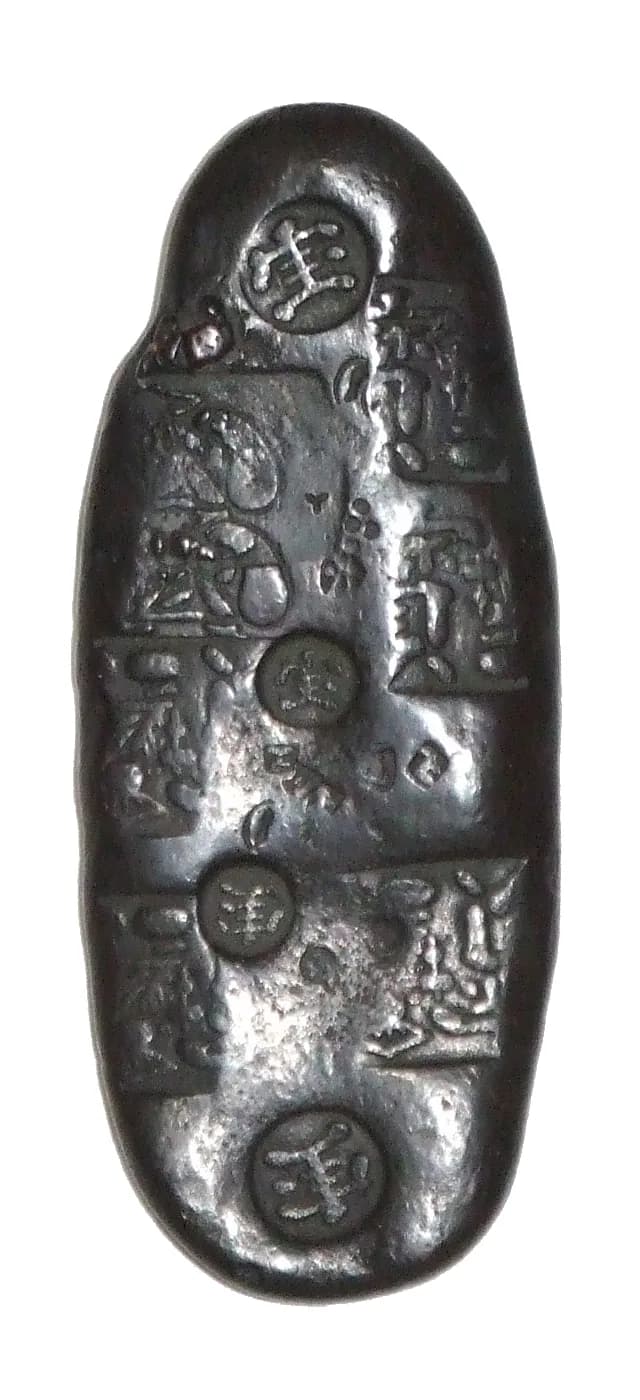
The Hōei Mittsu-Tama Chōgin (宝永三ツ宝丁銀) is a weight-based silver coin of the Edo period, consisting of a sea-cucumber-shaped silver ingot struck three times with the character "宝" (treasure/hō). It was minted in 1710, yet its silver fineness differs from that of the Hōei Eiji Chōgin (宝永永字丁銀), which was minted in the same year. This difference in fineness is the dividing line for determining coin type and assessing value.
What Is the Hōei Mittsu-Tama Chōgin? — A Weight-Based Silver Coin of 32% Fineness
The Hōei Mittsu-Tama Chōgin (宝永三ツ宝丁銀) is a weight-based silver coin of the Edo period minted in Hōei 7 (1710). It takes the form of a sea-cucumber-shaped silver ingot and is called "Mittsu-Tama" (three treasures) because three impressions of the character "宝" were stamped onto the silver surface as hallmarks. Its most distinctive feature is a silver fineness of 32%.
During this period, the shogunate was pursuing a policy of gradually reducing the fineness of silver coinage. The Hōei Futatsu-Tama Chōgin (宝永二ツ宝丁銀), minted in Hōei 3 (1706), had a silver fineness of 50%, yet within a mere five years four types of chōgin were issued in rapid succession. In Hōei 7 (1710), the present coin — the Hōei Mittsu-Tama Chōgin — was minted in parallel with the Hōei Eiji Chōgin, which had a fineness of 40%. Then in Shōtoku 1 (1711), the Hōei Yottsu-Tama Chōgin (宝永四ツ宝丁銀) appeared with a fineness of 20%.
The Hōei Mittsu-Tama Chōgin occupies an intermediate position in this process of fineness reduction. Compared with the Eiji Chōgin minted in the same year, its silver fineness is 8 percentage points lower. For this reason, lumping it together under the single label "Hōei Chōgin" carries the risk of confusing finenesses. Accurately grasping what fineness each individual coin type was minted at is indispensable for understanding the silver coinage of this era.
Differences in hallmark impressions and minting year directly correspond to differences in silver content — that is the defining characteristic of Hōei-period chōgin and the dividing line for market valuations.
The Role of Chōgin in the Hōei Period and Challenges in Authentication
The Hōei Mittsu-Tama Chōgin (宝永三ツ宝丁銀) is a weight-based silver coin minted by the shogunate during the Hōei period (1708–1711). Because all chōgin of this period share the distinctive sea-cucumber shape, it is impossible by appearance alone to distinguish this coin from the Hōei Futatsu-Tama Chōgin or the Hōei Eiji Chōgin. Confirming the hallmark impressions stamped on the silver surface is therefore an essential requirement for determining the coin type.
Differences in silver fineness are reflected in the color tone of individual specimens. Because the Mittsu-Tama Chōgin has lower silver purity, the proportion of copper is relatively higher, causing the surface to exhibit a darker tone; over time it is more prone to darkening and verdigris. However, changes due to storage environment exert an equally significant influence, making it impossible to determine coin type on the basis of color tone alone.
Moreover, because these are weight-based coins, differences in weight between individual specimens are inherent to the type, which makes weight-based identification equally difficult. For distinguishing genuine from counterfeit, confirmation of the hallmark impressions takes center stage in authentication, taking precedence over color tone or weight.
Looking at transaction records in the market, the flea-market and online-auction data collected by this site contains no confirmed hammer-price examples that can be clearly identified as the Hōei Mittsu-Tama Chōgin. Accordingly, we do not currently hold any basis for indicating a specific price range. If it is necessary to gauge the prevailing market price, inquiring with a specialist antique-coin dealer is the most reliable course of action.
Recent Price Levels for the Edo Silver Coin Category
With August 27, 2026 as the reference date, the median hammer price for the Edo silver coin category as a whole over the most recent 90-day period (34 transactions) is ¥4,700. Compared with the median of ¥2,900 for the preceding 90-day period (30 transactions), the rate of change represents a 62.1% rise. Both periods have a sample size of 30 or more transactions, and the reliability is judged to be moderate.
This upward trend is also readable from the actual hammer-price records within the category. In recent transactions, Ichibu-gin (一分銀) lots were concluded at price points of ¥8,500 (August 18, 2026), ¥7,000 (August 10, 2026), and ¥5,000 (August 10, 2026). Ansei Ichibu-gin (安政一分銀) examples include a case at ¥5,500 in extremely fine condition and ¥4,600 for an unwashed specimen. When multiple coin types were offered as a set, a case reaching ¥13,500 (June 28, 2026) has also been recorded. On the other hand, a hammer price of ¥2,800 was also recorded on August 10, making it clear that prices vary widely depending on the condition of the lot and the coin type.
As an important note, the figures presented here reflect the overall level of the Edo silver coin category and are not the individual market price for the Hōei Mittsu-Tama Chōgin. Even within the same Edo silver coin category, transaction prices differ according to coin type, minting location, and preservation condition. While the overall category trend indicates the underlying market tone, separate verification is required for assessing the value of individual issues.
You can track more detailed price movements by checking price trends on the market chart.
Conditions Under Which Authentication and Preservation State Determine Value
The Hōei Mittsu-Tama Chōgin (宝永三ツ宝丁銀) is recorded as a coin type carrying high authentication risk. Because the mintage volume is small even among Edo silver coins, the number of specimens circulating in the market is limited, creating an environment in which cast counterfeits and later deliberately altered pieces are likely to be intermixed. Looking at hammer-price records, there exist multiple cases in which judgments on authenticity are divided even for specimens bearing the same reverse character, and opinions among collectors and authenticators sometimes differ.
Preservation condition is also a major factor that differentiates value. Silver coins are prone to surface oxidation over time, giving rise to darkening and white powdery corrosion (silver bloom). When evaluated against the standards and interpretation of antique coin grading, even specimens of the same coin type show a large gap in market assessment between those in near-mint condition and those with prominent circulation wear. In the case of the Hōei Mittsu-Tama Chōgin, the low mintage means that specimens in better condition become increasingly rare, and the range of variation in hammer prices tends to widen accordingly.
Classification by reverse character is also an important criterion for judgment. Cross-referencing against confirmed mint locations, the reverse character "亀" (Edo Kameido mint), "千" (Sendai Ishinomaki mint), "佐" (Sado mint), "元" (Osaka Kōzu mint), "盛" (Nanbu domain mint), and "足" (Ashio mint) each indicate different minting sites. Mintage volumes and the number of surviving specimens differ for each of these reverse characters, and transaction records in the market likewise diverge. The records indicate that rarer reverse characters command higher valuations, but at the same time the difficulty of authentication also increases.
Referring to how to detect counterfeits and verifying the depth of engraving on the coin face, the texture of the metal, and the accuracy of the reverse character script is indispensable. Cases in which a specimen purchased through amateur assessment later turns out to be a forgery are also observed. When dealing with the Hōei Mittsu-Tama Chōgin, obtaining an evaluation from a trustworthy authenticator or consulting the records of an official authentication institution is the minimum condition for confirming the authenticity and value of a specimen.
The Place of the Hōei Mittsu-Tama Chōgin
The Hōei Mittsu-Tama Chōgin (宝永三ツ宝丁銀) is an Edo silver coin minted in 1710. Its composition of 32% silver fineness, as one of four chōgin types minted during the Hōei period, illustrates one facet of the shogunate's silver coinage policy of the time.
The chōgin of this period were diverse in form, stamps, and fineness alike. The Hōei Mittsu-Tama Chōgin is situated within that diversity. A silver fineness of 32% represents an alloyed silver incorporating other metals rather than pure silver, reflecting a balance between the practical utility of a circulating silver coin and the cost of raw materials.
The value of Edo-period silver coins is determined not by their stamps or shape alone, but by the combination of minting date and silver fineness. The Hōei Mittsu-Tama Chōgin, as a record bearing both pieces of information, is a document that speaks to a specific moment in the history of Japanese silver coinage. In the market, even among chōgin of the same Hōei period, differences in fineness and condition give rise to differences in transaction price, and those differences are governed by the precision of authentication and classification.
The historical value that a single silver coin possesses lies in the accumulation of facts: when it was minted, in what composition, and against what background. The Hōei Mittsu-Tama Chōgin exists as a physical piece of evidence transmitting those facts to the present.