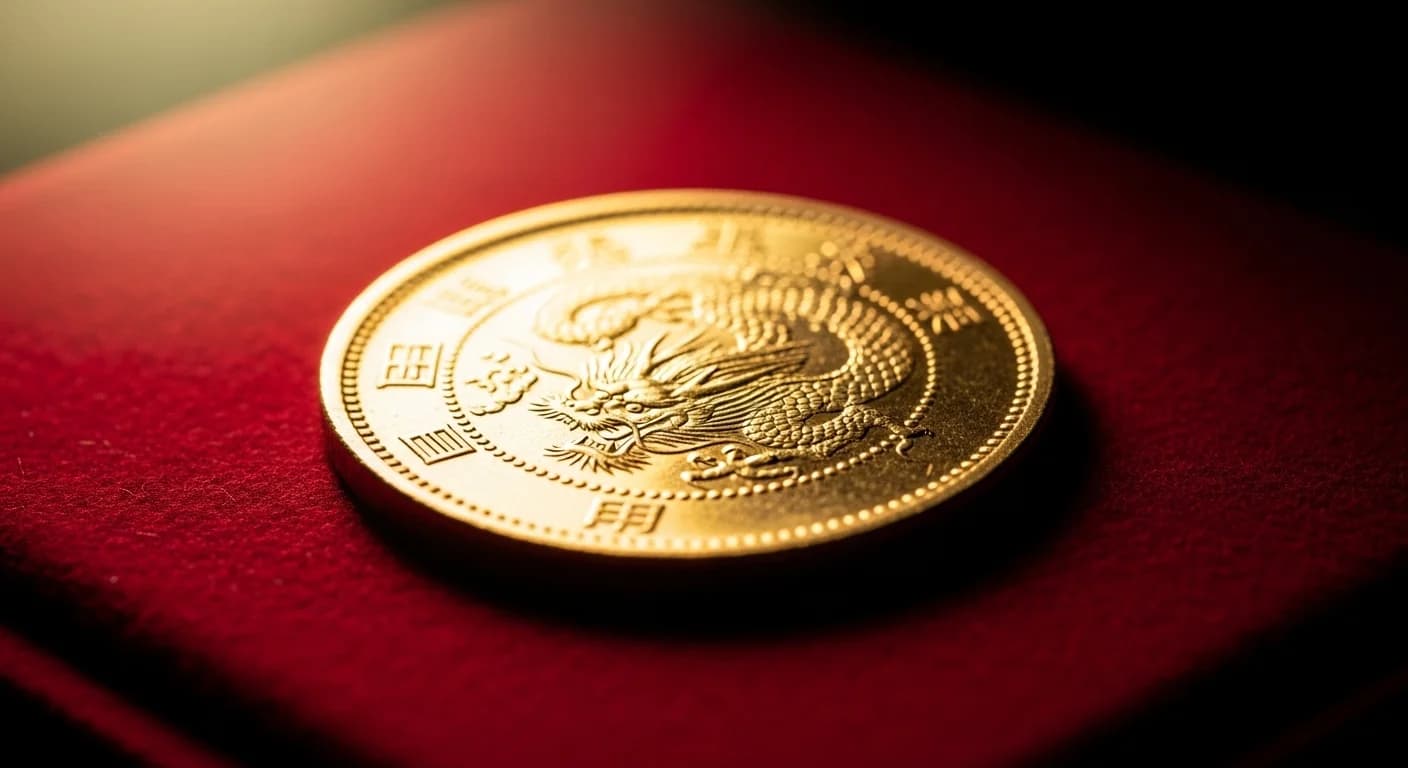
What Is the Old 20-Yen Gold Coin? — Japan's First Modern High-Denomination Gold Coin
The old 20-yen gold coin (Kyu 20-en Kinka) was first minted in 1870 (Meiji Year 3).
It was the highest denomination coin issued under the Meiji government's modern monetary reform.
Gold fineness is 900/1000 (90% gold), with a total weight of 33.33g and gold content of approximately 30g.
At today's gold price (approximately 15,000 yen per gram), the bullion value alone is around 450,000 yen.
Yet collectors routinely pay far beyond that. A standard circulated specimen in VF grade fetches 600,000 to 1,000,000 yen.
Rare date pieces in high Mint State grades can exceed 5,000,000 yen.
For a complete picture of Meiji-era numismatic hierarchy, including comparisons with the old 10-yen gold coin, see our overview of modern Japanese gold coin types and rarity.
Minting ran from 1870 to 1897 — approximately 27 years.
Production volumes varied dramatically by year.
The coin series ended with the currency reform of 1897 (Meiji Year 30).
As a result, surviving high-grade specimens are becoming increasingly scarce each decade.
Four Factors That Drive Prices
Understanding the four key drivers of modern Japanese gold coin prices is essential before entering the market.
Factor 1: Date and Mintage Volume
Meiji Year 3 (the inaugural issue) has extremely low mintage.
The government was in an experimental stage of its gold standard implementation.
As a result, Meiji Year 3 specimens are treated as the pinnacle of the series among collectors.
By contrast, specimens dated Meiji Year 13 through 25 have relatively high mintage.
At equivalent grades, they can be acquired for less than half the price of a Meiji Year 3 coin.
Date-driven supply differences translate directly into price differentials.
Factor 2: Grade (NGC/PCGS Certification)
Understanding Japanese coin grading standards and how to read them is the single most important knowledge for modern gold coin investment.
VF (Very Fine) grade shows wear from circulation. Details survive but fine lines show scratches under magnification.
MS (Mint State) indicates near-uncirculated condition. The gap between MS63 and MS65 looks subtle visually.
Yet in the market, MS65 can trade at 10 times the price of MS63.
NGC and PCGS-slabbed certified coins offer dramatically better access to international auction markets.
This certification premium is itself a factor in the price architecture.
Factor 3: Varieties and Strike Differences
The old 20-yen gold coin comes with known variants including rectangular vs. oval countermarks and eagle wing configuration differences.
These distinctions are invisible to the untrained eye.
Yet for specialist collectors, they represent a 2x to 3x price multiplier.
Factor 4: Bullion Gold Price
Modern gold coins carry a hard bullion floor.
When gold prices rise, so does the minimum value of the coin.
The gold price surge since 2024 has pushed up prices even for ordinary circulated specimens.
However, the premium above bullion varies enormously based on grade and date.
Price Ranges by Date
The following are approximate auction-based price references compiled by Ittendo editorial team.
- Meiji Year 3: VF-EF 3,000,000-5,000,000 yen / MS62+ from 6,000,000 yen
- Meiji Year 4: VF-EF 2,000,000-3,500,000 yen / MS63+ from 4,500,000 yen
- Meiji Year 5-9: VF-EF 800,000-1,500,000 yen / MS63+ from 2,500,000 yen
- Meiji Year 10-20: VF-EF 600,000-1,000,000 yen / MS63+ from 1,800,000 yen
- Meiji Year 21-30: VF-EF 550,000-900,000 yen / MS63+ from 1,500,000 yen
These are reference values only.
Known varieties can add 50-200% premium to the above.
Timing also matters: specimens offered when multiple competing bidders are active will outperform average market expectations.
Relying solely on average prices is therefore risky when making acquisition decisions.
Grade and Market Valuation
The price jump at each grading tier for the old 20-yen coin is steeper than for most other Japanese coin series.
- VF (25-35): Surface wear visible. Trades near bullion floor.
- EF (40-45): Minimal wear. Entry point for collector-grade demand.
- AU (50-58): Near uncirculated. Minor contact marks under high magnification.
- MS (60-70): Uncirculated. NGC/PCGS slab is the standard at this tier.
The price gap between VF and AU is typically 2x to 3x.
However, the jump from AU to MS63 often represents a 2x to 5x price increase.
This reflects the intense concentration of demand for pure uncirculated specimens.
AU58 specimens often look nearly identical to MS60 under casual inspection, yet the price difference can be substantial — making AU58 an undervalued entry point in some market conditions.
Bullion Floor and Price Stability
The most distinctive advantage of the old 20-yen gold coin is its hard price floor.
The formula: 30g gold content x spot gold price = minimum value.
As long as this formula holds, the coin cannot reach zero value.
In 2020, with gold at approximately 6,500 yen per gram, the floor was around 195,000 yen.
By 2025, with gold exceeding 15,000 yen per gram, the floor has risen to approximately 450,000 yen.
This doubling of the floor is entirely independent of collector value dynamics.
Gold price increases also generate broader bullish sentiment in numismatic markets as a secondary effect.
Yen weakness adds additional upward pressure from foreign collectors who see Japanese coins as undervalued in dollar terms.
International Demand and Its Effect on Prices
The old 20-yen gold coin attracts stronger demand from overseas collectors than domestic buyers alone.
American and European high-net-worth collectors value these coins for their historical context as Japan's first modern gold coinage.
When international bidders enter domestic Japanese auctions, unexpected price highs occur.
Conversely, in markets without international participation, these coins can trade at a discount to their true global value.
A notable 2024 example: a Meiji Year 4 MS65 specimen from a prominent American collection sold at 1.5 times the domestic pre-sale estimate.
This demonstrates how international demand can lift the ceiling for the entire series.
Yen depreciation amplifies this effect. In dollar terms, Japanese coins become cheaper for foreign buyers, which increases demand.
Building relationships with internationally-connected dealers is a meaningful competitive advantage for serious investors.
Our Conclusion — Investment Framework by Experience Level
The old 20-yen gold coin is a three-layered asset: bullion + rarity premium + international demand.
Within modern Japanese numismatics, it stands apart for both historical significance and market liquidity.
Beginners: Start with Meiji Year 10-20 specimens in VF-EF grade. Prices remain close to bullion value, limiting downside risk. The 600,000-1,000,000 yen range offers a manageable entry point.
Intermediate collectors: Focus exclusively on MS63-MS64 slabbed coins. Certified grade ensures global marketability and steady collector demand. In the current market, the MS63-MS64 price gap has narrowed, making MS64 relatively good value.
Advanced investors: The current price gap between MS64 and MS65 is near historical highs. Rather than accumulating multiple MS64s, targeting one unslabbed high-quality Meiji Year 3 or 4 specimen and submitting it for grading may offer superior upside potential.
At Ittendo, we track real-time auction histories and price trends to help you monitor the "now" of Japanese antique coins. Add categories you care about to your Vault to stay ahead of market movements.