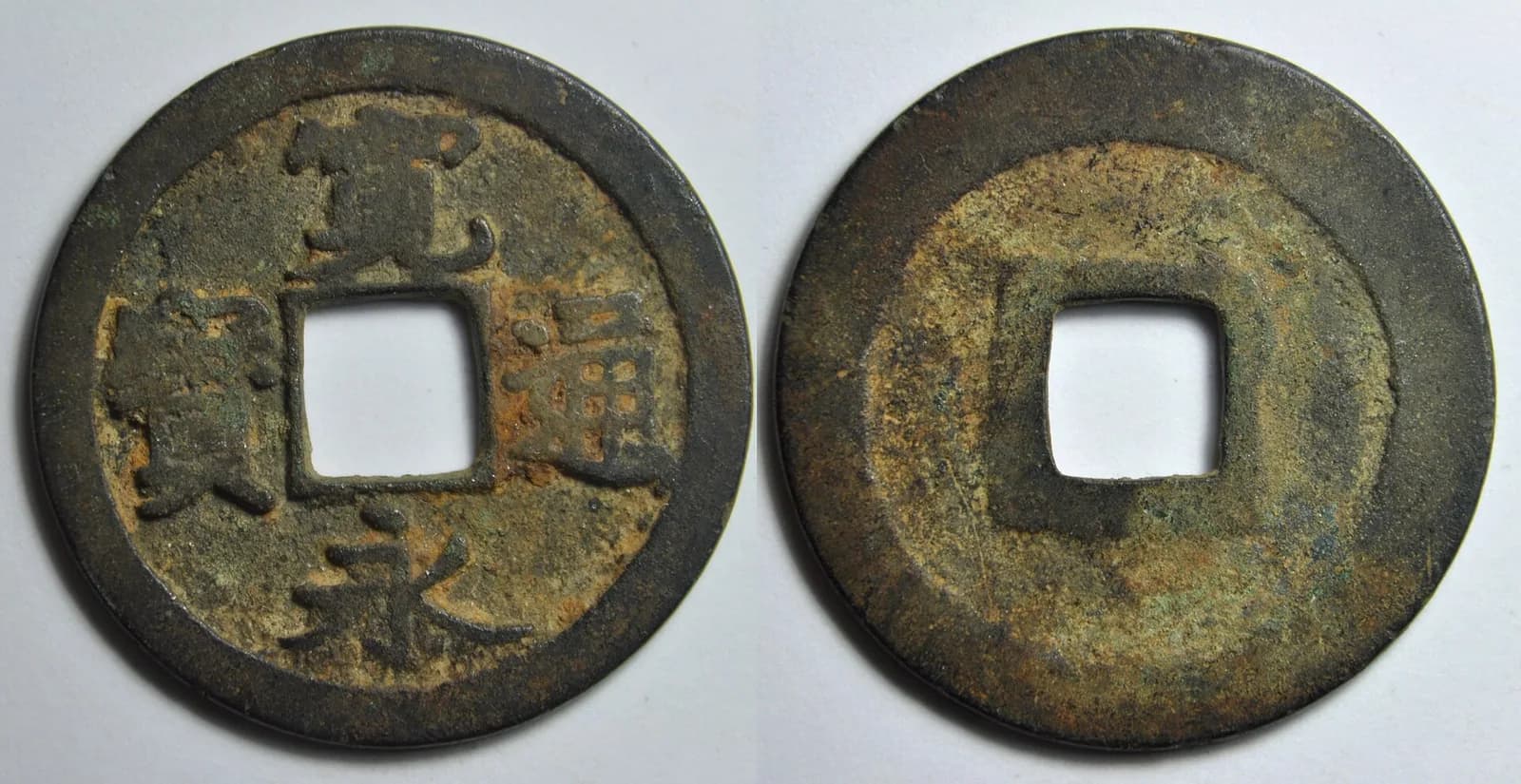
They look almost identical.
So what determines the value——
What Is Tenpō Tsūhō? — A Star Coin Among Holed Coins
Tenpō Tsūhō (天保通宝) is a holed coin that was minted for a long period from 1835 through the 1870s, in the late Edo period. Holed coins (ana-sen) are a general term for old coins with a square hole in the center; as explained in the detailed guide on holed coins (Kan'ei Tsūhō and Tenpō Tsūhō), they served as the backbone of Edo-period circulation.
While not as well-known as Kan'ei Tsūhō (寛永通宝), Tenpō Tsūhō is popular among beginners in the market as an "accessible entry-point holed coin." However, precisely because of that popularity, many people make mistakes by judging coins on appearance alone.
Tenpō Tsūhō was minted at multiple locations. It was struck across the country, including Edo (present-day Tokyo), Kyoto, Osaka (大坂, present-day Osaka), and Nagasaki. Even coins bearing the same date differ greatly in circulation volume depending on mint location, which in turn affects rarity.
The "3 Value Factors" Beginners Miss
[Factor 1] Rarity Differences by Mint Location
Tenpō Tsūhō coins have a mint designation (mei, 銘) struck on their reverse, indicating "Edo," "Kyo (京)," "Osaka (大坂)," and so forth. This designation is the primary factor that moves the market significantly.
Tenpō Tsūhō minted in Edo had the highest circulation volume and is relatively inexpensive. By contrast, coins minted in Nagasaki and certain years of Kyoto-minted coins had limited circulation, and the same grade can fetch more than twice the price.
Beginners tend to judge solely by the "Tenpō Tsūhō" name without looking at the reverse designation, and then buy. The result is a common mistake: "I bought it because it looked cheaper than market price, but it turned out to be a high-circulation Edo mint coin."
[Factor 2] Price Differences by Grade (Condition)
As explained in detail at Standards and How to Read Ancient Coin Grading, grading is the most important element in determining the value of old coins. For Tenpō Tsūhō, prices vary as follows even for the same designation:
This applies to coins sharing the same designation and date. A single step up in grade moves the hammer price by an amount equal to the width of the price ranges listed above.
The beginner's trap is buying something thinking "I found a bargain," only to discover afterward that the grade is low.
[Factor 3] Differences in Circulation Volume by Year
Tenpō Tsūhō was minted over a long period starting in 1835. During that time, annual mintage volumes varied dramatically.
Coins from the early minting years (1835–the 1840s) in particular have lower circulation volumes and are considered rarer. Coins from the late Edo period (the 1860s), on the other hand, were minted in large quantities, so they are less expensive than early-period coins of the same grade.
However, this "rarity" is not always reflected in the market. For dates with few transactions, the hammer price of a single lot can pull the entire perceived market along with it.
Why Do Beginners Misunderstand? — Information Asymmetry
The Tenpō Tsūhō market is not as active as the Kan'ei Tsūhō market. As a result, market information is scattered and it is difficult for beginners to make accurate value judgments.
Beginners cannot judge "what is a fair price" and tend to fall into the behavior of "just buy the cheapest one for now."
As also touched on in Basic Knowledge of Old Coin Auctions, auctions are subject to a phenomenon called "thin trading." For coins or dates with few transactions, a single hammer price can heavily influence subsequent market formation.
That hammer price may involve a different grade or designation. A single transaction cannot be called a market price.
How to Read the Tenpō Tsūhō Market Correctly
Look at Multiple Data Points
The most important thing in reading the market is not a single hammer price, but rather looking at the median of multiple transactions. If you have hammer-price data for at least three lots sharing the same grade, designation, and date, the median of those can reasonably be considered the "current market price."
A single hammer price should be treated as a "special transaction in a thin-trading environment" and regarded only as a reference value.
Always Confirm the Designation and Date
Before buying a Tenpō Tsūhō, confirm the following:
- What is the designation on the reverse (Edo, Kyo, Osaka, Nagasaki, etc.)?
- What year was it minted?
- What is the grade level?
Without all three of these pieces of information, market comparison is impossible.
Understand the Market Price by Grade Range
Even for the same designation and date, the market is divided by grade range. Knowing which grade range is currently moving in the market is the key to judging whether something is cheap or expensive.
For example, if the median for "Edo mint · Tenpō-era · VF grade" is ¥7,000, then a coin sold for ¥5,000 under the same conditions might be undervalued.
3 Failure Patterns Common Among Beginners
Failure 1: Judging "cheap" by appearance alone
- Very low grade (Fair)
- High-circulation Edo mint, not Nagasaki mint
- From the late Edo period and therefore low in rarity
- Not yet authenticated (genuineness unconfirmed)
Any one of these could apply. Judging by appearance alone leads to the trap of "after buying it I researched the market and found out there was a reason it was cheaper than market price."
Failure 2: Jumping into the high-price range without authentication
Even within the MS grade, the judgment varies by authentication organization. As explained in The Complete Guide to Fake Detection, forgery techniques for old coins are becoming more sophisticated every year. For high-value old coins in particular, authenticity should always be verified by a trustworthy authentication organization.
Even when a coin is listed as "authenticated," it is important to verify the credibility of that authentication organization.
Failure 3: Being misled by the news of a single hammer price
The auction market is a collection of "points." Multiple transaction data points are needed before those points form a market trend.
What Is Happening in the Tenpō Tsūhō Market Right Now
In recent years, attention to holed coins in general has been rising. As Kan'ei Tsūhō prices have climbed, funds have been flowing into Tenpō Tsūhō as the "affordable holed coin."
However, this inflow is characterized by being "grade-range specific."
MS (uncirculated) grade Tenpō Tsūhō has been trending upward over the past two years. In particular, MS specimens with rare designations (such as Nagasaki mint) have limited supply, so buyers are moving aggressively.
On the other hand, VF–XF grade coins (pieces with some degree of circulation wear) have relatively stable prices and function as the "entry point" for new market participants.
This "widening price gap between grade ranges" is also evidence that the market is maturing. In this mature market, beginners are required to make more accurate information-based judgments.
ITTENDO's Conclusion: Decision Criteria for Beginners to Succeed
Tenpō Tsūhō is an excellent introductory coin in the holed-coin category. However, jumping in simply because "it's cheap" will lead to regret.
The strategy beginners should adopt is "enter from the zone with high transaction volume."
Specifically:
- Start with Edo mint · VF–XF grade · late Edo period (1860s) coins.
- Confirm the median using multiple hammer-price data points (at least 3).
- Consider coins priced 15–20% below that median as "undervalued candidates."
- Before buying, always confirm the reverse designation, date, and grade.
- Where possible, choose coins that have already been authenticated (especially important for beginners).
Following these steps will give you a genuine sense of "I bought below market price."
Another important point is always being aware of "which grade range is currently moving in the market." The market-formation dynamics differ between periods when only MS coins are trading and periods when VF coins are actively moving.
At ITTENDO, past auction histories and market charts are available so that you can track the "current moment" of old coins.
Three Structural Reasons for a 10× Price Difference
To understand the price gap in Tenpō Tsūhō, it is necessary to grasp structural factors that go beyond the surface-level question of "good condition vs. bad condition." This section organizes the three structural reasons that beginners tend to overlook.
The first reason is the difference in "mint location" (chūchi, 鋳地). The three-tier structure of honza (本座, officially minted by the Edo shogunate), han-chūsen (藩鋳銭, officially minted by domains such as the Mito domain, Satsuma domain, Fukui domain, and Tosa domain), and mitsu-chūsen (密鋳銭, illicitly struck coins) causes prices to fluctuate by an order of magnitude. Understanding the minting system for holed coins covered in Introduction to Holed Coins and Explanations by Type allows one to grasp from a historical background why this three-tier structure came to exist.
Honza coins were minted through the Ginza system in Edo, and the quality of the characters, rim, and metal is stable. Han-chūsen were issued due to the economic circumstances of individual domains — a historical fact that sometimes earns them evaluations on par with honza coins in the collector market. Mitsu-chūsen were illegal counterfeits of the time, and in some cases even today it is impossible to make a complete distinction.
The second reason is the difference in "calligraphic style" (shotai, 書体). The four characters "天保通寳" come in categories such as chōji (長字, long-form characters), tanji (短字, short-form characters), kettsurin (刔輪, trimmed-rim type), and shukukei (縮形, reduced-size type), which in specialist literature are further subdivided into dozens of varieties. Even among coins called Tenpō Tsūhō, market value differs greatly by calligraphic classification, making style identification central to price determination. The system of variant classification for Kan'ei Tsūhō covered in Kan'ei Tsūhō Variant Classifications shares an underlying identification logic with Tenpō Tsūhō calligraphic classification.
The third reason is the presence or absence, and type, of "kakihan" (極印, assay or mint marks). A single small mark on the reverse can shift the value by an order of magnitude. Kakihan function as marks identifying the minter, minting period, and minting batch, and specimens bearing certain specific marks see large price increases due to their rarity.
The Independent Axis of Condition Assessment — The Relationship Between Grade and Price
In addition to the three structural factors of mint location, calligraphic style, and kakihan, "condition" also heavily influences price. Because condition is evaluated on an axis independent of the structural factors, the combination of four axes can produce a price difference of 10× or more for what is ostensibly the same Tenpō Tsūhō.
The objective standards for condition assessment are detailed in Standards and How to Read Ancient Coin Grading. The grading scale of AU, XF, VF, F, and G evaluates coins from four perspectives: degree of wear progression, condition of the rim, sharpness of the characters, and color of the metal.
In the case of Tenpō Tsūhō, because the circulation volume was enormous, high-grade specimens of AU or above are rare. The vast majority of coins on the market are VF–XF class, which serves as the median of the Tenpō Tsūhō market. AU-or-above specimens tend to be snapped up immediately when they appear, and both their liquidity and prices are in a class of their own.
Distinguishing Fakes and Imitation Coins
Tenpō Tsūhō has a history of counterfeits and imitation coins (mochū-sen, 模鋳銭) having been produced in large quantities. The basic points for identification are also touched on in How to Identify Fake Old Coins, but the following three checkpoints are specific to Tenpō Tsūhō.
First, is the color and texture of the metal consistent with coins of that era? On genuine coins, uniform oxidation progressing across the entire surface over close to four hundred years of elapsed time is present. Second, are the weight and dimensions within the standard specifications? Significant deviation from the honza standard values is a strong clue to question authenticity. Third, does the condition of the casting traces match the technology of the time? Modern reproductions exhibit characteristic patterns in the mold-machining traces that differ from those of period casting molds.
Proficiency in these perspectives is developed through accumulating experience observing actual coins. For this reason, purchasing authenticated slabbed coins from a trustworthy dealer is the safest entry point at the beginning. Utilizing international grading as covered in PCGS and NGC Grading Evaluations for Japanese Old Coins is particularly effective as a learning aid for beginners.
Practical Guidelines for Investment and Collecting
The approach to collecting and investing in Tenpō Tsūhō differs depending on one's objective. If the goal is long-term holding and asset diversification, the orthodox path is to focus on high-grade honza specimens or representative han-chūsen designations (Mito domain, Satsuma domain, etc.). If the goal is research and learning, an effective approach is to collect small quantities of specimens from multiple mint locations, calligraphic styles, and conditions, and to use them to study market price movements.
Understanding the etiquette of auction participation covered in Basic Knowledge of Old Coin Auctions allows one to efficiently take advantage of purchasing opportunities in the market. Tenpō Tsūhō is a coin group for which research has accumulated richly even within the holed-coin category, with an abundance of specialist books, study groups, and online resources, making it an environment in which identification accuracy can be improved through self-study.
Price Assessment Checklist
This section presents a checklist for practically assessing the price of Tenpō Tsūhō. It shows, in a five-step sequence, what to confirm and in what order when encountering a Tenpō Tsūhō in the market.
The first step is confirming "weight and dimensions." The honza standard is approximately 20–21g in weight and approximately 49mm in outer diameter; specimens that deviate significantly from this are likely not honza coins. Since han-chūsen have slightly different specifications, keeping the standard values for each domain in mind speeds up identification.
The second step is confirming "the sharpness of the rim and characters." Observe the evenness of the rim, the sharpness of the characters "天保通寳," and the depth of engraving of "當百" and "百" on the reverse. As covered in the grade evaluation of Standards for Ancient Coin Grading, the observations made at this stage form the core of condition determination.
The third step is "identification of mint location and calligraphic style." Using features such as the long-form or short-form calligraphic style, the presence or absence of kettsurin (trimmed rim), and the characteristic stroke endings of the characters, one distinguishes between honza and han-chūsen. The systematic classification covered in Introduction to Holed Coins and Organized Explanations by Type forms the foundation for improving identification accuracy at this stage.
Summary
Understanding the Structure of the Price Gap Is the First Step
The price gap in Tenpō Tsūhō is not the result of coincidence or luck; it is a phenomenon that can be structurally explained by the combination of four axes: mint location, calligraphic style, kakihan, and condition. Understanding this structure is the first step in collecting and investing, and the foundation for making appropriate judgments in the market. Rather than judging whether something is cheap or expensive based on price alone, aim to reach the point where you can structurally explain why it carries that price.
Long-Term Holding Strategy for Tenpō Tsūhō
In building a long-term holding strategy for Tenpō Tsūhō, it is important to understand the three-tier structure of market participants. The first tier consists of holed-coin specialist collectors, who possess deep knowledge of calligraphic classification and mint-location identification and focus their acquisitions on high-grade honza specimens and representative han-chūsen designations. The second tier consists of generalist collectors who collect holed coins alongside Edo-period gold and silver coins; they advance their acquisitions incrementally while learning the market's price movements. The third tier consists of investors and institutions seeking asset diversification, who position Tenpō Tsūhō — with its abundant circulation volume and accessible price range — as an entry-level coin. Because these three tiers trade the same coin group for different purposes, the Tenpō Tsūhō market maintains a stable transaction frequency and, from the standpoint of liquidity, is a relatively manageable coin group within the holed-coin category. In practicing long-term holding, the orthodox approach is to combine AU-or-above high-grade honza specimens with representative han-chūsen designations (Mito, Satsuma, Fukui, Tosa). In addition to this, collecting rare variants within the calligraphic classifications one piece at a time increases the academic value of the collection as a whole. Starting from the holed-coin framework covered in Introduction to Holed Coins and Explanations by Type and combining it with the individual coin-specific detail covered in Full Guide to Tenpō Tsūhō allows one to develop a three-dimensional grasp of both the overall market structure and the characteristics of individual coins.
Individual prices and auction results are listed only once verifiably matched records — with sale, lot, source URL and review date — exist.