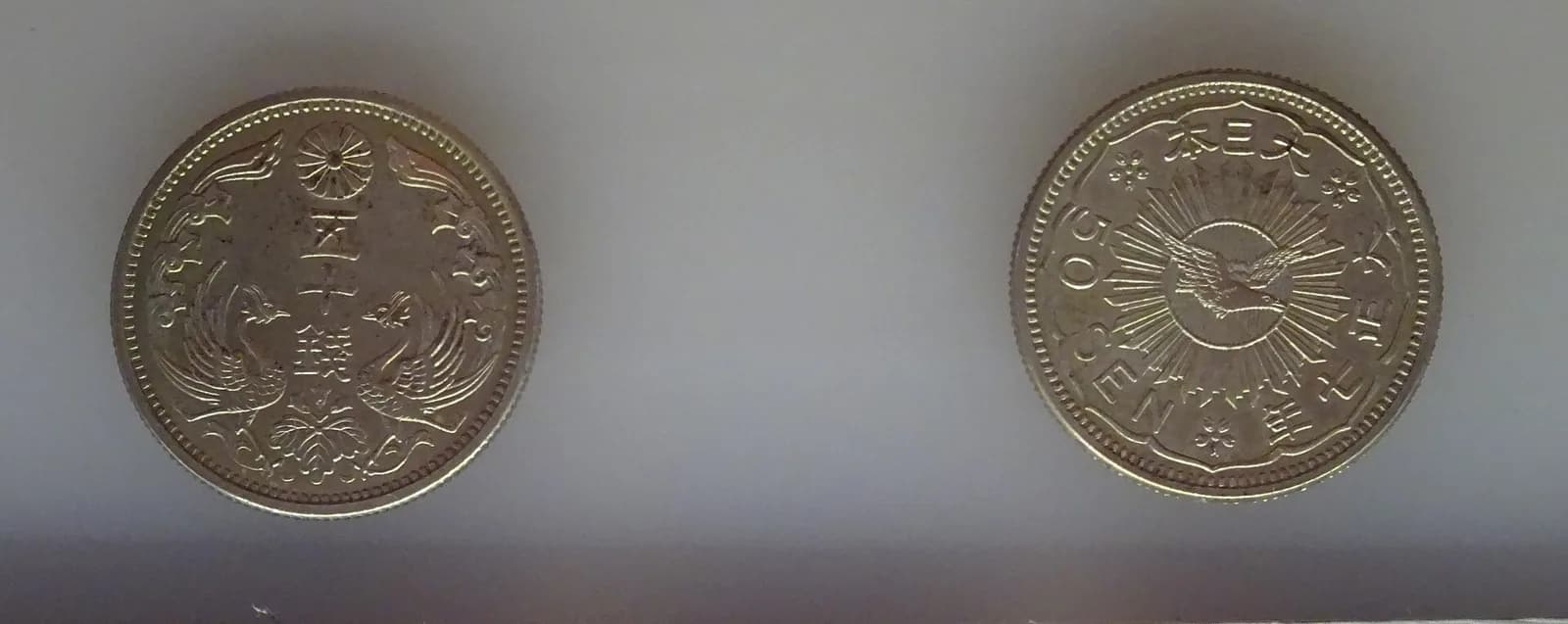
Overview of the Rising Sun Design Silver Coins
From the late Meiji period to the Taisho era, a new chapter in Japan's modern coinage history was opened with the "Rising Sun Series." This series is a groundbreaking group of silver coins that broke away from traditional dragon designs and adopted concise designs aligned with international trends. Specifically, the main components are the Asahi Ryū 50 sen silver coin (from Meiji 4), the Asahi 50 sen silver coin (from Meiji 39 to Taisho 6), the Asahi 20 sen silver coin (from Meiji 39 to Taisho 6), and the Asahi 10 sen silver coin (from Meiji 39 to Taisho 6). These can be seen as evidence of Japan's unique modernization under Western influence. Particularly, the three types of Rising Sun silver coins issued from the late Meiji 30s played an important role in determining the future direction of Japanese coin design. The design change from dragons to the Rising Sun symbolizes not just a visual transformation, but also the evolution of coin manufacturing technology, adaptation to the international economy, and the symbol of Japan's growing national power. Coins from this era are valuable historical materials that convey the turbulent "Introduction to Modern Gold and Silver Coins (Meiji to Showa)." At ITTENDO, we will delve into both the historical significance and the current market value of these Rising Sun silver coins. This article is positioned as a "Decision Terminal" that covers everything from basic knowledge to specialized perspectives, making it easy for beginners to start collecting.
Design Transition from Dragons to the Rising Sun
Early Meiji era modern Japanese coinage primarily featured designs with powerful dragon motifs. Examples include the Dragon 50 sen silver coin and the Dragon 1 yen silver coin. These dragon designs, crafted under the guidance of British engraver Thomas Gutton, merged traditional Japanese aesthetics with Western sculptural techniques. However, by the late 30s of the Meiji era, international coin design trends shifted towards smaller, simpler designs. Responding to this shift, Japan transitioned to a new design centered around the Rising Sun (sun rays) starting in Meiji 39 (1906). The Rising Sun design features distinct radiating rays with the denominations "五十錢", "二十錢", and "十錢" clearly displayed in the center. The reverse side features an eight-rayed mirror and chrysanthemum crest, creating a design that combines Western simplicity with Japanese symbols. Unlike the majestic expression of dragons, the Rising Sun design conveys a modern and functional impression. This design change enabled uniform engraving suitable for mass production of coins and helped reduce manufacturing costs. Additionally, it aimed to enhance the coin's acceptance as an internationally circulated currency. The design transition reflects significant changes in manufacturing technology and economic conditions, which are some of the "Factors Determining the Value of Old Coins."
Market Price and Rarity by Denomination
Market prices for the Rising Sun series vary greatly depending on denomination, year, and condition. For instance, the Rising Sun 50 sen silver coin generally trades at 1,000 to 50,000 yen. Early years like Meiji 39 or Meiji 40 tend to be valued higher if in good condition due to relatively low mintage. Meanwhile, coins from the Taisho years are more affordable due to higher mintages. The Rising Sun 20 sen and 10 sen silver coins fall mostly in the hundreds to a few thousand yen range, though certain rare years are exceptions. Each denomination shows significant differences in rarity by year. Notably, some years from the late Meiji are regarded as having low mintages, such as Taisho 3 (50 sen) and Taisho 6 (10 sen), often trading well above market average. These rare years consistently hold high demand among collectors and seldom appear on the market. Completing a full set of all denominations and years often sees these "last few pieces" as the greatest challenge. Current market price trends can be precisely understood by viewing "Price Trends on the Market Chart." When considering purchasing, it's important to clarify the desired year and condition and compare multiple selling channels.
Background and Design Policy of the Rising Sun Design
The switch to the Rising Sun design in Meiji 39 (1906) was not merely a change in motif but a strategic shift influenced by the domestic production of coin manufacturing technology and Japan's growing international economic status. Previously, the dragon-design silver coins were managed by British engraver Thomas Gutton, but the Rising Sun design was developed mainly by Japanese engravers. This shift towards domestic production symbolized Japan's increase in national power and technological independence after the Russo-Japanese War. There were two main design policies for the new Rising Sun design. One was "mass producibility" and "quality stabilization." The radial sun rays featured simple and uniform engraving suitable for mass production with the fast production presses of the time. This realization allowed for cost reduction and consistent quality, stabilizing currency supply nationwide. The second policy was "internationalism." The Western simplified design had a high affinity as an international currency, catering to the increase in Japan's foreign trade. The design embodies the spirit of modernization and internationalization aimed by late Meiji Japan in the medium of currency. Understanding the era's spirit behind the design is crucial for understanding the "Old Coin Types and Classification System."
Specifications of Each Denomination: Purity, Dimensions, and Weight
The silver coins of the Rising Sun series had different purities, dimensions, and weights for each denomination. This was an optimized design result in accordance with the coin's role and circulation conditions. - Asahi 50 sen silver coin: Diameter 31.0mm, weight 10.13g, silver purity 800/1000. Pure silver content is about 8.1g. - Asahi 20 sen silver coin: Diameter 23.5mm, weight 5.39g, silver purity 800/1000. Pure silver content is about 4.3g. - Asahi 10 sen silver coin: Diameter 17.6mm, weight 2.70g, silver purity 720/1000. Pure silver content is about 1.9g. Notably, only Asahi 10 sen silver coins have a purity of 720/1000, lower than other denominations. This was deliberately set to improve durability, as lower denomination coins were used frequently in everyday transactions. By reducing silver content and increasing other metals like copper, the physical strength of the coins was enhanced. These detailed data are also crucial benchmarks for determining the authenticity of old coins. For long-term collection, implementing these coins' characteristics into proper storage methods is essential.
Rare Years and Premiums by Year
The Rising Sun series contains "rare years" with extremely low mintage that carry a high premium in the market. Collectors and investors especially notice these years, causing them to be traded at high prices. - Asahi 50 sen silver coin: The rarest is Taisho 3 with a mintage of about 1.7 million, markedly less than other years. Uncirculated coins range from 30,000 to 50,000 yen, with some fetching more depending on condition. Even well-preserved coins can exceed 10,000 yen in value. - Asahi 20 sen silver coin: Meiji 45 (Taisho 1) had a mintage of roughly 1 million, with well-preserved coins ranging from 5,000 to 10,000 yen, and uncirculated pieces surpassing 20,000 yen. This year also has a unique background as it marks the transition from Meiji to Taisho. - Asahi 10 sen silver coin: The final year Taisho 6 is the rarest with about 850,000 minted; uncirculated coins are treated as rare items from 10,000 to 30,000 yen. Particularly well-preserved ones may be traded at higher prices. These rare years were minted late in the series or under special political/economic circumstances, leading to controlled production numbers. PCGS and NGC graded items of MS64 or higher for any denomination are seldom available and tend to fetch very high prices at auctions. Understanding the "Grading Standards for Old Coins," and aiming for certified rare years can lead to a well-documented collection.
The Challenge and Strategies for Completing All Years
Completing a full set of all denominations and years of the Rising Sun series is one of the thrills of coin collecting, and a realistic goal for beginners to intermediate collectors. Combined across three denominations, approximately 30 to 40 years exist. Common years (with mintage over 10 million) are relatively easy to obtain at hundreds to a few thousand yen from local coin markets, online shops, or auctions. These serve as excellent foundations for building a collection. However, the previously mentioned rare years, especially the Taisho 3 of the Asahi 50 sen and the Taisho 6 Asahi 10 sen, pose the greatest challenge in completing a set. These coins are highly coveted, leading to fierce competition among collectors, requiring quick decision-making and action when they appear on the market. A strategy of "waiting in ambush" is highly effective, involving signing up for newsletters from specialized coin shops or using watch functions on major coin auction sites to wait for the desired coin to appear. Also, referencing a "Guide to Places and Methods for Acquiring Old Coins" and securing multiple channels is crucial. With a well-planned collection strategy, completion within a year is a viable dream.
Historical Background and Economic Role of the Rising Sun Series
The Rising Sun series was issued during the late Meiji to Taisho periods, a time when Japan established its position in international society post-Russo-Japanese War and experienced significant economic changes. These silver coins played an important role in Japan's economic activities, particularly in commerce and everyday life. Industrialization and urbanization significantly increased the volume of currency in circulation and raised the demand for small denomination coins. While maintaining the gold standard, the Rising Sun silver coins had their purity and mintage adjusted based on international silver price fluctuations and domestic economic conditions. During the Taisho era, the economic boom (known as the wartime boom) brought about by World War I greatly energized currency circulation in Japan. However, post-war depression and events like the Great Kanto Earthquake also led to economic turmoil. Throughout this turbulent period, the coins of the Rising Sun series continued to function as fundamental currencies underpinning economic activity. The design and material changes of these coins always reflect the "Reading the Cycles of the Old Coin Market" and prevailing societal trends.
Identifying and Avoiding Counterfeits and Altered Coins
The Rising Sun series coins, though fairly widespread, do not see rampant counterfeiting except for particularly well-preserved high-value items or rare years, which require caution. Common forgeries include imitations made from inferior materials, genuine coins altered for date falsification, or surface-polished coins to appear in better condition. The primary point in identifying forgeries is accurately measuring "weight" and "dimensions." Significant deviation from the specified values (see Section 6) suggests potential forgery. Subsequently, carefully examine the "sharpness of the engravings" and "edge serrations." Genuine coins exhibit uniform and sharp engravings, while counterfeits may appear unclear and uneven edged. Ensure the coins are non-magnetic, as silver coins should not react to a magnet. When in doubt, consult a reputable specialist or enhance your judgment by referring to a "Guide to Identifying Counterfeits and Altered Coins."
Preservation and Practical Method for a Coin Album
Proper preservation is crucial for keeping the Rising Sun series in pristine condition over the long term. The first step in organization is acquiring coin holders that fit the three different sizes (50 sen, 20 sen, 10 sen). Recommended are Mylar flips, which are non-PVC (polyvinyl chloride) and cause less chemical damage to coins, making them suitable for long-term storage. Specifically, prepare holders sized for 50 sen (32mm diameter), 20 sen (24mm diameter), and 10 sen (18mm diameter). Coins placed in holders should be organized in dedicated coin albums or binders in chronological order to significantly enhance the appearance of your collection. Specialist manufacturers like Coin Vault and Lighthouse offer a variety of albums. Storage conditions should maintain humidity below 50% and temperature between 15 to 20℃, avoiding direct sunlight by choosing a cool and dark place. Regularly replace silica gel or other desiccants for moisture control. Additionally, maintaining a photo record of your entire collection and an account of each coin's purchase price and acquisition source functions as critical documents verifying its value for future sale or inheritance. Refer to the "Guide to Storage and Maintenance of Old Coins" for creating the optimal environment.