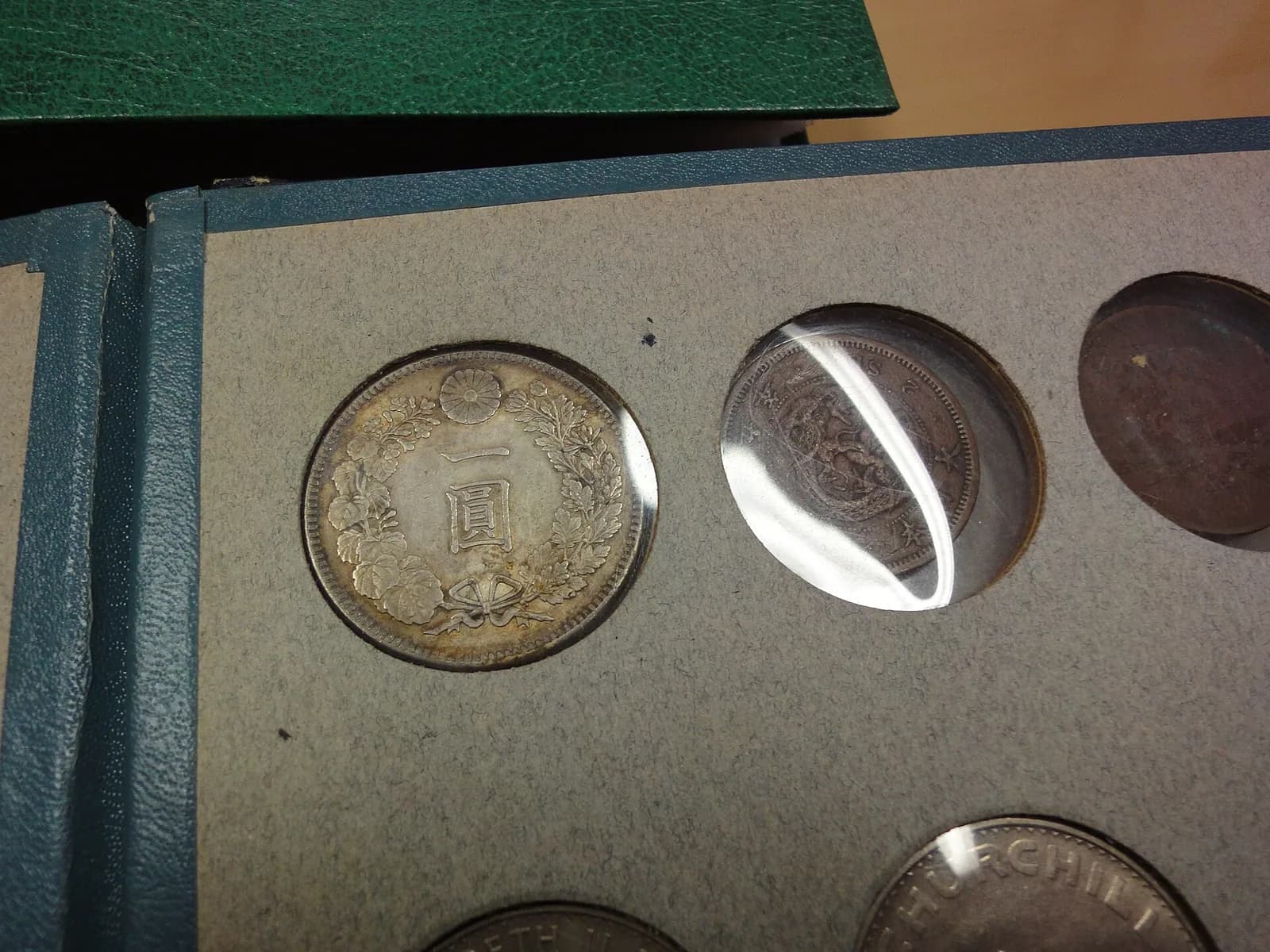
The Birth of the Large Silver Coin, Dragon 1 Yen Silver Coin, in the New Currency Ordinance System
The Dragon 1 Yen silver coin, first issued in Meiji 3 (1870), is Japan's first modern large silver coin. The Meiji government recognized the necessity of a currency usable internationally to smooth trade with Western powers. This silver coin was designed to align with the specifications of the Mexican silver dollar, which was widely circulated in international trade at the time. Its weight was set at 26.96g, and its silver fineness was defined as 900/1000 (with the remaining 100/1000 being copper), meeting global standards for quality. It is a significant coin symbolizing the establishment of Japan's domestic currency system and the transition to the silver standard. The issuance of the Dragon 1 Yen continued through the Meiji era, ending with its minting in Taisho 3 (1914). The creation of this silver coin marks a significant step toward Japan's modernization. For more detailed history of modern coins, please refer to Introduction to Modern Gold and Silver Coins (Meiji to Showa). In its early circulation, this silver coin played an important role in supporting Japan's economic foundation.
Strategic Design and Circulation Reality as an International Currency
The reverse of the Dragon 1 Yen silver coin features the English inscription "ONE YEN" and the number "416," denoting its weight in grains. This design was strategically intended for use as a settlement method in international trade. At the time, foreign merchants were unfamiliar with Japanese currency, so adherence to international standards enhanced credibility. At open ports like Yokohama, Kobe, and Osaka, the Dragon 1 Yen silver coin was actively used in trade settlements with foreign merchants, alongside the Mexican silver dollar. It also circulated widely in export trade to China and Southeast Asia and is still found in these regions today. Due to its international circulation record, it earns high praise and demand from world coin collectors abroad. The Dragon 1 Yen silver coin indeed had a face as an "international trade silver," depicting Japan's process of deeply integrating into the international economy. Its existence also contributed to enhancing Japan's international status.
Exquisite Dragon Design and the Charm of its Evolution
The greatest appeal of the Dragon 1 Yen silver coin lies in the large, intricately engraved dragon design on its obverse. As a large silver coin with a diameter of 38.58mm, it allows for detailed observation of the dragon's scales, whiskers, and claws. The surrounding features include the national title "大日本" and the year, composing a dignified design. The reverse showcases the Japanese symbol of the sun (rising sun) shining centrally, with the denomination "一圓" and the English notation "416·ONE YEN" balanced well. This dragon design underwent slight changes over its production period, classified broadly into three types: "thick dragon," "thin dragon," and "late type." Identifying these design differences is one of the great pleasures for specialist collectors. The design evolution of the dragon reflects advancements in engraving technology and adaptation to mass production at the time. Understanding these detailed design variations enhances one's appreciation of the coin variety and classification system.
Rarity by Year and Market Price Trends
The market price of the Dragon 1 Yen silver coin fluctuates significantly depending on the issuance year. The year of highest rarity, particularly valuable, is Meiji 3 (1870), with coins in good condition rarely traded for less than several hundred thousand yen. These specific price ranges are shaped by a combination of factors that determine factors affecting the value of old coins. By comparing data on annual issuance numbers, the rarity can be more precisely assessed. For collectors aiming to complete all yearly issues, securing these rare year coins presents a major challenge, yet that is the joy of collecting. Individual prices and auction examples are only listed in market records if they are verified records (with auction, lot, source URL, and verification date attached).
The Appeal as an Entry into Modern Coin Collections
The Dragon 1 Yen silver coin is one of the most attractive targets when starting a collection of modern Japanese coins. Standard yearly issues can be obtained for several thousand yen, thus lowering the financial barrier and allowing beginners to start collecting casually. Its large and powerful design offers high visual satisfaction and stimulates collecting interest. Moreover, with a wealth of year and design variations, setting a clear collection goal is easy. Collectors can enjoy diverse methods, such as assembling all dragon design types or completing specific year issues. The collecting journey allows for engagement with Japanese modern history and economic history, gaining profound knowledge beyond mere coin collection. Collection is not limited to accumulating coins but provides a valuable opportunity to learn about history and culture. For a detailed explanation of the differences and perspectives between collecting as a hobby and as an investment, see Differences and Perspectives on Investment and Collection.
Risks of Counterfeits and How to Identify Them
Due to the popularity and high trading prices of the Dragon 1 Yen silver coin, there is a risk of counterfeit and forged items circulating. Particularly for rare high-value years like Meiji 3, Meiji 13, and Meiji 18, there are sophisticated cast counterfeits, requiring utmost caution when purchasing. Even experienced collectors and beginners can misjudge them. To distinguish counterfeits, it is crucial first to accurately understand the weight, diameter, and thickness of genuine coins. Counterfeits may show slight differences in these physical characteristics. Additionally, the sharpness of the engravings on the dragon scales and characters, as well as the texture of the surface, are important judgment criteria. Compare against genuine items to check for subtle deficiencies or unnatural luster. The most reliable method is to purchase from reputable dealers or choose items graded by third-party organizations such as PCGS or NGC. More detailed information on distinguishing counterfeits can be found in Guide for Identifying Fakes and Altered Items. Individual transactions carry risks, necessitating careful judgment.
Grading and Evaluation Criteria for Beautiful Toning
To accurately assess the value of the Dragon 1 Yen silver coin, grading by international third-party organizations such as PCGS or NGC is essential. These organizations evaluate coins based on objective criteria and assign grades. Especially uncirculated coins graded MS65 or above are generally highly valued at over several hundred thousand yen, regardless of the year. The phenomenon unique to silver coins known as "toning" also significantly influences evaluation. Uniformly rainbow-hued "natural toning" is formed naturally over many years on silver coins, and its beauty is highly valued as added worth. Conversely, spotted discoloration or corrosion marks detract from the coin's aesthetic, causing point deductions. PCGS and NGC incorporate the quality of toning into their grading criteria, and items with particularly favorable toning may receive a grade higher than others in similar condition. You can learn more about grading standards at Standards for Old Coin Grading.
Proper Long-term Storage Methods and Taboos
To maintain a Dragon 1 Yen silver coin collection in a beautiful state for long periods, proper storage methods are essential. The greatest taboo is performing polishing or cleaning. Polishing with polish or toothpaste to restore luster can erase the coin's surface relief (hairlines) leading to a "CLEANED" judgment during grading, drastically reducing its value. The correct storage method includes using non-PVC (polyvinyl chloride) coin holders or dedicated capsules for encasement. PVC material causes chemical reactions over time, leading to discoloration of the silver coin and should be avoided. Furthermore, storing in a sealed container with silica gel or other desiccants and maintaining a low-humidity environment is crucial. Natural toning can add value, but if concerned, it is imperative not to treat it without consulting an expert. For long-term preservation, special flips (cases) sealed with nitrogen gas are also an effective option. For more detailed storage methods, see Proper Storage Methods for Old Coins.
Comparison with Other Modern Silver Coins and Market Position
The Dragon 1 Yen silver coin is a major modern Japanese silver coin, but during the same period, various denominations of silver coins, such as the Dragon 50 Sen silver coin and Rising Sun Dragon 50 Sen silver coin, were issued. Comparing these currencies clarifies the unique market position of the Dragon 1 Yen silver coin. For instance, the Dragon 50 Sen silver coin is smaller than the 1 Yen coin and was widely used in everyday transactions. The same dragon motif design is used, but differences in diameter and weight target different collection audiences. The Dragon 1 Yen silver coin stands out among modern silver coins due to its large size and role as an international currency. From a collection standpoint, the 1 Yen coin is often positioned as a "core collection," and collecting it along with other modern silver coins allows for a comprehensive understanding of the Meiji era's coinage system. The appeal to collectors is drawn by each silver coin's rarity, historical background, market popularity, and price range.