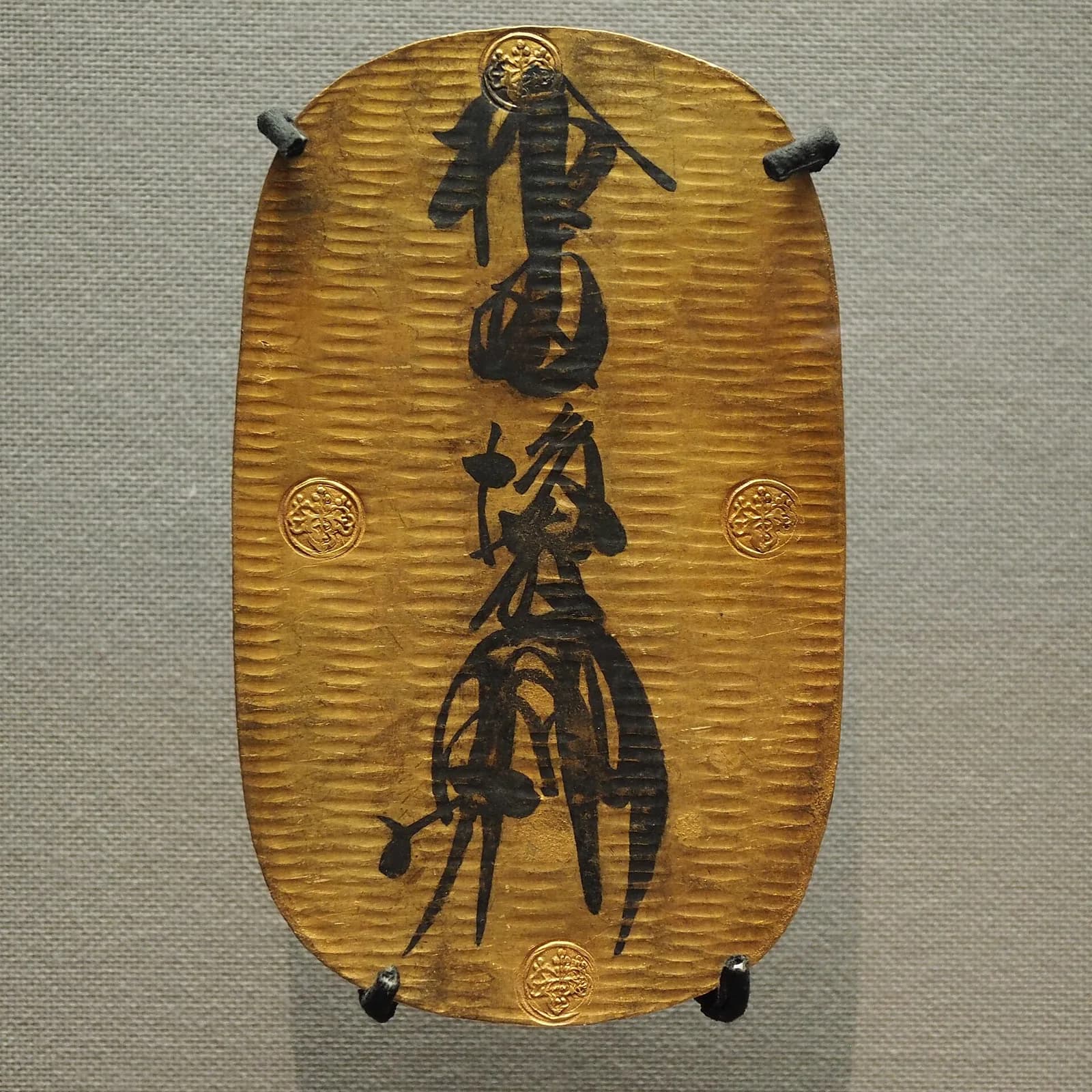
Keichō Ōban Overview
The Keichō Ōban gold coin, whose minting started in Keichō 6 (1601) under the orders of Tokugawa Ieyasu, is a symbolic entity that established the monetary system of the early Edo period. It unified the diverse coins that circulated in various regions and was a crucial step in creating a shogunate-led gold coin minting system. The standard weight is approximately 165g (44 monme), with a gold purity of about 67% (approximately 110g of pure gold). Its surface is majestically adorned with the calligraphy "拾両" and the seal of the Goto family from the gold regulatory authority. This Ōban was the first systematically issued Ōban gold coin by the Edo shogunate, holding historical significance as it established the basic form for all subsequent Ōban gold coins. Its dignified appearance was fitting to symbolize the unification under Tokugawa, playing a vital role in supporting the economic foundation of the Edo period.
Details on Weight, Dimensions, and Gold Purity
The standard specifications for the Keichō Ōban are set at approximately 165g (44 monme) with a gold purity of around 67% (about 33% silver). Its size measures approximately 155mm in length and 95mm in width, indicating its grand size that cannot fit in the palm of a hand. Compared to the Tenshō Ōban (gold purity 73%), it has a slightly lower purity, which was part of the shogunate's policy aimed at stabilizing the currency supply and the economy. Due to the prolonged minting period, subtle variations in purity and weight can be observed in later mintings. Especially during the post-Genroku recoinings, some pieces exhibit lower purity. Accurate measurement is essential in determining the factors that affect the value of such coins, and later pieces with lower purity may appear slightly whitish on the surface. Only verified records with auction events, lots, source URLs, and verification dates are published in the market records concerning individual prices and auction instances.
Position of Ōban in Shogunate Finance
The Keichō Ōban was not merely a high-value currency but also served as essential reserves supporting the finance of the Edo shogunate. It was used for a variety of purposes, including rewards and grants to daimyo, offerings to the imperial court, and loans to various domains. Its issuance volume vividly reflected the shogunate's financial status and political intentions. Particularly in the early Edo period, it was minted in large quantities, demonstrating the shogunate's firm authority and immense financial power to the nation. Receiving this from the shogunate reaffirmed the vassal-daimyo relationships, pledging loyalty to the shogunate. The minting of the Keichō Ōban continued until the Genroku recoinings, with the total number of coins minted estimated to have reached tens of thousands. This gold coin occupies a special position in Japanese coinage history, as explained in the "Edo Gold Coins (Koban and Ōban) Introduction," and its historical context is a major attraction for modern collectors.
Transition of Keichō Ōban
The Keichō Ōban, due to its long minting period, can be largely classified into three periods: the early (Keichō), middle (Genwa to Kan'ei), and late (Meireki onwards). Early pieces provide a strong impression with relatively rough and powerful casting textures, reflecting the manual work of artisans characteristic of the developing coin minting technology of the Keichō era. In the middle period, improvements in minting technology lead to a slightly smoother surface finish. By the late period, highly refined minting technology resulted in a generally beautifully balanced finish. Furthermore, the calligraphic style of the ink writing on the surface also subtly changed with the generational change of the Goto family. Experts meticulously estimate the minting period of individual Keichō Ōban by subtle differences in casting texture, ink writing, and minor changes in the stamp shapes and positions. These differences are crucial points in assessment.
Ink Writing and Stamp of the Goto Family
The "拾両" ink writing and seal at the center of the Ōban gold coin were handwritten by the head of the Goto family for each coin, serving as the most crucial element in the authenticity determination of the Keichō Ōban. The Goto family, a lineage of metalworkers from the Muromachi period to the end of the Edo period, exclusively handled Ōban production and ink writing, reflecting each generation's individuality in their handwriting. "Reinked" pieces, where the ink writing has faded over time or been rewritten in later years, are significantly lower in market value compared to pieces with original ink writing still clearly visible. This is because the ink writing itself serves as proof of authenticity and quality. Beside the ink writing, a stamp indicating the manufacturer is also applied, and the types and positions of these stamps are crucial clues in identifying counterfeits and modified items according to the "Complete Guide to Identifying Fakes and Modifications." The stamp also served as proof of quality control in the Ōban manufacturing process.
Generational Assessment Points of the Goto Family
Understanding the generational characteristics of the Goto family is essential for assessing Keichō Ōban. The seal of the first-generation Mitsunori, involved from the Keichō to Genwa periods, is characterized by a large and bold style with strong pen pressure, embodying the vigor and authority following the unification of Japan. In the period of the second generation Joshin, from the Kan'ei to Meireki periods, the seal becomes slightly slimmer, with refined and elegant finishing touches on the line ends. During the time of the third generation Teinori, from the Manji to Genroku periods, the writing style becomes even more delicate and elegant, showcasing skilled technique. Identifying these generations requires meticulous comparison with handwriting samples published in specialized books and consultation with experts with extensive appraisal experience. Accurate generational identification is critical in applying the "Coin Grading Standards," significantly affecting rarity and market price.
Comparison with Tenpō Ōban
Keichō Ōban and Tenpō Ōban are representative Ōban gold coins of the Edo period, but there are clear differences in their historical backgrounds and market evaluations. Both weigh approximately 165g, with the Tenpō Ōban having a gold purity very close at about 67.4% compared to the 67% of the Keichō Ōban. However, apparent differences manifest in the intricacy of the engravings, the style of the ink writing, and the characteristics of the minting technology era. The price difference is attributed to the historical rarity and symbolism of the Keichō Ōban, which was minted right after the establishment of the Edo shogunate, a crucial turning point in Japanese history. The Tenpō Ōban, issued during the chaotic end period of the Edo, tends to be more numerous in issuance, which is reflected in market prices. Detailed comparison can be referenced in "Types and Price Ranges of Koban." Only verified records with auction events, lots, source URLs, and verification dates are published in the market records concerning individual prices and auction instances.
Major Auction Case Studies
To understand the market trends of the Keichō Ōban, analyzing recent major auction cases is indispensable. Specimens considered top quality appear extremely rarely, about 1 to 3 times a year at major domestic auctions, and those with vivid ink writings and excellent casting surface preservation can fetch over 30,000,000 yen. Recently, the active entry of overseas collectors into the Japanese ancient coin market has also contributed to pushing up auction prices. By searching past auction records, more detailed price trends and transaction histories for specific pieces can be tracked. Items with a clear provenance tend to receive particularly high evaluations. Only verified records with auction events, lots, source URLs, and verification dates are published in the market records concerning individual prices and auction instances.
Practical Advice on Appraisal and Storage
When purchasing expensive Keichō Ōban, undergoing a strict appraisal process is essential. First, always verify if there is an appraisal certificate issued by the Japan Numismatic Dealers Association (JNDA) or major auction houses. Next, conduct a fluorescent X-ray analysis to measure gold purity, confirming it is around the standard 67%. Most importantly, the handwriting verification of the seals by the Goto family head must be done by an experienced expert, as accurate assessment is difficult otherwise. Follow "Proper Coin Storage Methods" to prevent deterioration of the ink writing, by storing it in environments avoiding direct sunlight and high temperatures or humidity. Using a dedicated paulownia box or archival quality hard case to maintain a sealed state is ideal. Avoid "reinking" faded ink writing casually, as it significantly diminishes its value, with status maintenance being most critical. Regular checks of the condition should not be neglected.