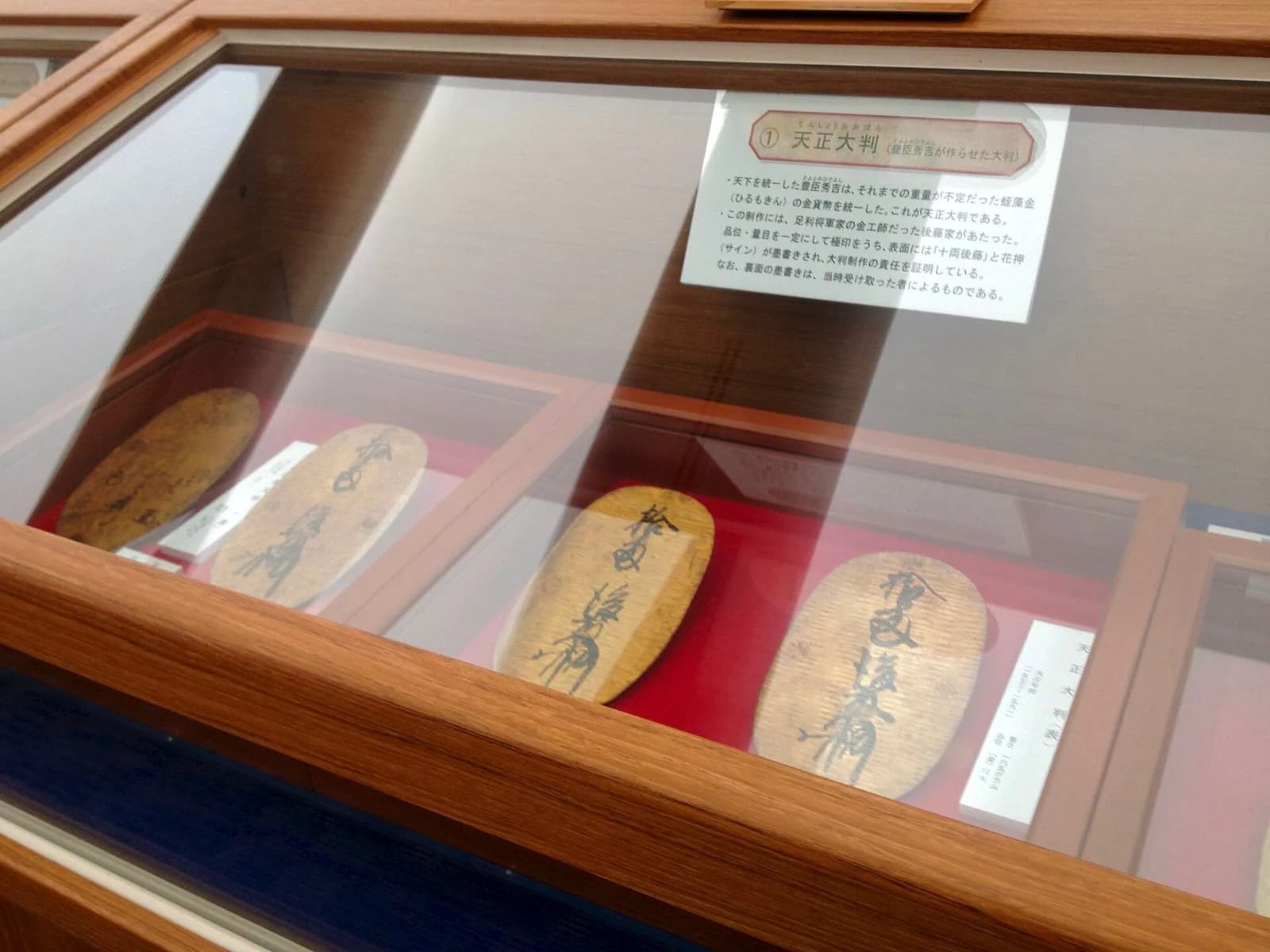
Tenshō Ōban's Historical Positioning
The Tenshō Ōban kin was Japan's first Ōban gold coin, minted by Gotō Tokujō in Tenshō 16 (1588) under the orders of Toyotomi Hideyoshi, who was advancing toward national unification. This Ōban transcends the mere framework of currency and is positioned as a monumental existence in the history of Japan's monetary system. It marked a turning point from forms like gold nuggets and gold dust to large gold coins with unified standards. In the process of unifying the nation, Toyotomi Hideyoshi needed to construct a new economic order. As its symbol, the Tenshō Ōban kin played a crucial role in demonstrating Hideyoshi's authority both domestically and internationally. At this time, unification of currency was essential for consolidating the foundation of centralization. In discussing the history of Japan's gold coins, the emergence of this Ōban cannot be overlooked. For further details, please refer to An Introduction to Edo Gold Coins (Koban and Ōban).
Details on Weight, Dimensions, and Gold Purity
The standard specifications of the Tenshō Ōban are approximately 165g (44 me) in weight, with a gold purity of about 73% (silver approximately 27%). With dimensions of approximately 170mm in length and 100mm in width, it is an impressive size, somewhat larger than half of an A5 sheet of paper. When held, its hefty weight is palpable, leaving one awed by its presence. However, the market evaluation of the Tenshō Ōban far exceeds its material value due to its significant historical and collectible value. The material value accounts for only a few percent of its total price, highlighting its exceptionally high historical significance and rarity. The 73% gold purity of the time was a result of considering the limits of refining technology and practicality. It is thought that mixing silver aimed to maintain hardness and ease of processing as a gold coin. Individual prices and auction examples are included in market records only for cases verified with records (host, lot, source URL, and verification date).
Gotō Tokujō and the Manufacturing Process
Gotō Tokujō (1550–1631), tasked with manufacturing the Tenshō Ōban, was the head of the well-known Gotō family of metalworkers, a lineage dating back to the Muromachi period (the catalog does not list the generations). His duties involved not merely currency production but also creating an artifact embodying Hideyoshi's authority. The manufacturing process required strict management and advanced techniques. The specific process involved the melting of the gold-silver alloy, molding, casting, surface finishing, and rigorous quality inspection. In the final stage, Gotō Tokujō himself handwrote "拾両也" in ink along with his unique, complex signature on each piece. This signature was not just a mere autograph but a crucial element at the core of authenticity determination. In the workshop located in Kyoto, elite craftsmen, utilizing the Gotō family's secret techniques, meticulously completed each Ōban one by one.
Economic Role in Toyotomi Government
The Tenshō Ōban functioned not just as a circulating currency, but as a political tool demonstrating Toyotomi Hideyoshi's governing authority and economic strength. It was used as rewards for various daimyō, presented to the Imperial Court, and gifted in diplomatic settings. Its overwhelming size, weight, and the shine of gold symbolized Hideyoshi's absolute power. It was not intended for general circulation, and its issuance was limited relative to the economic scale. As a result, the Ōban maintained rarity, enhancing its value as a symbol of power. Through this Ōban, Hideyoshi sought to have the nation's daimyō recognize his governance and strengthen the centralized system. The value of the Tenshō Ōban is deeply rooted in its historical and political background, which also relates to Factors Determining the Value of Old Coins. After the fall of the Toyotomi government, the minting of the Tenshō Ōban ceased, and under the Edo Shogunate system, it was succeeded by the Keichō Ōban. This marked a significant transition to a new era of monetary system.
Types of Tenshō Ōban
There are mainly three types of Tenshō Ōban: "Tenshō Hishi Ōban", "Tenshō Chō Ōban", and "Daibutsu Ōban". Each type has its unique historical background and characteristics, which are important points for collectors to distinguish. Tenshō Hishi Ōban: Characterized by its diamond-shaped framing on the surface, it is considered the oldest form. It is said that fewer than 10 pieces exist, making it an extremely valuable rarity. Its unique design conveys the appearance of early Ōban to the present. Tenshō Chō Ōban: With an elongated shape, this type prominently features the ink writings of the Gotō family. Definite records of existing numbers cannot be confirmed, but it is extremely rare. Daibutsu Ōban: A type said to have been minted to fund the construction of the Great Buddha Hall at Hōkō-ji in Kyoto. Its clear minting purpose adds to its allure as a historically romantic artifact. The types of Tenshō Ōban represent a profound research theme even within Types and Classification Systems of Old Coins.
Current Locations and Counts of Existing Tenshō Ōban
The count of existing Tenshō Ōban greatly varies by type. The most rare Tenshō Hishi Ōban is said to have fewer than 10 remaining, most of which are held as important cultural properties or artworks at museums or art galleries. Representative holding institutions include the Tokyo National Museum, Kyoto National Museum, and the Currency Museum. The Tenshō Chō Ōban has a few dozen pieces existing, with rare items occasionally appearing in the private market. However, these also trade at very high prices. Daibutsu Ōban also has extremely few existing pieces, and definitive records of existing numbers for any type cannot be confirmed. These Ōban are precious heritage representing Japan's history and are strictly managed and preserved. It is very rare for general collectors to have the opportunity to view them.
Market Price and Trading Results
The market price of Tenshō Ōban varies greatly depending on its type, condition, and historical background. There are pieces from tens of millions to over 100 million yen, and particularly rare well-preserved specimens can harbor the potential to set new record prices. This serves as proof of its value exceeding mere gold, being evaluated for its historical and artistic value. Opportunities for it to appear in the market are extremely rare, occurring only once every few years, making acquisition exceedingly difficult. Upon appearance of listing information, collectors must rapidly gather information and prepare funds. Demand is very high among wealthy collectors and history enthusiasts worldwide, and it draws attention even at international auctions. The price formation of the Tenshō Ōban is a good example for understanding How to Read Coin Market Cycles.
About Auction Records
It is extremely rare for the Tenshō Ōban to appear in the public market. One Point Do's auction records have not yet included successful examples of Tenshō Ōban sales in domestic general markets or specialized auctions. Regarding past individual auction amounts, due to the policy of only publishing examples confirmed with primary sources (lot and auction results announced by the host), specific amounts are withheld here. Understanding of An Introduction to and Utilization of Coin Auctions can be helpful in preparation for listing information.
Difficulty in Authentication
Due to the high value of Tenshō Ōban, numerous sophisticated forgeries exist. Therefore, authentication requires highly specialized knowledge and technology. Personal judgment is extremely risky, and hasty purchases may lead to significant losses. The ink writing by the Gotō family is considered the most important aspect in authentication. Tokujō's unique handwriting has subtle characteristics that even experienced appraisers might struggle to discern. Moreover, authentication requires a comprehensive judgment combining several expert methods, such as chemical composition testing using X-ray fluorescence analysis, microscopic observation of casting techniques, and specific gravity measurements. Reliable authentication agencies conduct evaluations through these multifaceted approaches. When considering purchase, obtaining authentication certificates from multiple expert institutions and carefully consulting the Counterfeit and Alteration Detection Guide is advised.
Procedures When Considering Purchase
Purchasing Tenshō Ōban is likely to be a significant decision that might occur once in a lifetime. To avoid failure, it is strongly recommended to adhere to the following procedures. Step ① Securing a Trustworthy Route: First, seek opportunities for acquisition through trustworthy coin-specializing dealers or internationally reputable auction houses. Private exchanges and internet auctions involve extremely high counterfeit risks and should be absolutely avoided. For more information, please refer to Coin Acquisition Sources and Purchase Methods Guide. Step ② Obtaining Authentication Certificates: Always obtain certificates from multiple independent expert authentication bodies (at least two institutions). It is crucial to carefully select authentication institutions and thoroughly verify their track record and reliability. Step ③ Confirming Gold Purity: Conduct gold purity measurement using X-ray fluorescence analysis (around 73% is the normal value) and receive a report. This is a very effective measure for detecting forgeries. Step ④ Verifying Price Reasonableness: Rigorously verify that the purchase price is reasonable compared to past auction records and market prices. Because it is a large purchase, calm decision-making is required. By following these procedures, risks can be minimized, and a genuine masterpiece can be acquired.