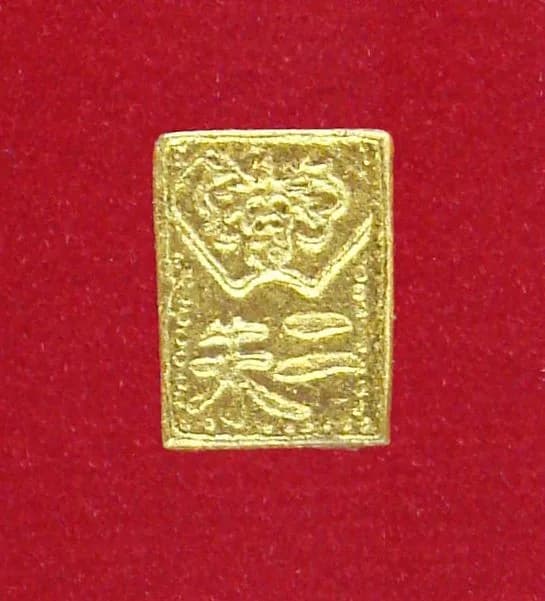
This high-purity gold coin was seen as a symbol for restoring the shogunate's finances and recovering its authority.
The Birth and Significance of the Kyōhō Ōban
The Kyōhō Ōban (享保大判) is a gold coin minted in Kyōhō 10 (1725) during the reforms of the Kyōhō era led by Tokugawa Yoshimune, the 8th Shogun of the Edo shogunate. Yoshimune first introduced the Kyōhō Koban, and following its success, he applied the reforms to the Ōban as well. The gold fineness of the Kyōhō Ōban is approximately 68%, significantly improved from the 52% of the earlier Genroku Ōban (元禄大判) (see catalog). This increase in purity demonstrated a strong intent to restore the shogunate's finances and rebuild its authority.
The Kyōhō Ōban was intended more for ceremonial use and gifting rather than circulation. Therefore, its high fineness was valued as a means to showcase the shogunate’s prestige. The face value "拾両" (10 ryō) is inscribed with ink on the surface, along with the signature of the Gotō family head. This ink inscription is handwritten, granting individuality to each coin. Additionally, it features engravings of a paulownia crest and fans, and its golden hue from approximately 68% gold purity reflects its high quality (see catalog).
The reverse side shows the “Gozame,” a pattern transferred from the mat used during casting, and it bears the hallmark indicating its serial number and quality assurance. Furthermore, the natural pattern known as "Fukime," which occurs during casting, varies with each piece, enhancing its appeal as a work of art. With such designs and high gold fineness, the Kyōhō Ōban has established its value as a gold coin from the Edo period. For more detailed information about the Kyōhō Ōban, refer to Kyōhō Ōban.
The Historical Background of the Kyōhō Ōban and Its Impact on Evaluation
The Kyōhō Ōban is characterized by its approximately 68% gold fineness, markedly raised from the 52% of the preceding Genroku Ōban (see catalog).
This substantial presence, combined with a gold fineness comparable to contemporary 18 karat gold, is one reason it continues to capture the interest of collectors.
In the authentication of the Kyōhō Ōban, the surface ink inscription "拾両" and the signature of the Gotō family head are crucial elements. These features, which vividly reflect the individuality of the Gotō family head and the characteristics of the period, serve as clues for a deeper understanding of the historical background. The state of the ink inscription and the shape of the signature convey the time and environment the coin has endured, making them important for evaluating its historical provenance.
The historical background of the Kyōhō Ōban influences its current evaluation, reflecting not only its high gold fineness but also the political and economic conditions of the time, as can be discerned from records. As a result, the Kyōhō Ōban holds value beyond a mere old coin, becoming an important research subject for collectors and researchers alike. By referring to related gold coins such as the Kyōhō Koban and Tenpō Ōban, one can gain a deeper understanding of the currency transitions during the Edo period.
Recent Auction Levels in the Edo Gold Coin Category
The median auction price for the Edo gold coin category over the last 90 days is ¥12,900 across 3 recorded transactions. In contrast, the previous 90 days saw 5 transactions with a median of ¥40,000. Such few transactions in the recent and prior periods prevent the calculation of a reliable rate of change or confidence level. With fewer than 10 instances, these figures should be taken as general directional guidance.
Examining specific auction cases, on September 26, 2026, a "Man'en Koban" was auctioned for ¥100,000. While high-value transactions exist, another example shows a "Rainbow* Old Coin Koban-type Currency" sold for ¥1,033 on September 17, 2026, and on September 16, the "J*8 Sample One-Bu Silver Koban Japanese Edo Old Coin Antique Coin Memorial Coin Collection Former Currency Retro" was traded for ¥1,300.
These individual transactions reveal a wide range of price bands within the Edo gold coin category.
For detailed price trends and valuation methodology, you can check here: See Price Trends on the Market Chart, Valuation Methodology and Sample Size. You can also view a list of auction histories for the Edo gold coin category: List of Auction Histories.
Factors Influencing the Value of the Kyōhō Ōban
This Ōban has a high gold fineness of 68%, significantly improved from the 52% of the Genroku Ōban (see catalog).
The market value of the Kyōhō Ōban is influenced primarily by its historical background. Collectors emphasize this historical context and its high fineness, as seen in auction records where it receives high praise.
Furthermore, since the Kyōhō Ōban was often used in formal settings, the condition greatly affects market evaluation. For condition evaluation, refer to The Standards and Interpretation of Old Coin Grading.
On the other hand, the risk of forgery with the Kyōhō Ōban cannot be ignored. This Ōban, as a symbol of authority and fiscal health, is known for the difficulty in distinguishing between genuine and counterfeit items. In the market, the skill and knowledge to discern authenticity are required, making the knowledge of How to Differentiate Genuine from Fake essential.
The Kyōhō Ōban is considered to have unique value compared to successive Ōban, particularly as a "symbol of reform," making it attractive to collectors. Although it boasts the same gold fineness as the late Tenpō Ōban (1838), differences in mintage and condition influence its attention in the market. These factors combine to give the Kyōhō Ōban its unique market value due to its rarity and high fineness.
Points to Check When Acquiring and Holding the Kyōhō Ōban
When acquiring or holding the Kyōhō Ōban, it is critical to thoroughly assess the risks of counterfeits and forgeries. These counterfeits are made of brass or copper with gold plating, making authenticity determination from appearance very difficult.
Additionally, concerning the ink inscriptions on the surface of the Kyōhō Ōban, there are forgeries printed or transferred meticulously. The bleed patterns of the ink, the naturalness of the brushwork, and the subtle angles and line variations of the signature are challenging to distinguish without an experienced appraiser, so consulting a professional is crucial.
For authenticity determination, weight measurement and X-ray fluorescence analysis are effective, but these measurements alone cannot conclusively verify authenticity. Combining scientific analysis with items certified by reputable appraisal organizations such as the Japan Numismatic Dealers Association (JNDA) is a potent way to mitigate counterfeit risks.
Although the Kyōhō Ōban does not frequently circulate in the market, it is one of the more commonly available among the historic Ōban series.
When actually holding a Kyōhō Ōban, appropriate storage methods should also be considered. Detailed guidelines on old coin storage can be learned from Correct Storage Methods for Old Coins. This helps maintain the value of the Kyōhō Ōban over the long term.
Reflections on the Value and Collection of the Kyōhō Ōban
The presence of multiple bidders competing has been recorded, indicating the popularity and value of the Kyōhō Ōban. For the wealthy, it offers intrinsic value as a cultural asset and is attractive as long-term asset preservation.
Conversely, due to its high price, adequate financial capacity is essential for purchasing the Kyōhō Ōban. Moreover, the risk of forgeries is high, with fake inscriptions and gold-plated imitations circulating. Therefore, obtaining certified items from a reliable appraisal institution is crucial. Given the limited liquidity, it is important to carefully judge the appropriate sales channels and timing when selling.
Through the Kyōhō Ōban, one can deepen their understanding of Japan's historical culture and achieve long-term asset preservation. The basic concepts of old coin investment are further explored in Differences and Concepts of Investment and Collection.