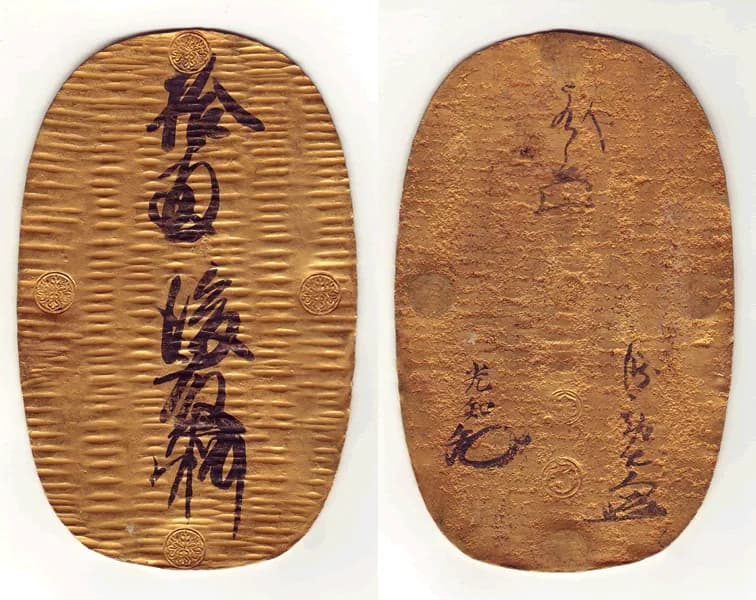
Keichō Ōban Kin is an iconic gold coin from the early Edo period, first minted in 1601 under the order of Tokugawa Ieyasu.
An Icon of the Early Edo Period, Keichō Ōban Kin
The minting of Keichō Ōban Kin began in Keichō 6 (1601) by order of Tokugawa Ieyasu. It marked a significant step in establishing a gold coin minting system led by the Tokugawa shogunate.
The obverse features the ink inscription "拾両" (ten ryō) and a seal by the Gotō family of the Gold Mint, creating a solemn impression. As the first Ōban Kin systematically issued by the Edo shogunate, it laid the foundation for all subsequent Ōban Kin coins, holding significant historical value. Its dignified appearance is fitting to symbolize Tokugawa's unification of Japan and played a crucial role in supporting the economic foundation of the Edo period.
During the long minting process, subtle variations in fineness and weight can be found in coins minted later. Notably, some from the Genroku period mintings have a lower fineness.
Such subtle changes are important for determining the factors that decide the value of ancient coins. Coins with lower fineness from later periods may appear slightly whitish on the surface, requiring precise measurements. Keichō Ōban Kin occupies a significant position in the monetary system of the Edo period and is an intriguing subject for collectors and researchers. For more details, see Keichō Ōban Kin.
Bakufu Finance and the Historical Significance of Keichō Ōban
Beyond its value as a high denomination coin, it was used in diverse ways such as rewards to feudal lords, offerings to the imperial court, and loans to various domains.
As explained in The System and Overview of Edo Gold Coins, Keichō Ōban occupies a special position in Japan's monetary history. Its minting continued until the Genroku recoinage, with total minting supposedly reaching tens of thousands.
Keichō Ōban is further divided into three periods: early, middle, and late, each with distinct characteristics. Early coins are more handcrafted with rough surfaces, reflecting the evolving minting techniques of the time. In the middle period, improved techniques resulted in smoother finishes, and in the later period, even more refined techniques produced beautifully finished coins.
The ink script styles on the surface also subtly changed with generational shifts in the Gotō family. Experts use these differences in surface texture and ink script to estimate when individual Keichō Ōbans were minted. Such distinctions are crucial in appraisals.
Thus, Keichō Ōban, backed by its historical context and evolution in minting technology, remained a critical currency supporting Bakufu finance.
Recent Auction Trends in the Edo Gold Coin Category
Considering the latest auction trends for the entire Edo gold coin category using September 19, 2026, as the base date, median auction prices over 90 days were ¥6,967 from 2 transactions. This is significantly lower compared to the previous 90 days' median of ¥40,000 from 5 transactions. However, as the number of transactions is under 10, it is insufficient to calculate a reliable confidence level. Hence, a fluctuation rate cannot be determined.
Looking at actual auction cases, coins such as "Niji* Antique Coin Koban Type" were auctioned for ¥1,033 on September 17, 2026, and "J8 Ichibu Silver Koban Edo Antique Coin Memorial Coin Collection Old Currency Retro" for ¥1,300 on September 16, 2026. Other transactions include "One Shu Silver Edo Japan Koban Antique Coin Memorial Coin Collection Old Currency Retro Organizing Item" auctioned for ¥1,500 on September 3, 2026, and "e5 Ichibu Silver Koban Silver Coin Antique Coin Memorial Collection Silver Retro Organizing" for ¥1,100 on July 29, 2026.
These data show variability in individual transaction prices within the Edo gold coin category. Therefore, assessing short-term trends in auction prices for the entire category is limited.
For a detailed confirmation of price trends, refer to Check Price Trends on the Market Chart or View Auction History List for further analysis. Increasing the number of future transactions is necessary to improve data accuracy.
Elements Determining the Value of Keichō Ōban Kin
One critical factor influencing the value of Keichō Ōban Kin is the "ten ryō" ink inscription and the seal at its center. These were handwritten by successive heads of the Gotō family and are the most crucial elements in authenticity judgment. The Gotō family, who exclusively managed Ōban production and inscriptions from the Muromachi to the late Edo period, displayed each generation's individuality in their handwriting. Inscribed coins may significantly decrease in market value if inscriptions fade over time or are later retouched as "re-inked items." The ink inscription itself serves as proof of authenticity and evidences its fineness.
Additionally, official stamps next to the ink inscriptions are vital in identifying manufacturers, as emphasized in Complete Guide to Identifying Counterfeits and Altered Items as significant clues, representing quality control in production processes.
Furthermore, understanding generational features of the Gotō family is indispensable in Keichō Ōban appraisal. The seal of the first generation, Mitsunori, in the Keichō to Genna period, is robust, large, and strongly pressed, symbolizing authority and vigor following unification. During the Kanei to Meireki period under the second generation, Norishin, seals became slightly slimmer with refined line ends, appearing elegant and sophisticated. The third generation, Torinori, in the Manji to Genroku era, brought even more delicate and graceful scripts displaying mastery.
Identifying these generational traits requires meticulous comparison with handwriting samples in specialized literature and consultation with specialists with extensive appraisal experience. Accurate generational identification is vital in applying Standards and Reading of Coin Grading, significantly affecting rarity and market price.
Points to Verify When Acquiring and Owning Keichō Ōban
When acquiring or owning a Keichō Ōban, several practical points must be confirmed. Firstly, a comparison with Tenpō Ōban, another representative coin of the Edo period, is necessary. Despite differing in engraving precision, ink script, and period-specific minting techniques, focusing on these distinctions is crucial.
Thus, it's recommended to check auction examples by searching Past Auction Results to understand price trends.
In owning ancient coins, following Proper Coin Storage Methods and ensuring proper storage are essential. Recent active entry by overseas collectors is a factor in rising auction prices. Considering these trends, it is important to review detailed market records when purchasing. Individual prices and auction cases will be published based on verified records.
Importance of the Value and Preservation of Keichō Ōban Kin
According to Ittendo's perspective, Keichō Ōban Kin, a high-value historical gold coin symbolizing Edo shogunate authority and wealth, derives its value from rarity and assured material worth. Its historical background itself is significant, making it an appealing subject for many collectors and researchers.
When appraising Keichō Ōban Kin, a rigorous process is essential. Verification of certificates issued by the Japan Numismatic Dealers Association (JNDA) or major auction houses is crucial for ensuring reliability.
Particularly important is the handwriting verification of the seal by the Gotō family head. This requires reliable experts as judging is difficult without experienced professionals. Attention to preservation methods is also crucial, adhering to Correct Storage Methods for Coins by avoiding direct sunlight and extreme temperature and humidity.
Ideally, use exclusive paulownia boxes and archival-quality hard cases to maintain a sealed state, but avoid careless "re-inking" to prevent the ink inscriptions from fading.
Hence, proper appraisal and preservation are key to safeguarding their value.