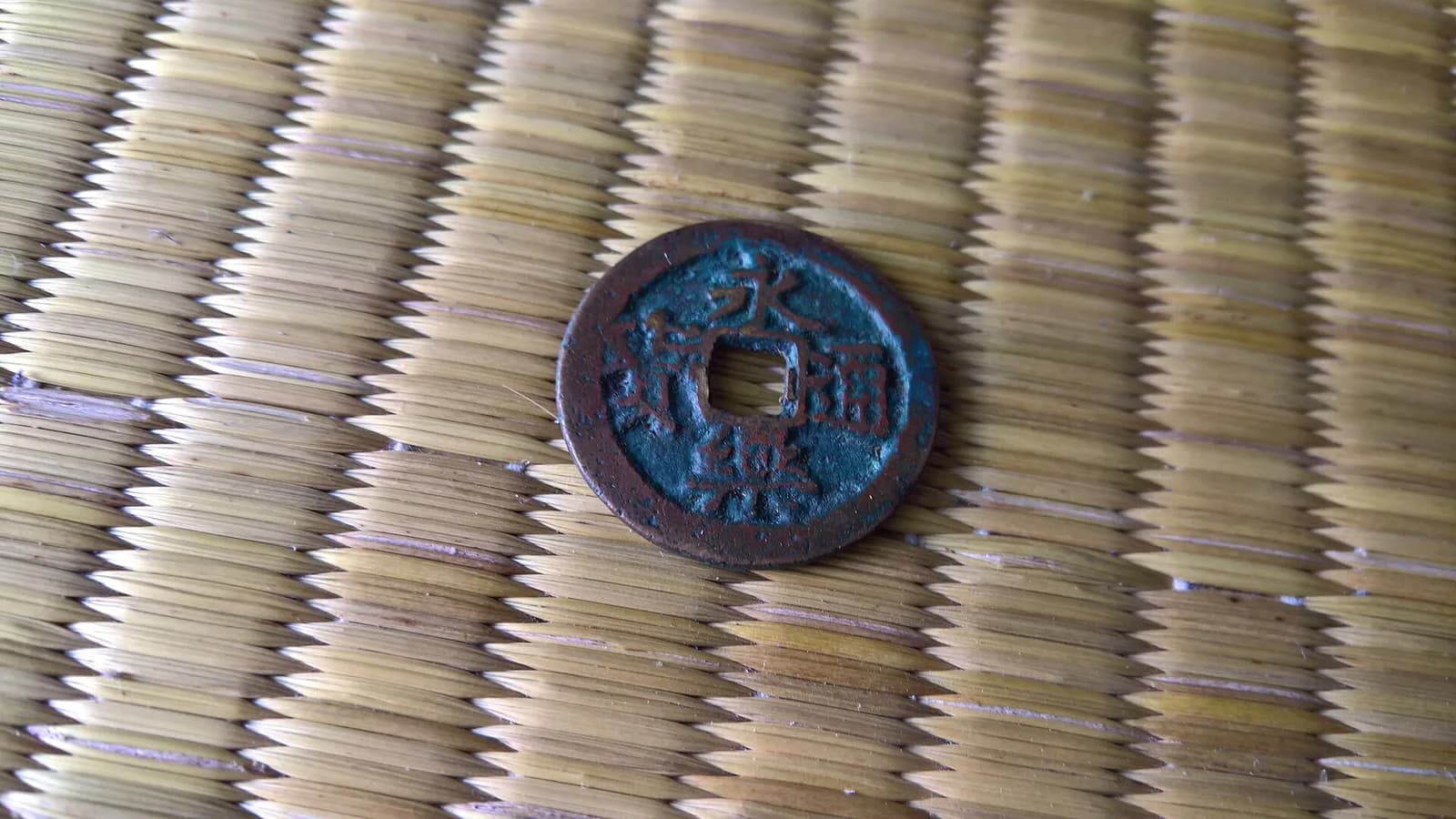
Eiraku Tsuho (永楽通宝) is a historical copper coin minted during the Ming dynasty in China, which circulated widely in Japan as a key currency.
History and Significance of Eiraku Tsuho
Eiraku Tsuho is a copper coin whose minting began during the reign of Yongle Emperor, the third emperor of China’s Ming dynasty. During the Yongle years (1403-1424), this currency became an important trade medium not only in China but across the East Asian economic sphere.
It was a principal import item in Japan through the Japan-Ming trade, known as the tally trade, and represents a significant instance of imported currency. This coin is considered an important predecessor when discussing Japan's holed coins (Kan'ei Tsuho, Tempō Tsuho).
1403, the year of the Yongle Emperor's accession, was when the Ming dynasty aggressively pushed foreign policies, symbolized by Zheng He's expeditions, which invigorated trade across Asia.
In Japan, where domestic coin minting was limited, Eiraku Tsuho became indispensable. Understanding this context reveals that Eiraku Tsuho holds value beyond being a mere old coin. Its presence is noteworthy in the history of Japanese currency, and its influence is detailed by unpacking the history of Eiraku Tsuho.
Impact of Eiraku Tsuho on Japan’s Monetary Economy
From the mid-Muromachi period onward, Eiraku Tsuho entered Japan through the Japan-Ming trade, catalyzing major economic changes. It prompted a shift from the barter system of rice and cloth to a currency-based economy, boosting the development of commercial cities and the rise of new industries.
During the Sengoku period, Eiraku Tsuho was indispensable for commercial transactions and paying annual taxes.
Moreover, Oda Nobunaga used Eiraku Tsuho as a symbol of national unification. Nobunaga hoisted this coin inscription as his army’s banner "Eiraku coin flag," aiming for unification based on economic power. In Kyoto, a single Eiraku coin equaled four inferior coins, acting as a "fine coin" with high credibility. Nobunaga’s choice of Eiraku Tsuho reflects his advanced economic perspective, popularizing the coin historically.
Understanding this background is crucial in appreciating the socio-political transformations in Japan. For those interested, the Holed Coin Introduction provides more in-depth information.
Recent 90-Day Auction Trends in the Holed Coin Category
During this period, the median auction price increased from the previous 90 days’ ¥1,499, showing a 23.4% change, based on data as of September 17, 2026.
The reliability of this data is moderate, grounded on over 30 transactions conducted per period. Although fewer samples might only offer directional insights, this data carries reasonable credibility.
One example includes a Tempō Tsuho old coin auctioned for ¥14,110 on September 15, 2026. Another Tempō Tsuho coin was sold the same day for ¥1,400. Meanwhile, a Kan’ei Tsuho coin fetched ¥600, whereas a rare Kan’ei Tsuho coin with "Two-Water Yong Large Character on Star" back was auctioned for ¥15,000.
These details highlight the market trends and price variability in the holed coin category. For deeper insights into price fluctuation and specific trends, check the Market Chart for Price Trends or Auction History List.
Factors Determining the Value of Eiraku Tsuho
The value of Eiraku Tsuho is determined by condition, rarity, and authenticity risk. Firstly, in terms of condition, Eiraku Tsuho established a position as a "fine coin" under the Currency Selection Law, due to its high quality and stable credibility. Accordingly, well-preserved Eiraku coins may hold particularly high value.
Regarding rarity, Eiraku Tsuho features both authentic "Ming coins" minted in mainland China and "privately minted coins" produced within Japan. Privately minted coins, made to meet high demand and counter supply shortages, are generally coarser in script and inferior in copper quality to Ming coins, making differentiation important. Authentic Ming coins are rare, and subtle differences in script styles and mint locations pique collectors’ interest.
Lastly, authentication risk is key in valuing Eiraku Tsuho. Distinguishing authentic coins, especially through features like the subtle "two waters" of the character "永" or the radical style in the character "通", is crucial. Professional knowledge is essential, and consulting resources on Authentication Methods and Old Coin Grading Standards is advised.
Evaluating these factors collectively is needed to assess the value of Eiraku Tsuho.
Points for Authenticating Eiraku Tsuho
When acquiring and owning Eiraku Tsuho, careful authentication of its legitimacy and type is important. Several specific points aid in distinguishing genuine Ming coins from privately minted ones.
Genuine Eiraku Tsuho coins feature a finely carved and refined left stroke of the "永" character, and a properly spaced dot in the "通" character's radical, contributing to an overall orderly impression. High-quality copper, rich in red tones, gives a sense of weightiness, and the neatness of the coin's edge and rim reinforces authenticity.
Conversely, privately minted coins exhibit traits where the wood radical of "楽" may be omitted, and characters tend to be thicker with vaguer outlines. Copper quality includes mixed brass, appearing yellowish, possibly with a high lead content, suggesting a potential for private minting. Such coins might be smaller or thinner, warranting comprehensive observation of these features.
Enhancing authentication accuracy requires close examination with tools like magnifying glasses and gaining experience, guided by Old Coin Grading Standards. Understanding Proper Coin Storage Methods and maintaining quality are crucial for preserving Eiraku Tsuho's value. Applying these points is important for authenticating and owning Eiraku Tsuho.
Historical Value and Collecting Appeal of Eiraku Tsuho
Eiraku Tsuho, prized by Nobunaga, holds significant historical value as a passage coin, making it an attractive collection focus. This holed coin offers deep exploration through script varieties. Records of specific fine varieties selling for tens of thousands illustrate its worth and present notable points for collectors.
Starting with Eiraku Tsuho, collectors can expand their scope to other Ming coin family passage coins like Hongwu Tsuho, Xuande Tsuho, and Hongzhi Tsuho. Each of these has ties to Japanese history, enabling affordable compilations of a comprehensive collection that chronicles medieval Japanese currency history by era or type. The collecting world revolving around Eiraku Tsuho is easily accessible for beginners and serves as a key to exploring Japan's monetary history.
Combining historical value and the joy of collecting make Eiraku Tsuho a cherished item that will continue to capture many enthusiasts' hearts.