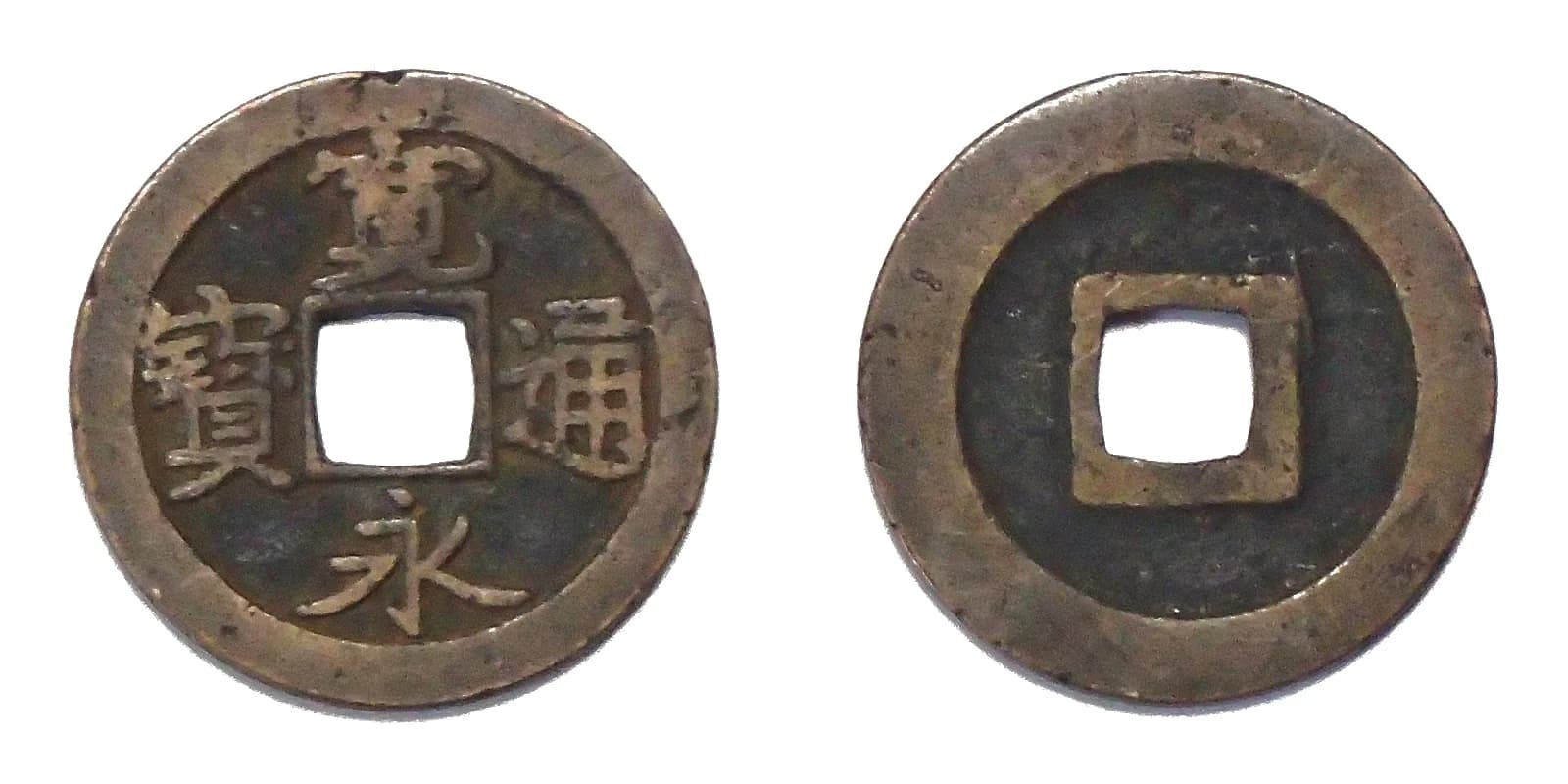
Tōshi Mon Sen holds an important place in Japan's currency history. Its distinctive design and material diversity are attractive features for collectors.
Characteristics and Historical Background of Tōshi Mon Sen
Tōshi Mon Sen (当四文銭) is a large Anasen that occupies an important position in Japan's currency history. This coin had a value of four mon per piece and was circulated from the mid-Edo period to the end of the Edo period. Tōshi Mon Sen made its presence felt as a high-denomination coin following the one-mon coins, Kan'ei Tsuuhou (寛永通宝), which began minting in Kan'ei 13 (1636).
Tōshi Mon Sen is approximately 28mm in diameter, weighing about 6-7g, and is primarily made of copper. It is slightly larger than the standard one mon coin (about 24mm), and its weight in hand is a distinguishing feature. Particularly notable is the wave pattern cast on the back, with the "eleven wave" being standard, though various variations exist. This wave pattern distinctly separated it from one mon coins.
In daily transactions among common people, Tōshi Mon Sen significantly contributed to simplifying high-value payments and change. Especially during the economic turmoil at the end of the Edo period, its importance increased further. Thus, Tōshi Mon Sen, as a coin that supported Japan's currency economy, is an indispensable presence in Japan's Anasen history, as explained in Introduction to Anasen (Kan'ei Tsuuhou, Tenpō Tsuuhou).
During its long minting period, Tōshi Mon Sen was made from various materials. Initially, they were minted from copper around Kanbun 8 (1668) as "Kan'ei Tsuuhou Sen." Characterized by a reddish hue, they are commonly seen. Subsequently, from Genbun 1 (1736), brass (a copper-zinc alloy) Tōshi Mon Sen appeared. Brass features a beautiful color close to gold, with many well-preserved specimens due to its resistance to rust. Post Bunkyū 2 (1862), due to fiscal pressure and the introduction of Western minting technologies, a large number of iron Tōshi Mon Sen were minted. Known as "Bunkyū Eihou Iron Coins," these are characterized by their grayish-black color and magnetic attraction.
Differences by material are detailed in Tōshi Mon Sen, providing an understanding of the historical background and features of Tōshi Mon Sen.
Historical Background of Brass Tōshi Mon Sen and Its Impact on Evaluation
Brass Tōshi Mon Sen is appealing to many collectors for its unique golden shine and excellent durability. Made from a copper-zinc alloy, it is less prone to rust compared to copper coins, with more gentle verdigris. Due to this property, many individuals have been preserved in good condition and are highly regarded for display purposes. Especially, well-preserved specimens that retain their mint state stand out as exceptional pieces in any collection.
The brass coins minted in large quantities during the Bunkyū period are considered relatively accessible. However, by focusing on the intricacies of design and the beauty of patina, one can feel the depth of collection even further. The shine of brass is a crucial element in determining the "condition," a factor affecting the value of coins, which greatly influences evaluation. Collectors and researchers focus on this aspect, ensuring that the market valuation for brass Tōshi Mon Sen remains stable.
Additionally, the wave pattern on the back of Tōshi Mon Sen plays an important role in its identification and classification. Besides the standard "eleven wave" pattern, variations in the number, depth, and shape of waves arise based on the minting place, period, and mold wear. For instance, some have deeply and clearly carved patterns, while others are shallow and indistinct, with some mints exhibiting unique wave expressions. Identifying these subtle differences goes beyond mere classification and provides clues to where and when the coin was minted. Researching these minute differences is crucial for understanding the concept of "varieties" in types and classification systems of old coins.
Understanding the historical background and impact on evaluation of Tōshi Mon Sen necessitates recognizing the durability and beauty of brass Tōshi Mon Sen and the variations of wave patterns on their backs. Such features make Tōshi Mon Sen an object of exploration for collectors and researchers. This enriches the understanding of the Types and Classification Systems of Old Coins and Factors Determining the Value of Old Coins.
Recent Auction Levels in the Anasen Category
According to records, the median winning bid in the Anasen category over the last 90 days is ¥1,850, with 48 transactions taking place. Compared to the previous 90 days, where the median winning bid was ¥1,499 with 65 transactions recorded, there has been a 23.415610406937958% increase in winning bid prices for the Anasen category. The reference date is September 16, 2026, with a medium level of confidence due to over 30 transactions in each period.
Specific auction examples include a Tenpō Tsuuhou old coin selling for ¥14,110 on September 15, 2026. Other transactions on the same day include another Tenpō Tsuuhou at ¥1,400 and additionally at ¥3,200. Further examples show recordings of transactions for ¥1,444 and ¥1,500 on the same day. Looking back, a Kan'ei Tsuuhou sold for ¥600 and another for ¥15,000 on September 12, 2026. These examples illustrate the price diversity within the Anasen category.
For those wanting to know more about price trends in the Anasen category, consult View Price Trends in Market Charts or Browse Auction History. This information serves as useful material for antique coin collectors and investors to understand the current market situation.
Factors Affecting the Value of Tōshi Mon Sen
One of the key factors affecting the value of Tōshi Mon Sen is the diversity of calligraphy. Subtle differences exist in the characters "寛" (Kan), "永" (Ei), "通" (Tsuu), and "宝" (Hou) depending on the minting place and time, which are important clues indicating where they were minted. Specifically, some mints feature distinctive bold strokes, while others employ a delicate calligraphy style, intriguing collectors and enhancing market value. Particularly, rare or unique coins deviating from standard calligraphy receive high praise, showcasing the diversity within the currency system of the Edo period.
Tōshi Mon Sen is also classified into mother coins and general circulation coins, impacting value. Mother coins are prototypes for making the molds of circulation coins, and due to their rarity, they can have very high value. Mother coins are slightly larger than circulation coins, with deeper, clearer engravings of characters and wave patterns on the back. Their edges are finely finished with minimal burrs, boasting an overall precision in crafting. Such characteristics exemplify the rarity associated with Factors Determining the Value of Old Coins.
In the market, mother coins can fetch from tens of thousands to hundreds of thousands of yen, not rare in light of the meticulous differences found in minting. Occasionally, they are mistakenly listed as circulation coins at low prices, requiring deep knowledge and keen discernment.
Thus, numerous factors influence the value of Tōshi Mon Sen, with particular emphasis on the diversity of calligraphy and the rarity of mother coins. Understanding these factors allows for better authentication and market value assessment. Interested individuals are encouraged to consult Standards and Interpretation of Old Coin Grading to further explore their collection.
Points to Check When Appraising and Storing Tōshi Mon Sen
When acquiring and holding Tōshi Mon Sen, material specification, condition evaluation, and authenticity determination are key points. To specify the material, combine color identification, magnet tests, and weight measurements. Copper appears reddish-orange, brass is golden, and iron is grayish-black, with magnetic attraction identifying iron. Iron coins are heavier compared to coins of the same size, making weight a crucial indicator. Weighing with a specific gravity meter aids in accurately identifying material.
In evaluating condition, consider the wear of characters and wave patterns, surface scratches, and the beauty of patina. Brass coins are often well-preserved due to their resistance to rust, whereas iron coins are prone to rust and should be carefully assessed. Understanding appropriate Old Coin Grading Standards assists objective condition evaluation.
To determine authenticity, assess the clarity of minting marks, character strokes, wave pattern craftsmanship, and weight. Modern sophisticated fakes and alterations exist, necessitating inspection for unnatural gloss and minting irregularities. Referencing the Guide to Identifying Fakes and Altered Coins supports cautious judgment.
Proper storage requires methods suitable to the material. Copper coins are sensitive to moisture, readily developing verdigris, thus storing in airtight coin capsules or slabs with silica gel is ideal. Brass coins are relatively stable but should avoid direct sunlight and rapid temperature changes. Iron coins are most susceptible to rust, benefitting from a light coating of anti-rust oil and storage in sealed containers with desiccants. Use of abrasives or metal polishes is strictly prohibited; wiping with a clean, soft cloth should suffice if cleaning is necessary. Check Proper Storage Methods for Old Coins for more detailed storage advice.
By fully understanding and implementing these points, it is possible to maintain the value of Tōshi Mon Sen over time.
Value and Significance of Collecting Tōshi Mon Sen
Tōshi Mon Sen is solidified as an ideal entry-level coin for beginners. Its affordable price range makes it suitable for starting Anasen collection, allowing enthusiasts to enjoy the variety of materials and wave patterns. Standard coins are easily accessible, and for the first steps of collection, it is recommended to acquire one coin each of copper, brass, and iron. Handling and appreciating these different materials enhance the joy of collecting.
Furthermore, seeking beautifully defined wave patterns on the back or coins with distinctive calligraphy can enhance the quality of a collection. Particularly, high-quality brass coins are popular and can fetch several thousand yen depending on their condition. Market records often show high appreciation for such fine and rare specimens.
However, when considering Tōshi Mon Sen as an investment, major price increases are unlikely for general circulation coins. Nonetheless, rare mother coins, early mints from special years, or coins with exceptionally rare calligraphy can hold values exceeding tens of thousands of yen. Thus, acquiring through reliable channels is essential when advancing collection, and referencing the Guide to Obtaining and Purchasing Old Coins is recommended.
In the collection of Tōshi Mon Sen, its value as a reference cannot be overlooked. These coins reflect historical backgrounds and regional characteristics, assisting in deepening cultural understanding. Additionally, Monitoring Prices of Interesting Coins in Vault helps track market trends, thereby broadening collection horizons and aiding in acquiring valuable pieces.