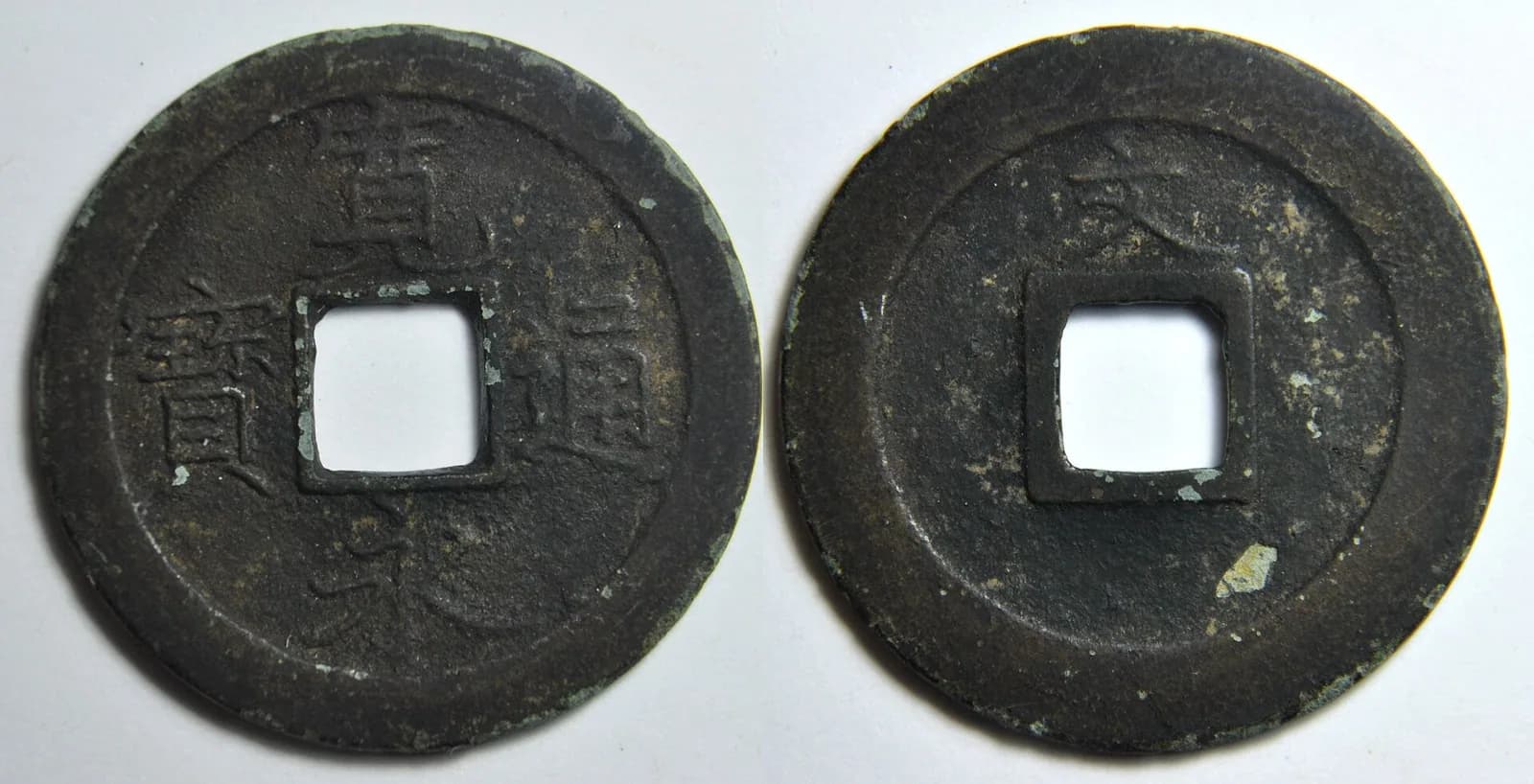
Kan'ei Tsūhō (寛永通宝), which circulated for roughly 230 years as the core currency of the Edo period, gave rise to a great many varieties thanks to its long history and the minting houses established throughout the country. Differences in casting techniques, mother coins, and copper alloy ratios from one mint to the next produced subtle divergences in calligraphic style, size, and copper quality.
Varieties of Kan'ei Tsūhō: Background to Their Diversity and Representative Examples
Kan'ei Tsūhō circulated as the core currency of the Japanese economy for roughly 230 years, from Kan'ei 13 (1636) in the early Edo period through to the end of the shogunate era. The long casting period and the minting houses (zeni-za) established throughout the country were the factors that gave rise to the coin's many varieties.
Differences in casting technique and mother coins from one mint to the next—and even individual craftsmen's habitual hand movements and copper alloy ratios—introduced subtle variations in calligraphic style, size, and copper quality. These differences were especially pronounced during the early Kan'ei period (ca. 1636–1659), when privately run minting houses proliferated.
With the onset of the later Kan'ei period (from 1668 onward), the number of shogunate-controlled mints increased and quality standardization was pursued. Even so, coins with distinctive calligraphic styles and characteristics continued to be cast at each of the major mints, including Kameido, Fukagawa, Sado, Sendai, and Akita. The number of varieties is said to run into the hundreds, and their complete classification is still being advanced by numismatic researchers today. For the basics of Kan'ei Tsūhō, see Types and Market Prices of Kan'ei Tsūhō.
The varieties of Kan'ei Tsūhō are wide-ranging, but several representative ones are particularly popular among collectors. The "Nisuiei (二水永)," the quintessential early Kan'ei coin, features an early calligraphic style in which the character "永" resembles two water droplets; its rarity makes it highly sought after. The "Shimayabun (島屋文)" is characterized by a unique script style with thick, powerful strokes and is one of the iconic varieties of the early Kan'ei period.
In the later Kan'ei period, "reverse-character coins (背文字銭)" bearing characters on the reverse that indicate the place of casting are frequently seen. The "Seiji Haibun (正字背文)" is a Kanbun-era Kameido coin bearing the character "文" on the reverse—"文" being taken from "寛文 (Kanbun)." In classification catalogues it is listed under "Kanbun-era Kameido coins, Seiji type." "Haisa (背佐)" denotes Sado coins and "Haisen (背千)" denotes Sendai–Ishinomaki coins; the reverse characters serve as clues for tracing the place of casting.
"Matsumoto coins (松本銭)," cast in Matsumoto in Shinano Province, are characterized by a neat and well-ordered script style. "Mito coins (水戸銭)," cast in the Mito domain, display a bold and distinctive script style that strongly reflects regional character. An overview of these diverse coins can be found in Introduction to Hole Coins (Kan'ei Tsūhō and Tenpō Tsūhō).
Value as Indicated by Rarity and Historical Significance
The market evaluation of Kan'ei Tsūhō varieties differs greatly depending on type, rarity, and condition. Circulated examples of ordinary later Kan'ei Tsūhō are commonly traded at around ¥10 to ¥50. However, circulated coins with rare calligraphic styles cast during the early Kan'ei period may be valued at around ¥500 to ¥5,000. Rare later Kan'ei coins with reverse characters or specific script styles can also trade in the range of ¥5,000 to ¥30,000.
This wide price range exists not simply because of the large number of varieties, but because historical background and manufacturing-process rarity directly affect current valuations. Trial-cast coins and extremely early rare pieces rank among those commanding the highest values, and these can be appraised at ¥300,000 to over ¥1,000,000. For the rarest pieces—such as the Nisuiei—prices reaching several million yen have been confirmed, depending on condition.
Among Kan'ei Tsūhō varieties, the ones that carry the greatest value and historical significance in collecting are the "mother coins (母銭, bosen)." Mother coins were used as the original patterns from which the casting molds for actual circulating coins were made. Owing to this special role, mother coins possess characteristics that distinguish them from circulating coins. Specifically, their diameter is approximately 1–2 mm larger than that of circulating coins, and the engraving of the characters is deeper and more distinct. The finishing of the rim is extremely precise, and the casting surface is often smooth. These characteristics testify to the meticulous care taken by the craftsmen of the mints of that era, and they are factors that enhance historical value.
Even a calligraphic style whose circulating coins trade for around ¥10 apiece can command a high appraisal of tens of thousands to hundreds of thousands of yen if its mother coin is identified. Authenticating a mother coin requires a high degree of experience and specialized knowledge. Rather than simply measuring size, one must make a comprehensive judgment based on weight comparison, clarity of characters, texture of the casting surface, and patterns of wear due to aging.
These price ranges also fluctuate depending on market supply and demand and whether an expert authentication has been performed. To learn what your collection is worth, refer to Factors That Determine the Value of Old Coins; understanding Standards for Old Coin Grading is also helpful.
Recent Market Overview for Hole Coins
The price levels in this section indicate trends for the hole-coin category as a whole, not for individual varieties. The figures below are compiled from market snapshot `2026-08-31-001` (reference date: 2026-08-30) and are calculated from hammer prices in the general market (flea-market apps and internet auctions).
The median hammer price for the most recent 90 days is ¥1,850 (50 lots), up +24.2% from the preceding 90 days (median ¥1,490 · 60 lots). The confidence level of this figure is "MEDIUM."
Recent hammer-price examples (aggregated lots only · hole coins):
- Tenpō Tsūhō antique coin / currency Tamatsuka Tenpō commemorative coin — ¥15,100 (2026-08-26)
- For ho\*ri — Tenpō Tsūhō hole coin — ¥2,200 (2026-08-26)
- Tenpō Tsūhō antique coin collection — ¥700 (2026-08-25)
- Tenpō Tsūhō Fuchi Hosaikaku-te (antique coin / hole coin / 天保通寶 / unknown coin) — ¥5,000 (2026-08-24)
※ Market prices fluctuate. The figures above reflect conditions as of the reference date 2026-08-30. For the latest values, see the Market Index.
Key Points for Rarity and Authentication That Determine the Value of Kan'ei Tsūhō
Kan'ei Tsūhō varieties are wide-ranging, and among them the particularly rare ones carry high value. To judge the value of such coins, it is essential both to understand their rarity and to obtain a professional appraisal.
One factor that greatly influences value is the existence of trial-cast coins (試鋳銭, shichūsen). Trial-cast coins were experimental pieces made before mass production began, in order to verify casting quality, script style, and materials. They served a role similar to that of a prototype in modern product development. Kan'ei Tsūhō trial-cast coins are characterized by more precisely rendered characters compared to circulating coins, with outstanding expression of fine detail. Their materials and weight may differ from those of the final mass-produced coins, and those differences become subjects of academic study. Trial-cast coins were produced in only very limited numbers and extremely few survive, meaning they are almost never encountered by ordinary collectors in the market. Nevertheless, their existence provides extremely important clues for elucidating the casting techniques and currency policy of the time. Most are held in museums and research institutions, and their discovery constitutes major news in the numismatic world.
To distinguish genuine examples of such rare varieties from fakes and to accurately evaluate their value, calligraphic authentication (shotai kantei) is particularly important. Authenticating the script style of Kan'ei Tsūhō is a specialized task that involves analyzing multiple elements in combination. First, the four characters "寛永通宝" engraved on the obverse of the coin are observed in detail. Specifically, one checks in order: ① whether the "hōgai" (the canopy-shaped top of the "寛" character) is wide or narrow; ② the angle and length of the "nisuibu" (the two-water portion) of the "永" character and the position of its dot; ③ the way the "マ" portion of the "通" character is written and the position of the dot in the "shinnyō" element; and ④ the number of horizontal strokes in the "貝" portion of the "宝" character (three strokes or four). By analyzing these combinations it becomes possible to narrow down the calligraphic lineage.
Next, one confirms the presence or absence of reverse characters (haiji) on the back of the coin and identifies their type. Accurately measuring diameter, thickness, and weight also forms part of the authentication. Finally, the standard approach is to identify the minting house by making a comprehensive assessment of such characteristics as copper quality, texture of the casting surface, and the finishing of the coin's rim (rim edge). These specialized authentication tasks are indispensable for confirming the authenticity of rare Kan'ei Tsūhō and assessing their intrinsic value. For deeper understanding, How to Detect Fakes is also a useful reference.
Selective Collecting and Identification of Kan'ei Tsūhō Varieties
In collecting Kan'ei Tsūhō varieties, "selective searching (sentaku)" is a common technique practiced by many collectors. This refers to purchasing large quantities of Kan'ei Tsūhō sold in bulk lots by coin dealers or at auctions and then manually searching through them for rare varieties. Since ordinary examples can be obtained for around ¥10 to ¥50 per coin, one can casually begin collecting by buying a lot of 100 coins for around ¥1,000. The satisfaction of finding a rare variety through this process is one of the reasons that Kan'ei Tsūhō collecting endures.
The key to successful selective collecting lies in cultivating the discerning eye needed to distinguish subtle differences in script style. Systematic study from specialized reference books is of course important, but hands-on experience of handling and comparing large quantities of coins is indispensable. When conducting a search, having bright lighting, a high-magnification loupe, and a classification table close at hand enables efficient work.
To deepen the study and collecting of Kan'ei Tsūhō varieties, making use of reliable reference works and learning tools is essential. Zuroku Nihon no Kahei (Illustrated Record of Japanese Currency), edited by the Research Department of the Bank of Japan (Tōyō Keizai Shinpōsha), is the ideal comprehensive historical resource for understanding the currencies of the Edo period as a whole—including Kan'ei Tsūhō—in their historical context. For coin classification systems, also refer to Types and Classification Systems of Old Coins.
In recent years, online databases and old-coin research forums have also become well-developed, making it possible to compare photos of actual coins and exchange information with other collectors without leaving home. By making full use of these tools, one can explore the world of Kan'ei Tsūhō more efficiently and in greater depth.
Prospects for Collecting Kan'ei Tsūhō Varieties and Counterfeit Countermeasures
Collecting Kan'ei Tsūhō varieties is a deeply rewarding field in which understanding the historical background and sharpening one's authentication eye can lead to the discovery of a classifiably rare piece.
Rare varieties of Kan'ei Tsūhō have long been targets for counterfeiting, owing to their high value. In the modern era, sophisticated counterfeits produced using advanced techniques such as electroforming (electroplating casting) also exist, and in some cases they are difficult to distinguish from genuine pieces.
Several points can be raised as countermeasures for detecting counterfeits. First is weight measurement. Counterfeits often use different metals such as lead or zinc, so the weight may differ from that of genuine coins. Next is the feel of the casting surface: electroformed pieces tend to have a surface that is unnaturally uniform. Checking under an ultraviolet lamp is also effective. Artificially applied patina (coloring to simulate age) can fluoresce when exposed to ultraviolet light.
When considering the purchase of a high-value rare coin, it is strongly recommended that you always have it authenticated by a reliable specialist. When making a purchase, be sure to confirm whether a guarantee is provided and exercise careful judgment. For more detailed information on counterfeits, see Complete Guide to Detecting Fakes and Altered Pieces.