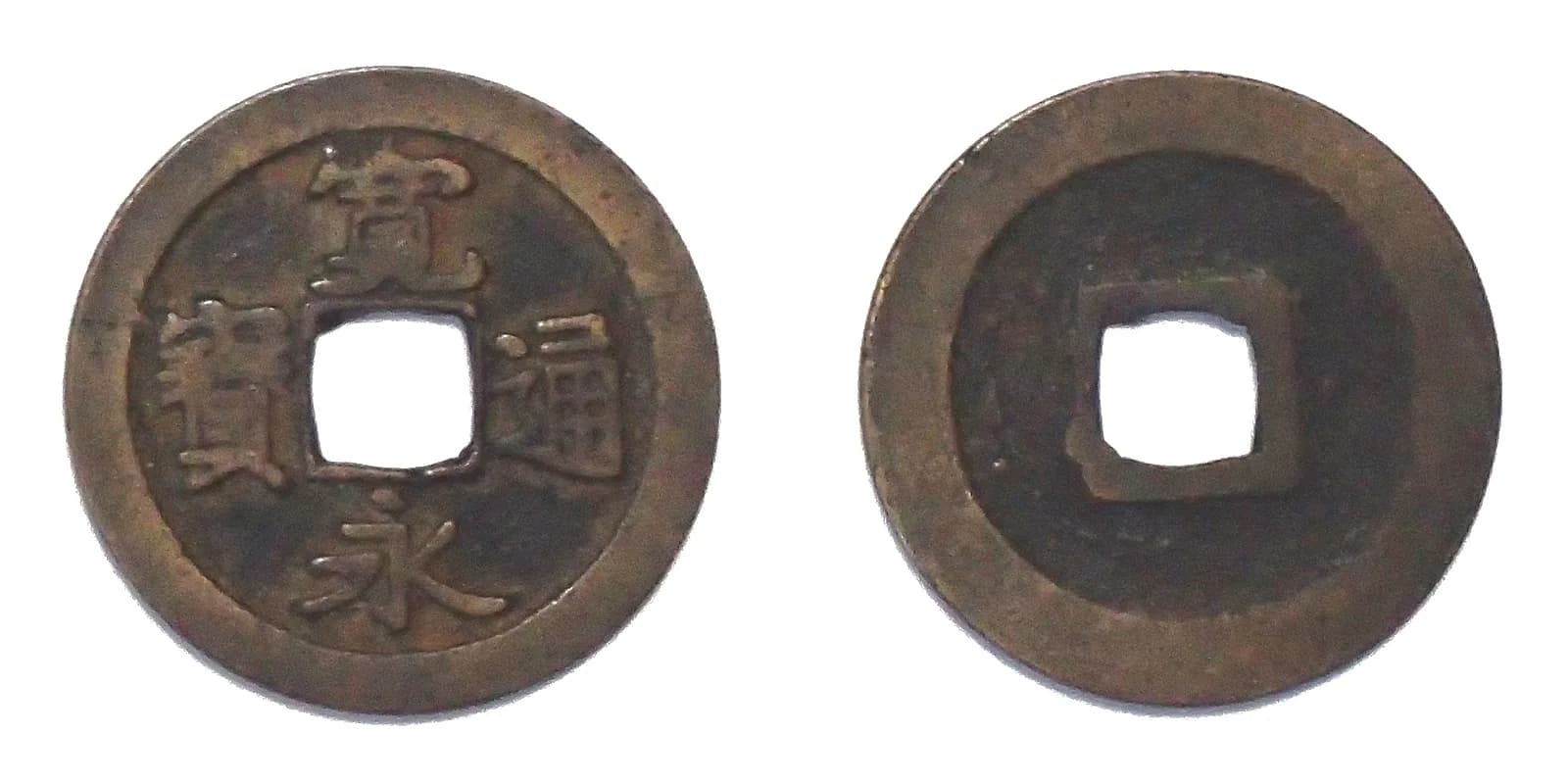
Kan'ei Tsuho coins, familiar since the Edo period, each hold hidden value that varies greatly. Why do coins that look similar have such a wide range of auction prices?
The Price Range of Kan'ei Tsuho Coins as Shown by Auction Records
Among the auction data collected by ITTENDO, here are 2 records where the auction price could be confirmed on the original lot page (verified on the seller's page as of October 14, 2026; auction prices do not include fees, from Auction World):
- ¥625,000 — 2026-03-20, Auction World, Shin-Kaneisen Maboroshiashi Kanbosen 25.6mm
- ¥330,000 — 2026-07-20, Auction World, Japan Shin-Kaneisen (described by the seller as Shimayabun, 25.4mm)
As these 2 records show, even within "Kan'ei Tsuho", the price changes drastically between ordinary circulation coins and mother coins or rare scripts. Individual prices are noted on the original lot pages. As records verified in ITTENDO's reconciliation ledger are still insufficient, the overall market level of Kan'ei Tsuho (case numbers or medians) is not indicated in this article. Market records can be confirmed via Auction History.
Diversity of Kan'ei Tsuho and the Basics of Value
Kan'ei Tsuho, widely circulated as copper coins during the Edo period, are said to exist in several hundred to several thousand types. Although they may all look the same at a glance, each one holds a different historical background, contributing to its value. The basic elements to understand the value of old coins are "type", "condition", and "rarity". These overlap to create differences in auction prices.
[For Beginners] What Determines Value? Why Coins That Look the Same Have Different Value
The value of Kan'ei Tsuho is significantly affected by its "type". Since they were minted across the nation, different scripts and minting technologies are observed per minting location. For example, there are many variations, such as Edo's "Shibasen", Mito's "Mitosen", and "Nagasaki Trade Coins" minted in Nagasaki for trade. Since each type varies in the number of coins minted and extant, rarity differs greatly.
Even within the same type, the "condition" of the coin is a crucial determinant of its value. Coins with minimal wear, legible inscriptions, little rust, and conditions close to the mint state are of higher grades. Grading by expert organizations objectively evaluates this condition, with the grade affecting price significantly. The standard and interpretation of grading are detailed in Old Coin Grading Guidelines and Reading.
Finally, "rarity" is an indispensable factor. Coins minted for a short period at specific locations or with particular scripts are considered to have few existing samples. Even if similar in appearance, minor differences can define a coin's rarity, leading to varied auction prices. This diversity and depth add tremendous allure to collecting Kan'ei Tsuho.
Mother Coins, Child Coins, and the Depth of Variations
To deeply understand the value of Kan'ei Tsuho, it's essential to consider the minting process. Particularly, the difference between "mother coins" and "child coins" is vital in discussing rarity. Mother coins are the "prototype" coins used when creating molds for coins meant for circulation (child coins). Since many molds are created from a single mother coin, which then give birth to countless child coins, mother coins are extremely rare and more valuable than child coins.
Mother coins are characterized by precision, with clear inscriptions and engravings. As shown in the auction records above, mother coins can be auctioned at different price tiers than child coins of the same type. Mother coins are precious materials for studying the history and manufacturing techniques of old coins. If you have a Kan'ei Tsuho in extremely good condition with unusually clear inscriptions, the possibility of it being a mother coin should be considered.
Kan'ei Tsuho exhibits numerous variations not only by minting location or era but also through differences in script, known as "ban". For example, within main classifications like "Asakusasen", "Mitosen", "Sendaissen", further classifications are made like "Long Frame", "Short Frame", "Leaning Ei", "Jumping Ei", based on the shape and arrangement of characters or the thickness of the coin's rim. Some of these variations were only minted during specific periods or in minimal quantities, enhancing their rarity.
Distinguishing these subtle differences requires specialized knowledge and experience. The method for identifying such variations is explained in detail in Types of Kan'ei Tsuho and How to Distinguish Them. Beginners might be confused by these subtle differences at first, but by observing each piece carefully and understanding their characteristics, one can enjoy the profoundness of ancient coins even more. The depth of these variations is one reason Kan'ei Tsuho collecting never becomes dull.
Perspectives When Reading Auction Records and Charts
Old coin market charts are valuable tools for visually capturing past transaction histories. However, instead of taking the numbers and graph movements at face value, critical viewpoints are essential for analysis. Knowing the meaning of the numbers helps in understanding them without getting swayed by individual high-priced sales.
First, while observing price trends, it is critically important to base interpretations on the "median". Charts also display maximum and minimum prices, but these can fluctuate significantly due to temporary factors or special transactions. The median, on the other hand, represents the middle value of transaction data over a certain period, less affected by individual high-priced sales, making it useful for gauging the value level of these coins. Avoid getting misled by individual high-priced sales and focus on grasping overall trends.
Next, always verify the "number of transactions". If the number of transactions for a brand is extremely low, a single high-priced sale may appear as a "dot" on the graph, giving the misconception of a sudden surge in that coin's market. Such situations are referred to as "thin trading" and may not accurately reflect the overall market trend. The numbers for brands with low transactions should be understood as being easily swayed by a single sale.
When looking at market charts, "grade-wise analysis" is imperative. Even for the same Kan'ei Tsuho, there is a significant difference in market value between MS60 and MS65. You need to carefully compare and analyze the price bands if the chart aggregates data from multiple grades, or just a specific grade band. ITTENDO's chart features allow filtering data by grades, so take advantage of this feature. By separating grades, you can read the price range within the same type.
Common Pitfalls Beginners Might Face in Collecting Kan'ei Tsuho
Collecting Kan'ei Tsuho attracts many people due to its depth and historical allure, yet there are common pitfalls that beginners lacking knowledge or experience may easily fall into. Being aware of these pitfalls beforehand forms a foundation for correctly evaluating coins.
The first mistake is "judging based solely on appearance". With so many types of Kan'ei Tsuho, distinguishing them can be difficult for amateurs. For instance, even within the so-called "Mon Coin", minor differences in minting location or script can result in significantly different values. Without expert knowledge, judging a coin as "rare" might lead to the discovery that it's actually a widely circulated common coin or a different type altogether. Before purchasing, always verify with trustworthy sources or reference books about the type, and if possible, seek expert opinion.
The second mistake is "neglecting authentication and appraisal". The authenticity and alteration status of coins should be confirmed through third-party grading and expert appraisal as a basic step. This article does not confirm the prevalence of forgeries or specific forgery methods. Approaches for verification are organized in How to Distinguish Counterfeits and Altered Coins and How to Detect Counterfeits.
Conclusion
The value of Kan'ei Tsuho is assessed by considering "type", "condition", and "rarity". Differences between mother and child coins, variations by minting location and script, contribute to a wide price range within the same coin name. When interpreting auction records, it is fundamental to verify the median and number of transactions to avoid being influenced by a single high-priced sale.
Changes in market demand, actions of overseas or affluent buyers, and future price movements are not covered in this article due to the lack of verified records that could be presented. Basic knowledge is organized in Detailed Explanation of Hole Coins (Kan'ei Tsuho and Tenpō Tsuho) and Types of Kan'ei Tsuho and How to Distinguish Them, with auction records compiled in Auction History and Market Charts.