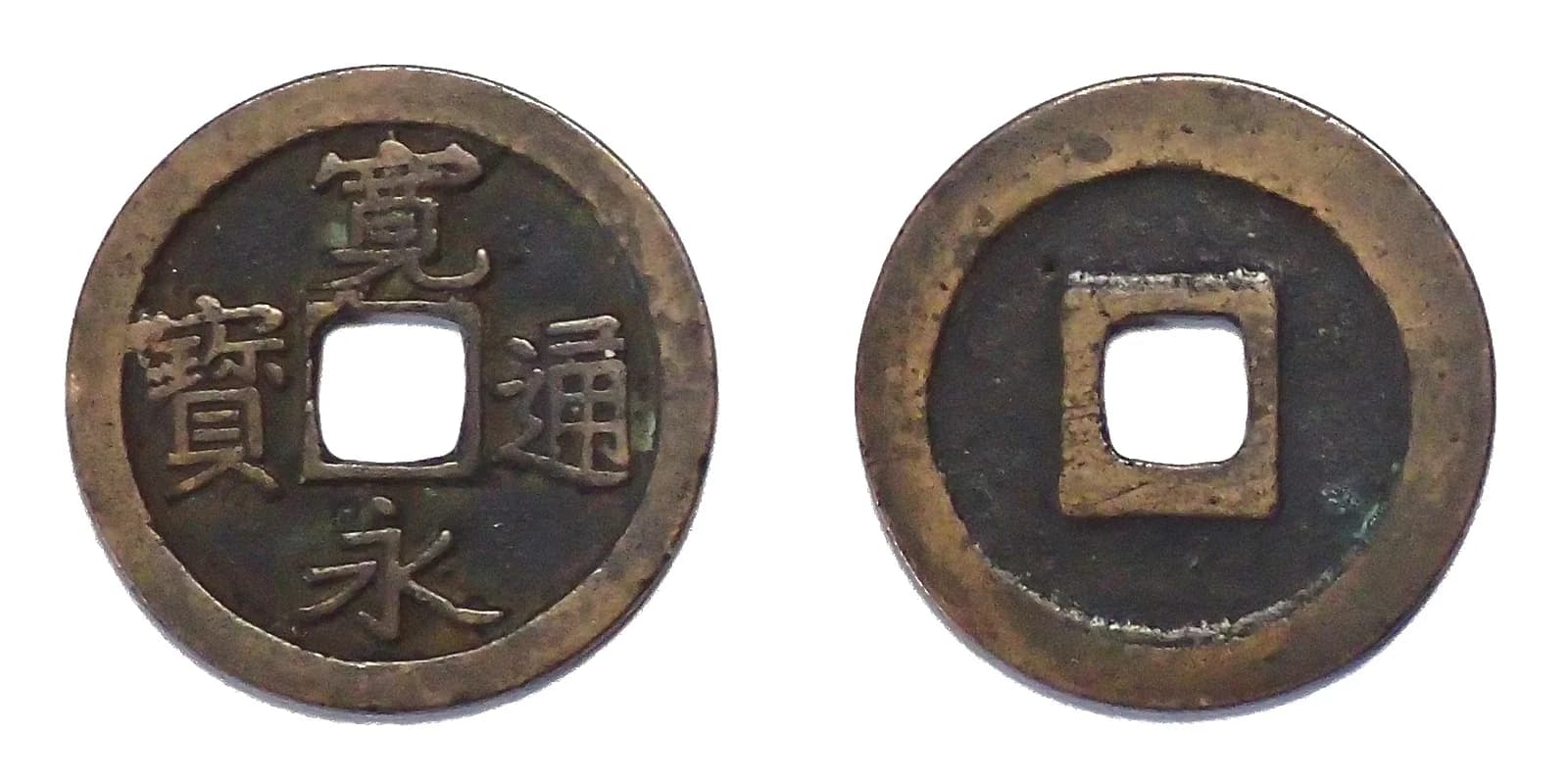
In our "Market Flash Report," we use the latest auction and flea-market transaction data as a starting point to read the current state of the Anasen market. Understanding the supply and demand behind the numbers makes it easier to avoid being swayed by price fluctuations.
What Is Anasen — Grasping the Basics of Anasen
Anasen (穴銭) are coin currencies that circulated for over two hundred years, from the minting of Kanei Tsūhō (寛永通宝) in Kanei 13 (1636) through to the early Meiji period. Because the script style, size, and metal composition differ depending on the domain that cast them and the era of production, the value varies greatly even among coins of the same name. The quickest way to understand Anasen is to first grasp this historical framework. A systematic overview of the foundational knowledge can be found at Detailed Guide to Anasen (Kanei Tsūhō and Tenpō Tsūhō).
A key perspective for understanding old coins is that currency was a product of the economics and institutions of its time. Knowing the background — who minted it, in what era, and for what purpose — transforms a single old coin from a mere piece of ancient metal into a document that reflects history. Anasen, too, carry the social circumstances of each era, and understanding that context sharpens one's ability to assess value.
If you are starting a collection, we recommend first learning the names and characteristics of representative coin types and looking at as many photographs of actual coins as possible. Familiarizing yourself with the key points to look for — such as the style and form of the script and the color of the metal — will serve as the foundation for later appraisal and market judgment.
The term "old coin" covers a wide range, from round cash coins to large-denomination currencies like koban, to modern coins and commemorative issues. Because each has its own distinct material, production method, and circulation history, it is helpful to first build a broad classification in your mind and decide where your interest lies, making it easier to chart a path of learning. Digging deeply into one field leads to a chain of understanding of related coin types and historical backgrounds, and your knowledge grows in a three-dimensional way.
Three Factors That Determine Value — Rarity, Condition, and Demand
The value of old coins is determined by three axes: "rarity," "preservation condition (grade)," and "market demand." Even among the same type, prices can diverge by several times to dozens of times depending on whether a coin is a master coin (母銭) or a circulation coin (通用銭), differences in script style, and whether the condition approaches uncirculated. Standards and How to Read Old Coin Grading is a useful reference for understanding condition assessment, and Factors That Determine the Value of Old Coins provides a detailed explanation of the overall value structure.
Rarity spikes for coin types that were produced in small quantities or where the number of surviving examples is limited. Types that were only produced for a short period, or coin types that circulated only in specific regions, are highly regarded because the opportunity for them to appear on the market is itself limited.
Preservation condition is judged by the sharpness of the characters and designs and the degree to which the surface is free of damage. Coins that circulated for a long time show advanced wear, and the crisp engraving from the time of minting is lost. The basics of grading are also organized in Basics of Old Coin Grading.
Demand is determined by the depth of the collector base paying attention to that particular coin type. Highly popular coin types have many buyers and stable prices, while less-noticed types can see prices move significantly on a single transaction.
These three factors are not independent; they influence one another. Even a rare coin type will not achieve a high evaluation if its condition is poor, and even a coin in excellent condition will be difficult to price if there is no demand for it. Conversely, a coin that combines rarity, condition, and demand is highly regarded by the market and tends to hold its value over the long term. Value judgment is nothing other than the work of comprehensively reading the balance of these three axes.
For beginners, the quickest path is to first develop an eye for assessing condition. Rarity and demand become apparent through the accumulation of knowledge and experience, but the ability to judge whether condition is good or poor can be developed relatively quickly by looking at many actual coins.
It helps to think of condition assessment as having defined stages. Condition changes continuously, from coins that retain the sharpness from the time of minting to those that show advanced wear from circulation. Because prices change in a stepwise fashion depending on where on that spectrum a coin falls, determining which stage a coin in your hand occupies is the key to buying and selling at an appropriate level.
How to Read the Market — Distinguishing the Median from Thin Trading
Most recently, "Old Coin Collection Including Tenpō Tsūhō (天保通宝) No. 14" sold on Mercari for ¥7,980 (2026-07-01). Judging the entire market from this single transaction alone would be premature, but it does serve as a clue for gauging the current transaction level for Anasen.
When looking at price trends, the basic approach is to use the median rather than the average as your benchmark. For coin types with few transactions, the entire market price tends to be pulled by a single high-value sale — a condition commonly known as "thin trading." Make sure to distinguish between times when actual demand has emerged and movements where only a single isolated data point has appeared. The latest price movements can be checked at Check Price Trends on the Market Chart, and the overall level of heat across categories can be checked at See Market Temperature by Category Heatmap.
It is also important not to confuse listed prices with transaction prices. An asking price at the time of listing is merely the seller's intention; it is the price at which a transaction actually concluded that speaks to the market. By gathering multiple concluded transaction examples and looking at the degree to which prices are scattered, you can judge whether there is thick or thin trading for that coin type. Past auction records can be checked at View Auction Record Data in a List.
Another thing to keep in mind when reading the market is the difference in the venue where the transaction took place. Prices and the type of buyers differ between specialist dealers' storefronts, online auctions, and flea-market apps. Since prices for the same coin type can vary by venue, building a sense of the market by looking across multiple channels prevents you from being led astray by overpricing or underpricing formed in a single venue.
It is important to read numbers calmly, but also including their background. When a hammer price is high, having the perspective to determine whether that reflects the coin type's intrinsic value or whether it was due to incidental factors such as the timing of the listing or the presence or absence of competing bidders improves the accuracy of market judgment.
There is also room to be creative about the time frame you use. Looking at only the most recent few transactions makes it easy to be pulled along by temporary overheating or cooling, so the prudent approach is to look at concluded transaction trends over a span of six months to several years, viewing long-term trends and short-term fluctuations separately. It is also worth paying attention to seasonal factors: during periods when more items are listed, options expand and prices tend to settle, while during periods when listings are sparse, buying tends to concentrate on high-quality examples. Knowing the cycles of supply and demand allows you to choose opportunities with good conditions without rushing.
Structural Background of the Market — How Supply and Demand Are Determined
The Anasen market is shaped by the balance of supply and demand. Because old coins are never newly produced, supply is limited to existing specimens. High-condition examples gradually leave the market over time, and rarity tends to increase as the years pass.
On the demand side, fluctuations occur due to external factors such as shifts in the popularity of collecting, media coverage, and advances in research. When attention focuses on a particular coin type, the number of buyers increases and the market tightens; when interest wanes, trading thins out and prices settle. Understanding these waves of supply and demand makes it easier to avoid being swayed by price fluctuations. The concept of market cycles is also organized in Understanding Old Coin Market Cycles.
The market contains both widely available common pieces and rare items whose very appearance for sale is infrequent. Common pieces have stable prices and are suited to beginners, while rare pieces attract competition from multiple collectors each time they appear. Determining which nature applies to the coin type you are looking at is the starting point for sound buying and selling.
The characteristic that supply decreases in one direction creates a market structure unique to old coins. High-condition examples gradually disappear through handling and the passage of time, and no new pristine specimens are ever created. This one-way increase in rarity underpins long-term value and is also one of the reasons why collecting takes on an aspect of historical preservation rather than mere consumption.
It is also worth keeping an eye on external factors that move supply and demand. Events such as exhibitions, news coverage, publication of research findings, and the release of related books can temporarily push up interest in specific coin types. Markets that overheat due to a surge in attention often return to their previous levels once interest settles, so a cool-headedness that avoids buying at peak prices during a wave of popularity is required.
Practical Appraisal — How to Assess Condition and Authenticity
In the practical work of evaluating old coins, the first step is to check the script style of the characters and designs, then to measure the diameter and weight (量目, ryōmoku) and compare them against standard values. Finally, you assess the degree of surface damage and any post-production alteration to determine how well the coin's original minted form has been preserved. Keeping a record of measurements provides a measuring stick when comparing with other examples, improving the reproducibility of judgments.
Authenticity verification requires greater care the higher the value of the coin type. Because sophisticated fakes and examples whose condition has been altered can be mixed into the market, judgment is made by combining weight, diameter, and details of the script. The key points for identification are summarized in How to Identify Fakes and Altered Coins.
If you are not confident in your own assessment, there is also the option of using evaluation by a third-party grading organization. Because the condition of a graded example is guaranteed, it reduces the burden of judgment for both buyer and seller.
The basics of observation involve examining fine details with a loupe in a well-lit environment. You look carefully at how much of the character ridges remain and whether there are any unnatural abrasion marks or signs of repair on the surface. Observing not just the obverse but also the reverse and the edge (rim) provides clues about the production method and series, increasing the accuracy of judgment.
The more sophisticated a forgery or alteration is, the harder it is to detect from any single observation. Comparing multiple viewpoints — weight, dimensions, script style, and surface — and maintaining a cautious stance if any one of them retains a sense of unnaturalness will prevent losses before they occur. For high-value items where you are uncertain, it is wise to borrow the eyes of an expert rather than forcing a self-assessment.
Having measuring tools on hand raises the accuracy of appraisal by a level. Measure the diameter and thickness with calipers, confirm the weight with a precision scale, and compare those figures against the specified values for each coin type. By combining the qualitative clue of script style with the quantitative backing of dimensions and weight, you become able to make judgments about series or authenticity that cannot be narrowed down by appearance alone, with a solid basis for doing so.
Storage and the Approach to Long-Term Holding
The condition of old coins is greatly affected by the storage environment. Humidity and oxidation are the greatest enemies of metal, and copper and silver coins in particular undergo discoloration and corrosion in high-humidity environments. The basics of preserving condition are to store coins individually in a dry location using neutral storage materials.
If you are holding for the long term, the approach that tends to be rewarded is to avoid being tossed about by short-term price movements, and instead preserve condition while waiting for periods of rising demand. In the short term, prices in thin trading markets move up and down, but over the long term they converge on the essential values of rarity and preservation condition.
Keeping records of acquisitions also supports long-term holding. If you keep a note of when, in what condition, and at what price level you acquired an item, you can track the average acquisition cost across your entire collection and which coin types are missing from it, and it also serves as documentation at the time of sale.
It is also worth paying careful attention to the choice of storage materials. Soft cases made of polyvinyl chloride can damage metal surfaces through plasticizers, so choose materials that are neutral and free of sulfur. Storing coins in a place with little variation in temperature and humidity, and not touching them unnecessarily with bare hands, are the basics of preserving condition over the long term.
What ultimately supports long-term holding is the accumulation of knowledge and records. By continuing to learn the background of each coin type and leaving records of how you acquired items and their condition, you can develop your entire collection in a planned way. The more seriously you engage, the sharper your eye becomes and the higher the probability of encountering a truly valuable coin.
Relationship to the International Market
Japanese old coins attract interest not only domestically but also from overseas collectors. In recent years, there have been increasing cases of overseas buyers entering the Japanese old coin market through cross-border e-commerce and online auctions. High-condition examples and coin types with beautiful designs tend to be well regarded internationally as well.
However, the evaluation framework of overseas markets tends to rely heavily on grades from third-party grading organizations, and the emphasis differs from the domestically detailed classification-focused evaluation. Depending on the coin type, the domestic market, which shares a culture of detailed classification, may reflect value more appropriately, and the method of authentication required differs depending on whether you choose to sell domestically or overseas.
The growth of international interest also stimulates domestic research and collecting. Attention from overseas prompts a reappraisal of the cultural depth of coin types, and this two-way exchange makes the evaluation of the overall market more multidimensional.
If you are considering transactions with overseas parties, extra care is required regarding authentication of condition and packaging. Because buyers have difficulty directly examining actual coins, a grading organization's grade and photographs recording the condition form the foundation of trust. Packaging that protects against changes in temperature and humidity and impacts during shipping is also essential for preserving condition upon arrival.
Japanese old coins are situated within the broader context of East Asian monetary history. Being aware of the connections to currencies of China and Korea reveals the flow of history beyond the framework of a single country. This broad perspective not only deepens the enjoyment of collecting but also helps in viewing the value of coin types from multiple angles.
Mistakes Beginners Tend to Make
Common mistakes are three: judging by appearance alone, taking authenticity verification lightly, and venturing into high-value items right from the start. Particularly with expensive items, sophisticated fakes and altered coins tend to circulate, making measurement of weight and diameter and detailed checking of script style indispensable.
Another pitfall is mistaking listed prices for market prices. If you estimate the market too high based only on the asking price at listing, it leads to overpaying. The habit of confirming price levels with multiple concluded transaction data points supports sound judgment.
Polishing coins to improve their appearance is also something to avoid. Because old coins are evaluated for their original surface and settled coloring in their natural state, forcibly polishing them causes the information on the surface to be lost, which actually reduces their value. Keeping them as they are without intervention is ultimately the choice that protects their value.
Rushing into buying and selling is itself prone to becoming a source of mistakes. Good examples will always come around if you wait, and simply avoiding periods when the market is overheated can significantly change the acquisition price. Rather than trying to amass many items at once, the approach of patiently building up one satisfying coin at a time cultivates a collection with greater long-term satisfaction.
Another point to keep in mind is not to rely too heavily on a single source of information. Words such as "rare" or "precious find" in listing titles are the seller's subjective opinion; it is the condition of the actual coin and multiple concluded transaction data that speak to the true value. Building the habit of judging by facts rather than words allows you to avoid being misled by inflated evaluations and continue on a steady path.
Carelessness in storage and handling is also a pitfall beginners tend to fall into. Carelessly storing coins in inexpensive storage materials and causing discoloration or corrosion, or touching them with bare hands and damaging the surface, means you yourself diminish the value of a coin you carefully selected. Being as conscious of protecting your coins as you are of acquiring them is what supports a collection you can enjoy over the long term.
ITTENDO's Conclusion
For beginners, the prudent approach is to start in zones where there are many transactions and a thick body of price data. After understanding the impact that differences in grade and script style have on prices, maintaining a stance of waiting until multiple data points are available prevents failures with thinly traded coin types. With Anasen as well, what matters most is to avoid rushing, compare multiple transaction data points, and gradually build your own framework for judgment.
Old coin collecting is a hobby that becomes more interesting the deeper your knowledge grows. The process of collecting while reflecting on the era, institutions, and lives of the people behind a single coin brings a richness that cannot be experienced from market numbers alone. By using Anasen as your entry point and gradually broadening your understanding of value assessment and history, collecting will eventually bear fruit as a genuine eye for discernment.
At ITTENDO, we make it possible to track the "present" of old coins based on past auction records and market charts.
To Learn More About Anasen
Old coin collecting is a hobby that traces the history of currency from the Edo period through Meiji, Taisho, and Showa in the palm of your hand. In the short term, prices in thin trading markets move up and down, but over the long term they converge on the essential values of rarity and preservation condition. Above all else, what matters is to avoid rushing, compare multiple transaction data points, and gradually build your own framework for judgment.
A single old coin has the economics and institutions of the era in which it was minted inscribed upon it. By collecting while learning the background of each coin type, collecting becomes a dialogue with history that transcends mere accumulation. The accumulation of knowledge connects directly to the power to perceive value.
When reading market figures, what is important is to focus not on isolated high or low prices but on the overall trend drawn by multiple concluded transactions. Coin types with thick trading have stable prices, while thinly traded coin types move significantly on a single transaction. Cultivating an eye that can distinguish between these two is the foundation of sound buying and selling.