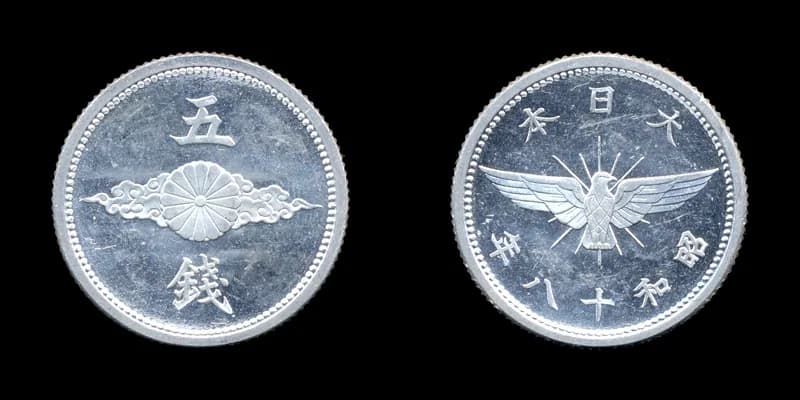
In "Today's Coin Spotlight," we pick up one item from the coin encyclopedia and clearly explain how to read its market price and value. Today we cover "Nagasaki Bōeki-sen (長崎貿易銭)," a representative trade currency. Nagasaki Bōeki-sen are historical documents that tell the story of the international economy of the Edo period, and systematic collecting combines scholarly value with market recognition.
What Are Nagasaki Trade Coins? — Grasping the Basics of Trade Currency
Trade currencies can vary enormously in value depending on period, place of casting, and production method, even when they share the same name. The quickest way to understand Nagasaki Bōeki-sen is to first grasp the historical framework of the era. Foundational knowledge can be reviewed systematically in the Detailed Overview of Hole Coins (Kanei Tsūhō · Tenpō Tsūhō).
The most important perspective when understanding old coins is that coinage was a product of the economics and institutions of its time. Knowing who minted a coin, in what era, and for what purpose transforms a single old coin from a mere piece of ancient metal into a document that reflects history. Trade currencies, too, carry the social circumstances of their respective eras, and understanding that context sharpens the accuracy of value judgments.
If you are just starting a collection, we recommend first learning the names and characteristics of representative coins, then looking at a large number of photographs of actual pieces. Getting a firm grasp of the basic points of interest — the style of the characters, the shape, and the color of the metal — will form the foundation for later authentication and market assessment.
The range covered by the term "old coins" (kosen) is broad, encompassing round copper cash, large-format coins such as koban, modern coinage, and commemorative coins. Because each has a different material, production method, and circulation history, it helps to first build a broad classification in your mind and decide where your own interest lies — that makes it easier to chart a course of study. When you dig deeply into one area, related coins and historical backgrounds become understood in a cascading fashion, and your knowledge develops in three dimensions.
Three Factors That Determine Value — Rarity, Condition, and Demand
The value of an old coin is determined by three axes: "rarity," "preservation condition (grade)," and "market demand." Even among coins of the same type, prices can diverge by several times to several tens of times depending on whether a coin is a mother coin (bosen) or a circulation coin, differences in character style, and whether condition approaches uncirculated. The thinking behind condition assessment is covered in Standards and How to Read Old Coin Grading, and the full picture of the value structure is explained in detail in Factors That Determine the Value of Old Coins.
Rarity shoots up for coins with low mintage or limited surviving numbers. Types that were only produced for a short period, or coins that circulated only in specific regions, have inherently limited opportunities to appear on the market, which drives up their evaluation.
Preservation condition is judged by the sharpness of the characters and design, and by how little damage the surface has sustained. Pieces that circulated for a long time show advanced wear, and the crisp original engraving is lost. The basics of grading are also organized in Fundamentals of Old Coin Grading.
Demand is determined by the depth of the collector base paying attention to a given coin. Popular coins have many buyers and a stable market, while coins with low visibility can see prices move sharply on a single transaction.
These three factors are not independent; they influence one another. Even a rare coin will not see its evaluation rise if the condition is poor, and even a well-preserved coin will struggle to find a price if there is no demand. Conversely, a piece where all three — rarity, condition, and demand — align is highly valued by the market and holds its value over the long term. Making a value judgment is nothing other than the work of reading the balance of these three axes in totality.
For beginners, the most direct path is to first learn how to assess condition. Rarity and demand become visible with accumulated knowledge and experience, but the ability to judge condition good or poor can be developed relatively quickly by looking at many actual pieces.
It helps to think of condition assessment as having certain distinct stages. From pieces that retain the crispness of the moment of minting to pieces showing advanced wear from circulation, condition changes continuously. Because prices shift in steps depending on which stage a piece occupies, identifying where the piece you are holding falls within those stages leads to buying and selling at an appropriate level.
How to Read the Market — Distinguishing the Median from Thin Trading
Nagasaki Bōeki-sen is a general term for copper coins that were exported overseas from Nagasaki, the only port open to foreign trade under the Edo period's sakoku (closed-country) system. From the Kan'ei era (1624–1644) onward, they were minted specifically for use in trade settlement, particularly with China and Southeast Asia. Within Japan, gold and silver coins were the primary currency, but in trade, copper coins played a crucial role. This special positioning is deeply connected to the economic policy of Japan at the time.
From the 17th century through the 18th century, it is estimated that tens of millions of coins flowed overseas annually, with the cumulative total believed to have reached hundreds of millions of coins. These copper coins circulated across a wide region of Asia backed by Japan's economic strength. Behind this lay the shogunate's policy of suppressing the outflow of gold and silver overseas, using the export of copper coins to adjust the trade balance. Understanding this historical background is [Introduction to Edo Gold Coins (Koban · Oban)]
When examining price trends, the standard approach is to use the median rather than the average as a benchmark. For coins with few transactions, the overall market tends to be pulled upward by a single high-price sale — a condition known as "thin trading" (usuyomiai). Distinguish between moments when genuine demand has emerged and movements that amount to a single isolated data point. The latest price movements can be confirmed in Check Price Trends on the Market Chart, and the overall heat level by category can be viewed in Check Market Temperature with the Category-by-Category Heatmap.
It is also important not to confuse listed prices with transaction prices. The asking price at time of listing is purely the seller's intention; the price at which a sale actually closes is what speaks to the market. Gathering multiple completed sale examples and examining the spread of prices makes it possible to judge whether a given coin has a thick or thin market. Past auction records can be confirmed at View Auction Hammer-Price Data in List Form.
Another thing to keep in mind when reading the market is the difference between venues where transactions take place. Specialist dealers' shops, online auctions, and flea-market apps each have different pricing dynamics and buyer profiles. Because the price level for the same coin can differ by venue, building a market sense by looking across multiple channels prevents you from being dragged into overpricing or underpricing formed in a single venue.
It is important to read numbers coolly, but with the full background in mind. When a hammer price is high, having the perspective to separate whether that reflects the intrinsic value of the coin versus incidental factors — such as the timing of the listing or the presence or absence of competing bidders — raises the accuracy of market judgment.
There is also room for refinement in how you set the time frame. Looking only at the most recent handful of transactions makes you susceptible to temporary overheating or cooling, so the sound approach is to look at completed-sale trends over a span of six months to several years, distinguishing long-term trends from short-term fluctuations. Seasonal factors are also worth watching: during periods when listings increase, choices are broader and prices tend to settle; during periods when listings thin out, buying concentrates on quality pieces. Knowing the cycle of supply and demand lets you wait and choose opportunities with favorable conditions rather than rushing.
The Structural Background of the Market — How Supply and Demand Are Determined
The market for trade currencies is shaped by the balance of supply and demand. Because old coins are no longer newly produced, supply is limited to surviving pieces. Well-preserved pieces retire from the market over time, and rarity tends to increase as the years pass.
On the demand side, fluctuations occur due to external factors such as shifts in collecting popularity, media coverage, and advances in research. When attention focuses on a particular coin, buyers increase and the market tightens; when interest wanes, trading thins and prices settle. Understanding these waves of supply and demand makes it harder to be buffeted by price swings. The thinking behind market cycle patterns is also organized in Understanding Old Coin Market Cycles.
The market contains both widely available common pieces and rare pieces whose very listing is uncommon. Common pieces have stable prices and are suitable for beginners; rare pieces see multiple collectors competing each time one appears. Identifying which of these two natures the coin you are looking at belongs to is the starting point for sound buying and selling.
The one-directional nature of supply — that it only decreases — creates a market structure unique to old coins. Well-preserved pieces gradually disappear through handling and the passage of time, and no new perfect specimens are ever produced. This one-way increase in rarity provides a long-term floor under value and is also the reason why collecting carries an aspect of historical preservation rather than mere consumption.
It is also worth keeping an eye on external factors that move supply and demand. Events such as exhibitions, news coverage, publication of research findings, and the release of related books can temporarily push interest in specific coins higher. Markets that have overheated in the wake of a surge in attention often return to their prior levels once interest subsides, so the coolheadedness to avoid paying peak prices during a trend is called for.
The Practice of Authentication — How to Assess Condition and Authenticity
In the practical work of evaluating old coins, the first step is to examine the character style of the text and design, then measure the diameter and weight (ryōme) and compare them against prescribed values. Finally, assess surface damage and any signs of post-minting modification to determine how well the piece retains its appearance as cast. Recording measurements allows them to serve as a yardstick when comparing with other pieces, increasing the reproducibility of judgments.
Authenticity verification demands greater care the higher-value a coin is. Because sophisticated reproductions and pieces with altered condition can be mixed into the market, judgment must integrate weight, diameter, and fine details of character style. Key points for identification are summarized in How to Spot Fakes and Altered Pieces.
When your own eye is not enough, there is also the option of using evaluation by a third-party authentication organization. Because graded pieces come with a guarantee of condition, the burden of judgment is reduced for both buyer and seller.
The fundamental approach to observation is to use a loupe in a well-lit environment and examine every detail. Look carefully at how much of the character ridges remains and whether there are any unnatural abrasion marks or traces of repair on the surface. Observing not just the obverse but also the reverse and the edge provides clues about production method and lineage, raising the reliability of your judgment.
The more sophisticated the forgery or alteration, the harder it is to detect from any single observation point. Cross-referencing multiple perspectives — weight, dimensions, character style, and surface — and treating anything that retains even one element of unnaturalness with caution is the stance that prevents losses before they occur. For high-value pieces where you are uncertain, it is wise to borrow the eyes of a specialist rather than forcing a self-assessment.
Having measuring tools on hand raises the precision of authentication by a level. Measure diameter and thickness with calipers, verify weight with a precision scale, and cross-check those values against the standards for each coin type. Combining qualitative clues such as character style with quantitative backing such as dimensions and weight allows you to determine the lineage or authenticity of pieces that cannot be narrowed down by appearance alone, with grounded reasoning.
Storage and the Approach to Long-Term Holding
For old coins, condition is greatly affected by the storage environment. Moisture and oxidation are the greatest enemies of metal, and copper and silver coins in particular suffer discoloration and corrosion in high-humidity environments. The basic practice for maintaining condition is to store each piece individually in a dry location using neutral storage materials.
For long-term holding, a patient stance — not fretting over short-term price movements but waiting for condition to remain intact and for periods of rising demand — tends to be rewarded. In the short term, thin-market prices move up and down, but over the long term they converge on the fundamental value of rarity and preservation condition.
Keeping records of acquisitions also supports long-term holding. Noting when, in what condition, and at what price level you acquired each piece lets you track the average acquisition cost across your entire collection and identify which coins are missing, and also serves as explanatory material at the time of sale.
Choosing storage materials also deserves attention. Soft cases made of polyvinyl chloride can damage metal surfaces through plasticizers, so choose materials that are neutral and free of sulfur content. Keeping pieces in a place with minimal changes in temperature and humidity, and avoiding unnecessary handling with bare hands, are the basics for protecting condition over the long term.
What ultimately supports long-term holding is the accumulation of knowledge and records. By continuing to study the background of each coin type and keeping records of acquisition circumstances and condition, you can develop your collection in a planned way. The more steadily you engage, the sharper your eye becomes, and the higher the probability of encountering a truly valuable piece.
Relationship with International Markets
Japanese old coins attract interest not only domestically but also from collectors overseas. In recent years, there has been a growing number of cases in which overseas buyers enter the Japanese old coin market through cross-border e-commerce and online auctions. Well-preserved pieces and coins with beautiful designs tend to be valued internationally as well.
However, the evaluation standard in overseas markets often leans on grades from third-party authentication organizations, and the emphasis differs from the domestic evaluation approach, which values fine-grained classification. Depending on the coin, the domestic market — which shares a classification culture — may reflect value more accurately, and whether you sell domestically or overseas changes the type of documentation required.
The growing international interest also stimulates domestic research and collecting. Overseas attention prompts a re-recognition of the cultural depth of certain coins, and the two-way exchange makes the overall market evaluation more three-dimensional.
If you are considering overseas transactions, extra care is required in documenting condition and in packaging. Because buyers cannot easily inspect the piece in person, authentication organization grades and photographs documenting condition form the foundation of trust. Packaging that protects against changes in temperature and humidity during transport and against impact is also essential for maintaining condition upon arrival.
Japanese old coins are positioned within the larger context of East Asian monetary history. Keeping in mind the connections with the coinage of China and Korea reveals a flow of history that transcends the framework of a single nation. This broad perspective not only deepens the enjoyment of collecting but also helps in viewing the value of individual coins from multiple angles.
Mistakes Beginners Often Make
The three most common mistakes are: judging by appearance alone, taking authenticity verification lightly, and jumping straight into the high-price bracket. In particular, the higher the value of a piece, the more sophisticated the fakes and altered pieces that circulate, making it indispensable to measure weight and diameter and to check the fine details of character style.
Another pitfall is confusing listed prices with market prices. If you look only at sellers' asking prices and overestimate the market level, you end up acquiring at inflated prices. The habit of verifying the level against multiple data points on a completed-sale basis supports sound judgment.
Polishing a piece to improve its appearance is also an action to avoid. Old coins are evaluated precisely for their original surface and their settled, natural coloration, so forcing a polish destroys surface information and actually lowers value. Leaving a piece as-is without intervention is ultimately the choice that protects its value.
Rushing into transactions itself is also a frequent source of mistakes. Good pieces will always come around if you wait, and simply avoiding periods when the market is overheated can make an enormous difference in acquisition cost. Rather than trying to assemble a large collection at once, the approach of building it one satisfying piece at a time produces a collection with high long-term satisfaction.
Avoiding over-reliance on a single source of information is also something to keep in mind. Words like "rare" or "unusual find" in listing titles are the seller's subjective assessment; the actual value is conveyed by the condition of the physical piece and multiple completed-sale data points. Cultivating the habit of judging by facts rather than words allows you to avoid being misled by inflated evaluations and to continue on a sound path.
Carelessness in storage and handling is another pitfall beginners often fall into. Tossing a piece haphazardly into an inexpensive container and causing discoloration or corrosion, or touching the surface with bare hands and scratching it, means damaging the value of a piece you took such care to select. Keeping as much awareness on protecting a piece as on acquiring it is what supports a collection you can enjoy for many years.
ITTENDO's Conclusion
For beginners, the sound entry point is the zone with many transactions and a thick body of price data. Once you understand the impact that differences in grade and character style have on price, a stance of waiting until multiple data points are available prevents mistakes with thin-market coins. With Nagasaki Bōeki-sen as well, what matters most is not to rush but to compare multiple transaction data points and steadily develop your own judgment framework.
Old coin collecting is a hobby whose interest deepens the more knowledge you accumulate. The process of collecting while imagining the era, the institutions, and the lives of the people behind a single coin brings a richness that cannot be tasted from market numbers alone. Using trade currency as your entry point and gradually broadening your understanding of value assessment and history will, in time, bear fruit as a genuine discerning eye.
At ITTENDO, we make it possible to track the "now" of old coins based on past auction records and market charts.