A few grams of metal can sometimes be worth as much as an entire house. Yet that gleam is not always genuine. Counterfeits quietly target your expectations — and your money.
Why High-Priced Antique Coins Attract Fakes
In the world of antique coins, the higher their value rises, the more persistently a shadow-like risk follows them. That risk is the existence of "fakes." Counterfeits exist even for coins worth tens of thousands of yen, but the risk increases dramatically for high-value pieces that trade at prices in the millions or even tens of millions of yen. So why are fakes more likely to be produced for more expensive antique coins, and why do they manage to infiltrate the market? Behind this phenomenon lies a structural set of reasons that everyone from beginners to advanced collectors needs to understand from their own perspective.
[For Beginners] The Source of Value Is "Rarity" — That Is Why Coins Are Counterfeited
The most fundamental reason is the straightforward pursuit of profit. For example, suppose a single Edo-period gold coin (koban or ōban) — detailed overview trades for ¥10,000,000. Let us say the intrinsic material value of the gold making up that koban is ¥100,000. The difference — ¥9,900,000 — is what is called "rarity value" or "historical value." If a counterfeiter can use ¥100,000 worth of gold to create the "appearance" of a ¥10,000,000 coin, they stand to make an enormous profit. The larger the gap between "material value" and "market price," the stronger the incentive to counterfeit. The reason why two coins that look identical can differ so completely in value is precisely that the market pays a premium for "the rarity that only the genuine article possesses."
[For Intermediate Collectors] Distorted Supply and Demand and Information Asymmetry Are Exploited
Market supply-and-demand imbalances also create openings for fakes to slip in. Suppose a particular antique coin — for instance, an old ¥20 gold coin bearing a portrait of Emperor Meiji (such as the Meiji 3 (1870) issue) — is featured in the media and suddenly surges in popularity. The number of people wanting to buy increases sharply while the number of people willing to sell (genuine owners) remains limited. This supply-demand imbalance drives up prices and simultaneously creates a sense of urgency in buyers who are anxious to acquire the coin quickly. Counterfeiters skillfully exploit this psychology. Even collectors who would normally examine a coin carefully may have their guard lowered in moments of excitement or fear of missing out — and those are precisely the moments that are targeted. The fewer genuine examples of a "phantom rarity" that exist, the less reference information is available, giving rise to information asymmetry. This too is a favorable condition for counterfeiters.
[For Advanced Collectors] The Flow of Money and Increasingly Sophisticated Distribution Channels
So who buys fakes, and who makes them? One hypothesis is that newly wealthy individuals whose specialized knowledge has not yet caught up with their spending power, and investors who have entered the market for asset-preservation purposes, tend to be the most vulnerable targets. They may have ample funds but lack the time to develop the "eye" needed to detect fakes. The distribution channels for counterfeits have also grown more sophisticated. While antique fairs were once the main venue, today's online auction sites with high anonymity and person-to-person transactions via social media have become fertile ground. Cases of sophisticated fakes manufactured abroad entering the market disguised as "items returning to Japan from overseas" are unceasing. Once such a fake has been traded as "genuine" in the market, that transaction record becomes a new form of certification, making it even harder to expose — a vicious cycle that perpetuates the problem.
Notable Counterfeiting Incidents That Shook the Market
The counterfeiting of antique coins is not merely rumor or theoretical possibility. There are numerous incidents that have genuinely shaken the market and sounded alarm bells for many collectors. Knowing these cases is indispensable for understanding the concrete risks posed by fakes.
In recent years, one case that attracted particular attention involved counterfeits mixed in among high-value Japanese coins consigned to a well-known overseas auction house. In the early 2020s, a Tenshō Hishi Ōban (天正菱大判) that appeared at an international auction sparked a fierce authenticity debate among specialists after it was listed. The ōban had been assigned an estimated hammer price of several hundred million yen, but detailed appraisal ultimately led to the conclusion that it was an extremely sophisticated modern fake. This incident threw into sharp relief the fact that even prestigious auction houses cannot always guarantee perfect authentication.
Domestic damage is also serious. On internet auction sites, fakes of popular modern gold and silver coins (Meiji through Shōwa era) — such as the old ¥20 gold coin and the old 1-yen silver coin — appear without end. Sellers cleverly construct stories like "clearing out my grandfather's collection" or "found in the storehouse," stoking the buyer's sense of opportunity. Items that are now difficult to distinguish from photographs alone have multiplied, and there are many cases of buyers only realizing a coin is fake after it has arrived in their hands. Among these are particularly malicious fakes that use actual gold or silver to match the correct specific gravity.
The lesson to be learned from these incidents is that the risk of fakes is ever-present, regardless of the venue or price range of a transaction. Especially in the immediate aftermath of news reports about record-breaking hammer prices, fakes tend to flood the market by riding the wave of market enthusiasm, making extra caution all the more necessary.
[By Type] Antique Coins with Especially High Counterfeiting Risk
Not all antique coins carry the same counterfeiting risk. From a counterfeiter's perspective, the targets are those where "the effort and cost are justified by the expected return." Below, we explain the representative types of antique coins for which the most counterfeits have been reported, along with their characteristics.
1. Ōban and Koban (Edo-Period Gold Coins)
Ōban and koban, owing to their iconic status and high value, have long been the foremost targets of counterfeiting. Particular care is required for well-known pieces such as the Tenshō Ōban (天正大判), the Keichō Koban (慶長小判), and the Genroku Koban (元禄小判). Because these are cast coins, they can theoretically be duplicated if a mold is available. Telltale signs of fakes include unnatural brushwork on the kakihan (花押, handwritten seal), gozame (茣蓙目, the reed-mat pattern stamped by chisel) that is either too uniform or conversely too crude, lower gold purity, or base metals such as lead coated with gold plating.
2. Old ¥20, ¥10, and ¥5 Gold Coins (Meiji Era)
These gold coins issued in the early Meiji period are representative of Japan's modern coinage and are internationally popular, consistently commanding high prices. Particularly scarce date issues (for example, the Meiji 3 (1870), Meiji 9 (1876), and Meiji 10 (1877) ¥20 gold coins) can fetch prices in the tens of millions of yen. Fakes are often cast from molds taken off genuine coins; as a result, the scales of the dragon and the fine details of the lettering tend to be soft, and the edges tend to be rounded. There are also examples with clearly visible discrepancies such as uneven reeding on the edge, or no reeding at all.
3. Trade Dollars and 1-Yen Silver Coins (Meiji Era)
Trade dollars and 1-yen silver coins (en-gin, 円銀) also have a large collector base, and many fakes circulate in this category. Because "special date" (tokunen, 特年) issues — those with scarce mintage years — command high prices, "altered coins" (henzōhin, 変造品) also exist in which the date digits of common-year coins are filed off and replaced with scarce-year dates. Sophisticated fakes manufactured in China and elsewhere (known as "China copies") have been flooding the market in large numbers; since these are made with silver content and weight brought very close to genuine coins, it is extremely difficult for beginners to distinguish them. It is important to study detailed methods by consulting the Complete Guide to Fake Detection.
4. Mother Coins (Bosen) and Trial Strike Coins of Holed Coins (Anasen)
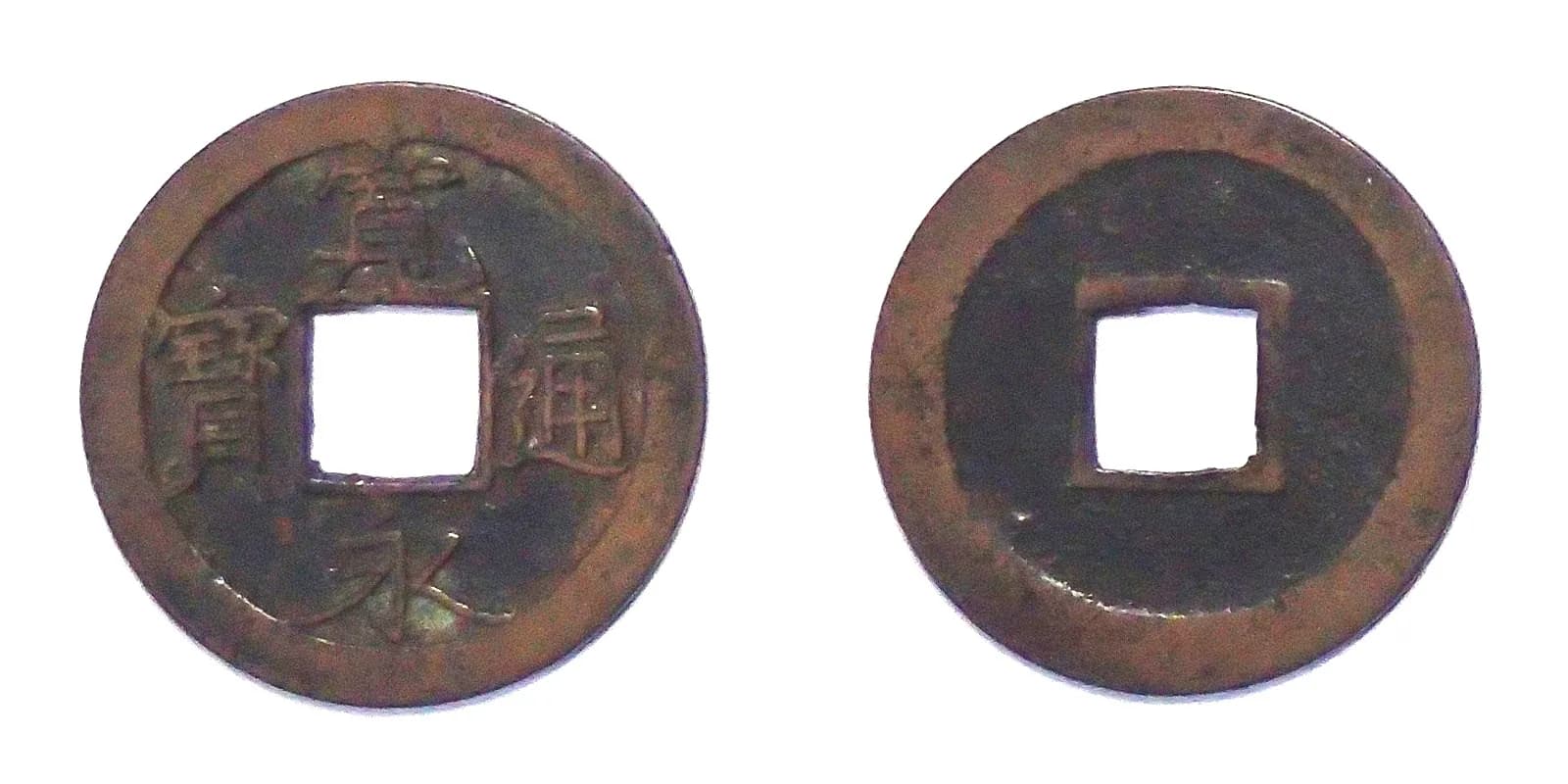
Holed coins such as the Kan'ei Tsūhō (寛永通宝) and Tenpō Tsūhō (天保通宝) that were used in daily circulation are mostly low in individual value, but "mother coins" (bosen, 母銭) and "trial strike coins" (shichūka, 試鋳貨) are in a different class entirely. Mother coins are the originals used to cast circulation coins, and because surviving examples are scarce, they trade for anywhere from several hundred thousand to several million yen. Fakes are made either by slightly reworking circulation coins to pass them off as mother coins, or by casting entirely new pieces from scratch. Key points for identification include lettering outlines that are not sharp, and unnatural casting flash (ibari, 鋳張り).
Methods of Counterfeiting: From Period Forgeries to the Latest Modern Technologies
The word "fake" covers a wide range of manufacturing techniques and backgrounds. Broadly speaking, fakes fall into two categories: "period forgeries" (jidai gansaku, 時代贋作), made at the time of the original coin's circulation for the purpose of passing as genuine currency, and "later forgeries" (kōdai gansaku, 後代贋作), made in subsequent eras for the purpose of deceiving collectors. The ones most deserving of vigilance are later forgeries that exploit modern technology.
The Evolution of Casting Technology
The traditional counterfeiting method involved pressing clay or another material against a genuine antique coin to make a mold, then pouring molten metal into it. Fakes produced by this method tended to have soft detail and frequently developed small voids called su (鬆) on the surface, making them relatively easy to identify. Today, however, precision casting techniques such as lost-wax casting are employed. This allows the production of fakes that faithfully reproduce even the finest details — the scales of a dragon or the serifs of a character.
Electroplating and Alloy Technology
The technique of using an inexpensive metal (copper, lead, tungsten, etc.) as a core and electroplating the surface with genuine gold or silver has also grown more sophisticated. Because tungsten has a specific gravity very close to that of gold, fakes made this way are virtually impossible to detect by weighing alone. Advances in alloy technology have also made it possible to mix metals in nearly the same proportions as the genuine article to produce a base material for counterfeiting; some examples can only be distinguished using specialist equipment such as a fluorescent X-ray analyzer.
3D Printers and Laser Engraving
As the latest technique, methods have appeared involving the use of a 3D scanner to capture precise digital data from a genuine antique coin and then using a 3D printer to produce a master pattern. If this master pattern is used to make a casting mold, extremely sophisticated counterfeits can be produced. Laser engraving technology also makes it possible to re-engrave worn characters after the fact, add hallmarks that never existed, and otherwise produce "altered items" and "tampered pieces" at will. These technologies are already far beyond the level of individual hobbyists, and there are indications that organized criminal enterprises may be involved.
5 Key Points for Distinguishing Genuine from Fake
How should we respond to increasingly sophisticated fakes? Specialists do not rely on any single factor; they assess authenticity by examining multiple points comprehensively. Here we introduce five basic points of focus that can be practiced by individuals. However, these are only a starting point — for a final determination, it is wise to defer to a trusted specialist or authentication body.
- Measure Weight and Size
This is the most basic and important step. Each antique coin has a specified weight and diameter. Obtain a digital scale accurate to 0.01 g and a caliper, and compare the readings against catalogue values. Bear in mind that coins may be slightly lighter than specified due to wear from years of circulation. Conversely, if a coin is clearly heavier than the specified value, the material may be different (for example, a supposed gold coin that is actually lead or brass), and the coin should be strongly suspected of being a fake. It is also important to practice the correct storage methods for antique coins to maintain accurate condition.
- Compare the Fine Details of the Design
Using a loupe (approximately 10× magnification), carefully observe the typeface of the characters (stroke endings, hooks, and sweeps), as well as the fine details of the design (dragon scales, paulownia leaf veins, etc.). Even a worn genuine coin retains a sharpness and vigor conveyed by the chisel that struck it. Fakes produced by casting, on the other hand, tend to have overall softness in the lines and rounded edges. Develop the habit of meticulously comparing fine details against photographs in reliable catalogues and databases.
- Check the Edge Treatment (Reeding)
For modern coins, the reeding (ridges on the edge) is also an important authentication point. Fakes may have reeding that is uneven in depth or spacing, or that differs in form from the genuine article. For Edo-period koban and similar coins, the shape and position of the hallmarks struck on the edge also provide clues for authentication.
- Observe Color and Luster
The color of the metal and the toning (patina) that develops over time are also hints. For example, the natural luster and pattern of wear on a genuine gold or silver coin have a unique character quite different from artificially produced imitations. Be wary of coins that are unnaturally brilliant, or conversely, of patina that looks as though it was forced on using chemicals. This assessment, however, relies heavily on experience and may be difficult for beginners to judge.
- Listen to the Sound
For silver coins, the sound produced when the coin is flicked with a finger has traditionally been used as one indicator. A genuine silver coin is said to produce a high, clear, ringing tone — a "keen" sound — that sustains for a long time. A fake containing much lead or copper produces a low, dull thud. However, this method also involves a strong subjective element and is not a reliable test on its own. It should be regarded as no more than a supplementary reference.
Reading Signs of Fakes Through Market Price Data
Beyond examining the coins themselves, market data — and specifically checking price trends on market charts — can also be useful for detecting the risk of fakes. Price movements can sometimes act as a mirror reflecting the health of the market and potential underlying problems.
The basic approach when looking at price trends is not to be swayed by peaks or troughs, but to track the movement of the "median." For rare antique coins with few transactions (thinly traded issues in particular), a single high-value sale can cause the average price to jump dramatically. If that single transaction later turns out to involve a fake or altered coin, that price is entirely meaningless as a reference. The median is less susceptible to the influence of such extreme outliers and is therefore better suited to grasping the actual trend of the market.
Issues for which transactions appear only sporadically on a chart deserve caution. These represent a situation where only isolated data points exist, and a stable market price cannot yet be said to have formed. When a high-value transaction suddenly appears under such conditions, it is necessary to carefully determine whether it reflects genuine demand, or whether it is a deliberate transaction to push up the price, or the result of a fake slipping into the market. The prudent judgment is to wait for continuous transaction data to emerge across multiple auctions.
In a healthy market, prices rise or fall gradually while being accompanied by a reasonable volume of transactions. By contrast, if an unnatural price spike occurs at a particular moment, or if prices fluctuate wildly, one should consider the possibility that some underlying problem — for example, market disruption caused by the influx of sophisticated fakes — may be at play.
3 Typical Patterns of the "Fake Trap" That Beginners Fall Into
The fake trap is something that people with less knowledge and experience are more likely to fall into. Here we introduce three typical failure patterns that many people experience. By treating these as cautionary examples, you can reduce the risk of paying a high price for an expensive lesson.
1. Being Seduced by Attractive Appearance or a Low Price
Suppose you find an antique coin listed on a flea-market app or online auction at a price clearly below market value, and in very good condition. Getting swept up in excitement and bidding immediately — telling yourself "this is a bargain!" — is a classic failure pattern. There is always a catch with something extremely cheap. It is likely either a fake or an "altered item" that has been cleaned or restored. The value of an antique coin lies in its historical background and rarity. An unnatural low price or unusually pristine condition should be understood as a warning sign rather than a cause for celebration.
2. Taking "Certificate of Guarantee" at Face Value
Words like "comes with an appraisal certificate" or "guaranteed authentic" seem reassuring at first glance. However, what matters is who is providing that guarantee. Certificates issued by the seller themselves or by an obscure dealer are, in most cases, completely meaningless. What can be trusted are certificates issued by internationally recognized third-party grading services such as PCGS or NGC. These organizations evaluate authenticity and condition according to rigorous standards and seal their assessment in a special slab holder, thereby certifying their evaluation. Understanding the standards and how to read coin grading and recognizing the value of third-party certification is an important first step in avoiding fakes.
3. Immediately Reaching for Expensive Rarities
When people begin collecting antique coins, almost everyone is at some point captivated by dreams of a "one-in-a-million find" or a "phantom masterpiece." However, it is far too reckless to reach straight for pieces priced at several million yen or more without sufficient knowledge or experience. The more expensive the coin, the more sophisticated the fakes, and even professionals may struggle to detect them. Start with modern coins that can be obtained for around ¥100,000 or less and for which the key authentication points are relatively well established, handling many genuine examples to develop your "eye." Proceeding without haste and starting with collecting that matches your own level of knowledge is, in the end, the best strategy for avoiding major mistakes.
[ITTENDO's Conclusion] A Framework for Investment Judgment to Overcome the Risk of Fakes
While the existence of fakes is the greatest risk in antique coin collecting, fearing them excessively will prevent you from experiencing the deep pleasures this hobby has to offer. What matters is correctly recognizing the risk and having a concrete framework for judgment that allows you to overcome it.
The framework ITTENDO proposes begins with a mindset: "Approach high-priced coins from the premise that fakes exist." Rather than assuming a coin is genuine, maintaining a healthy skepticism — "this might be a fake" — is what leads to cautious judgment.
Building on that, the strategy for beginners is clear. The most prudent path is to "start with modern coins priced under ¥100,000 that have high liquidity and well-established authentication criteria." Common-date issues of the Meiji-era 1-yen silver coin, for example, have high transaction volume, stable market prices, and authentication information that is widely shared in many books and websites. Gaining experience in this zone builds the foundational strength needed to take on higher-priced antique coins in the future.
If you are determined to target high-priced Edo-period gold coins such as ōban and koban, or scarce modern gold coins, then "purchasing from a trusted coin dealer" and "the coin being already certified by a third-party grading service such as PCGS or NGC" should be your minimum requirements. Purchasing through person-to-person transactions or from online auctions of uncertain reliability should be avoided, at least until you have acquired sufficient knowledge. Certified coins may feel expensive, but their price includes the extremely important value of a "guarantee of authenticity."
At ITTENDO, we make it possible to track the "current state" of antique coins based on past auction records and market price charts.