The Value of Tenpo Tsuho Cannot Be Judged by Appearance: Market Trends and Background
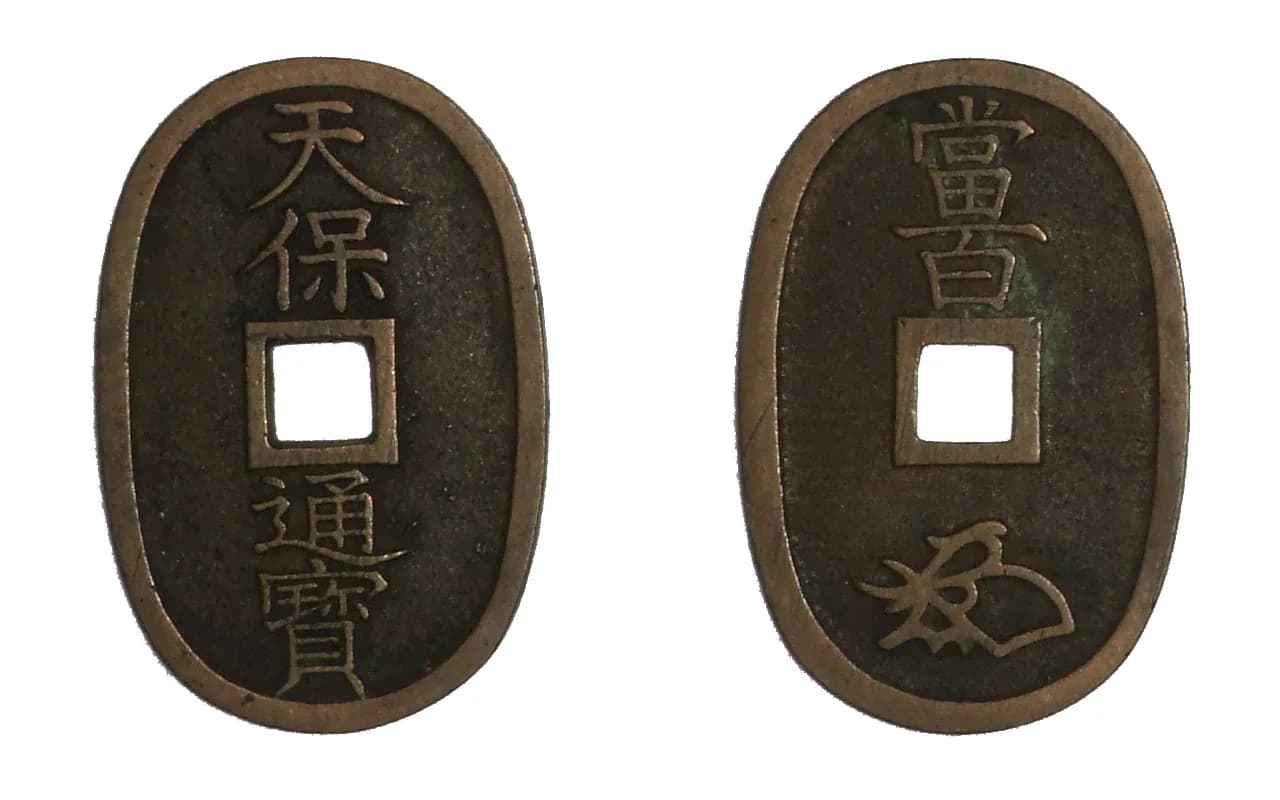
Tenpo Tsuho is a representative `anasen` (holed coin) whose issuance began in 1835 (Tenpo 6) during the late Edo period. It is widely recognized for its distinctive oval shape, central hole, and the inscription `Tenpo Tsuho` on the obverse, with `To-hyaku` on the reverse. However, are you aware that these Tenpo Tsuho coins, which at first glance appear identical, actually possess an astonishing range of values? In recent years, interest in Tenpo Tsuho has grown in the antique coin market, with well-preserved examples and rare `tegawari-hin` (variant types) increasingly trading at high prices.
This trend is fueled by a re-evaluation of their historical significance and an expanding collector base. As a crucial currency that supported the Edo period's economy and a testament to the tumultuous Bakumatsu era, Tenpo Tsuho coins embody more than just monetary value; they tell a rich story. Consequently, many enthusiasts seek out their diverse variations. Auctions feature Tenpo Tsuho coins ranging from a few hundred yen to those exceeding several hundred thousand yen. This price disparity is not merely determined by apparent age or condition. Instead, it is shaped by a complex interplay of underlying factors.
Why is Tenpo Tsuho's Value Complex? Understanding Price Formation in 3 Layers
The perceived complexity of Tenpo Tsuho's value stems from the intertwining of its function as currency, its role as a historical artifact, and its rarity as a collector's item. Here, we will explain the logic behind its value formation, progressing from beginner to advanced levels.
For Beginners: Why Value Differs Despite Similar Appearance
The value of a Tenpo Tsuho coin cannot be judged solely by its appearance. Most importantly, its value depends on `where` and `when` it was minted. Tenpo Tsuho coins were minted not only by the Edo shogunate's Kinza (gold mint) and Ginza (silver mint) but also by various feudal domains across Japan. For example, coins minted in domains like Mito, Kochi, or Satsuma exhibit distinctive calligraphic styles or subtle differences in coin shape, indicative of their minting location. These are known as `tegawari` (variants) and, due to their limited issuance, often command significantly higher values than standard Tenpo Tsuho coins (known as `johin`, or common types).
Furthermore, differences based on the mintage period are also crucial. Coins minted in the early period versus the later period can show variations in copper quality and casting techniques, affecting the coin's appearance and weight. Moreover, the `preservation condition`—such as minimal wear, clear inscriptions, and absence of rust or corrosion—also profoundly impacts value. Even a rare `tegawari` coin will fetch a lower price if its condition is poor. Conversely, a common Tenpo Tsuho coin in near-uncirculated (gem-uncirculated) condition can easily command several times its usual price. Thus, understanding the background information and condition, beyond just visual impression, is the first step in determining value.
For Intermediate Collectors: Scarcity Driven by Supply, Demand, and Market Trends
The market value of Tenpo Tsuho is not merely a matter of rarity but fluctuates significantly with supply-demand dynamics and current market trends. Specific mint locations and `tegawari` variants, due to their limited absolute numbers, tend to see rapid price increases when collector demand rises. For instance, `tegawari` coins with distinctive calligraphic styles like `Nagagai` or `Hirokaku` consistently attract high demand due to their unique characteristics. These items may appear on the market only a few times a year, and concentrated bidding inevitably drives up prices.
Furthermore, the `grade` of an antique coin is an extremely important factor in price formation. As explained in Ittendo's Guide to Coin Grading Standards and Interpretation, prices can vary dramatically based on grades such as Mint State (MS), About Uncirculated (AU), Extremely Fine (EF), Very Fine (VF), and Fine (F). For example, while a Fine-grade Tenpo Tsuho might trade for a few hundred to a few thousand yen, the same `tegawari` coin in Mint State could fetch tens to hundreds of thousands of yen, or even more. Recent auction data shows that rare, high-grade items, due to limited supply, are experiencing upward price trends, intensifying competition among collectors. Conversely, common `johin` coins are more abundant, leading to relatively stable prices, though demand for well-preserved examples remains strong.
For Advanced Collectors: Market Participant Behavior and Capital Flows
The pricing of Tenpo Tsuho in the market is deeply influenced not only by the intrinsic value of the coins but also by `who is buying`—the behavior of market participants—and the nature of the capital flowing into the market. Advanced collectors and investors don't just pursue rare types; they identify value in items with specific themes or historical contexts. For example, local Tenpo Tsuho coins minted in various regions during the chaotic Bakumatsu period are often regarded as valuable historical documents that shed light on the economic and social conditions of the time, attracting attention from historians and museum-level collectors.
From the perspective of capital flows, there has been a noticeable influx of new investors into the antique coin market in recent years. Beyond pure hobby collecting, these individuals view antique coins as a means of asset preservation or inflation hedging, focusing on coins with stable values or potential for future appreciation. Particularly, high-grade Tenpo Tsuho coins, certified by grading services, offer high reliability as investment assets due to guaranteed authenticity and condition, thus attracting concentrated capital. Moreover, the proliferation of online auctions has made it easier for international collectors and dealers to participate in the Japanese antique coin market, with global demand sometimes serving as a price-driving factor. This complex interplay of diverse market participants' motives causes Tenpo Tsuho prices to fluctuate daily.
Key Points for Interpreting Tenpo Tsuho Price Charts
To accurately grasp the value of Tenpo Tsuho, understanding how to read market charts is essential. Utilize Ittendo's View Price Trends on Market Charts and pay attention to the following points.
First, the `median price` is paramount. The median transaction price over a specific period is highly effective for understanding the typical trading range, without being misled by extreme highs or lows. While it's easy to be captivated by high-value auction results, these often pertain only to rare or gem-uncirculated items and do not represent the overall market trend. By observing the median, you can make a more realistic assessment of the value of your own Tenpo Tsuho coin.
Next, it's crucial to discern `trading volume` and `actual demand`. Transactions during periods of low volume (thin trading) are more susceptible to the specific intentions of individual buyers or sellers, making temporary price fluctuations common. Prices during such periods may not accurately reflect overall market demand. Conversely, prices during periods of high trading volume are the result of broader market participant consensus and are more likely to indicate stable price trends based on actual demand. Comparing price ranges across different grades is also indispensable. For instance, if prices for Very Fine (VF) coins are stable while Mint State (MS) prices are soaring, it might suggest speculative movements towards high-grade items. Analyzing charts from multiple angles will allow for a deeper understanding of the current market conditions.
4 Common Mistakes Beginners Make When Collecting Tenpo Tsuho
Collecting Tenpo Tsuho is a deep and fascinating hobby, but proceeding without knowledge can lead to unexpected mistakes. Here, we explain four common pitfalls for beginners and why they occur.
- Judging solely by appearance and buying common coins at high prices: This is the most frequent mistake. Tenpo Tsuho coins were mass-produced, so common, poor-condition examples can be acquired for a few hundred yen. However, even if a coin looks good, it doesn't necessarily mean it's a rare `tegawari`. If you purchase based solely on `it looks nice` without sufficient knowledge, you might end up with a very common coin at a price far exceeding its market value. Always learn the basics from Detailed Explanation of Anasens (Kanei Tsuho, Tenpo Tsuho) and understand the characteristics of different types.
- Failing to identify fakes or altered coins: Unfortunately, the antique coin market includes fakes and post-processed items. Tenpo Tsuho, being highly popular, has sophisticated replicas and altered coins (e.g., polished surfaces to appear in better condition). Beginners often struggle to distinguish these, risking the purchase of expensive fakes. Before buying, always consult reliable sources like the Complete Guide to Fake Detection and, if uncertain, opt for authenticated coins.
- Not understanding the importance of grading: Neglecting the concept of `grade`, which significantly influences an antique coin's value, is another cause of failure. The same type of Tenpo Tsuho can differ in price by tens or even hundreds of times between an uncirculated (MS) and a Fine (F) condition. Do not judge solely by photos; understand the Coin Grading Standards and Interpretation and either physically inspect the coin or choose a graded coin from a reputable authentication service.
- Neglecting information gathering and buying without market knowledge: Antique coin prices are constantly fluctuating, making information gathering indispensable. Do not rely solely on information from a single auction site or dealer. Failing to make an effort to understand current market prices from multiple sources, such as Ittendo's View Price Trends on Market Charts, can lead to buying at unfairly high prices or selling at unduly low ones. Continuous information gathering is key to smart collecting.
Ittendo Editor's Comment: The Smart Starting Line for Tenpo Tsuho Collecting
For those drawn to the profound depth of Tenpo Tsuho and beginning their collection, the most crucial element is `knowledge`. Instead of judging value solely by visual impression, adopting a multi-faceted perspective that considers its history, differences in minting locations, and preservation condition is the first step towards intelligent collecting.
As a concrete investment guideline, beginners should start by collecting common Tenpo Tsuho coins (known as `johin`), which have stable prices and high circulation, using them to train their eye for good condition. Begin by selecting coins in the range of a few hundred to a few thousand yen, prioritizing those with clear inscriptions and minimal rust or wear. This practice will help you develop an eye for evaluating coin condition. Next, when targeting specific rare `tegawari` or mint location variants, you must understand the Coin Grading Standards and Interpretation and choose coins that have been graded by a reputable authentication service. For significant investments, authenticity and condition guarantees are essential.
Furthermore, acquiring Basic Knowledge of Antique Coin Auctions can increase your chances of acquiring coins under more favorable conditions. Taking a patient, step-by-step approach to building knowledge and experience will allow you to truly savor the joy of collecting Tenpo Tsuho.