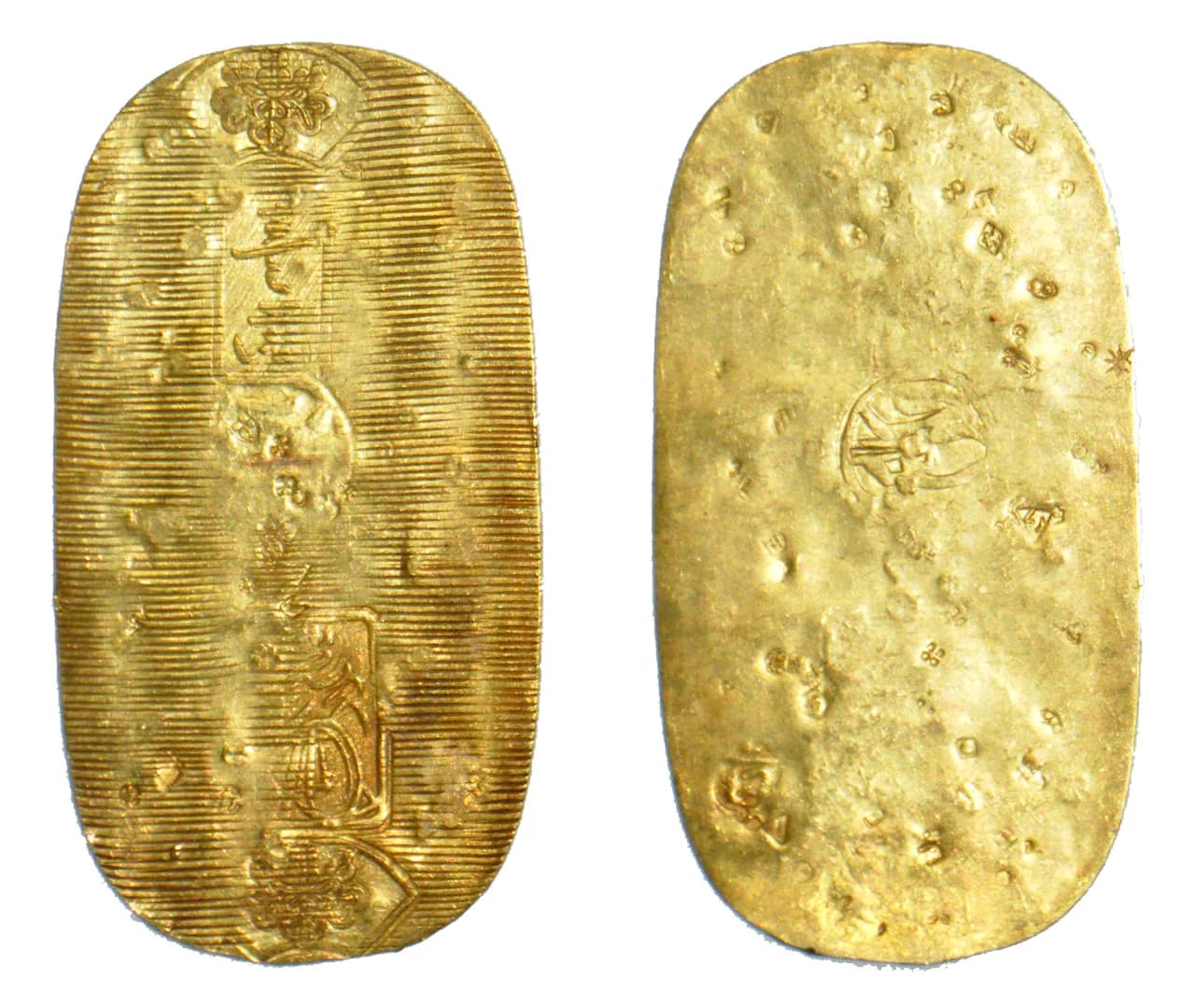
Is the sparkle of the Keichō Koban genuine? Unfortunately, these gold coins from the early Edo period, which are embedded in history, also have sophisticated counterfeits. Wouldn't you like to gain a professional's perspective to determine authenticity?
What is a Keichō Koban? The Value and Market Trends of Gold Coins from the Early Edo Period
The Keichō Koban is known to have a gold content of approximately 84% (cataloged) and was set at about 18g per ryō. The beautiful oval shape and the inscription "光次" within the "扇枠" on its surface convey the pinnacle of technology and aesthetic sensibility of the time.
Well-preserved Keichō Koban coins are perpetually in demand by collectors and investors worldwide. However, unfortunately, the market sees many sophisticated counterfeits, influenced by the coin's rising popularity. To safely collect and invest in such valuable ancient coins, knowledge of authenticity is essential. Hence, ITTENDO strives to spread accurate knowledge through a detailed explanation of Edo-era gold coins (Koban and Ōban).
The Logic Behind the Value of Keichō Koban: Explained in Three Levels from Beginners to Advanced Collectors
For Beginners: Factors Determining the Value of a Keichō Koban
The value of a Keichō Koban is not solely determined by the fact that it is an "old gold coin." The main factors affecting its value are "type," "fineness," "condition," and "rarity." Regarding "type," differences arise based on the year and location of minting, identified by stamps called "era marks" and "guild member marks" (personal marks of the coban artisan). For example, coins minted in the early "Suruga Guild" can differ significantly in collector popularity and existing numbers compared to those minted later in the "Edo Guild," affecting their value greatly. "Fineness" refers to the gold content, but since Keichō Koban are relatively stable, the focus of evaluation shifts to "condition" and "rarity."
"Condition" refers to the preservation state of the coin, evaluated in detail based on scratches, wear, discoloration, and signs of modification. There are standards and interpretations for coin grading by expert institutions, assigning objective grades. For instance, a near-unused (MS-grade) Keichō Koban can be worth tens of millions of yen, while one with heavy wear (below VF grade) may only fetch several million yen. "Rarity" is determined by how many of a specific type of Keichō Koban are in circulation or how few have certain guild marks. Even if they appear identical, the presence of a tiny mark on the reverse can significantly alter the value, requiring careful observation of details.
For Intermediate Collectors: Supply-Demand Balance and Market Trends
The market price of Keichō Koban fluctuates based on the supply-demand balance and recent market trends. Particular graded ranges, such as the almost unused class between MS63 and MS64, are in high demand among collectors, with auction prices serving as market price indicators.
However, if supply temporarily increases, prices may stabilize, making it crucial to continuously monitor market trends. ITTENDO's charts, which illustrate the shifts in medians, help distinguish between speculative high prices and those based on actual demand, aiding realistic value assessments.
For Advanced Collectors: Trends Among Market Participants and Fund Flows
The high-priced ancient coin market, like that of Keichō Koban, sometimes reflects the pricing influence of a few powerful market participants. Main participants include museums and galleries that value historical and cultural significance, affluent individuals and institutional investors seeking asset preservation or alternative investments, and passionate overseas collectors specializing in certain themes. When overseas collectors increase their interest in Japanese historical heritage and purchase aggressively during periods of yen depreciation, it raises domestic market price levels.
The logic of pricing first relies on "absolute rarity." Collectors with specific research themes or investors looking to diversify assets evaluate value from perspectives different from general collectors. They tend to emphasize historical backgrounds of the koban and its value as evidence of minting technology from a specific era, not just as gold. Thus, high-value transactions are driven by a limited number of informed and financially capable market participants, making it crucial for advanced collectors to interpret these trends as a strategic approach.
Key Points for Authenticity Evaluation of Keichō Koban: 5 Expert Tips
Authenticity evaluation for Keichō Koban is a deep field requiring specialized knowledge and experience. However, by grasping a few fundamental points, even beginners can develop a keen eye to spot counterfeits. Here, we detail five key evaluation methods practiced by experts. Since counterfeits can be incredibly sophisticated, it's essential to apply multiple points together for comprehensive judgment. ITTENDO also offers a complete guide to counterfeit detection for more detailed information.
1. Checking Shape, Size, and Weight
Many counterfeits deviate from the prescribed shape, size, and weight. For example, fakes coated with gold on low-density metals like copper or lead may look similar but are noticeably too light, or by mixing a denser metal, they are unnaturally heavy. While there are slight variations due to early Edo period minting technology, any significant distortion or uneven thickness should be considered a suspicious sign. Accurately measuring these physical traits is the first step in evaluation.
2. Detailed Examination of Inscriptions and Stamps
One of the most crucial points distinguishing authentic Keichō Koban coins is the examination of inscriptions and stamps on the surface and reverse. The "扇枠" on the surface should contain the inscription "光次," while the reverse features "花押" or "era marks" (indicating locations like Suruga or Sado) and "guild member marks" (personal marks of the coban artisan). Authentic stamps have the distinctive strokes and natural variations in depth seen in hand carving, with natural fluctuations in strength. Counterfeits often feature uniformly machined lines, unnaturally sharp edges, or unclear, blurred stamps. The position and balance of the stamps reflect the craftsman's quirks at the time, showing notable differences between genuine and fake coins. Using a high-magnification loupe, thoroughly check the replication quality of details.
3. Color and Luster
The vibrant yellow of pure gold or a reddish tint indicating a high copper content are not characteristic of genuine Keichō Koban coins. The naturally developed "patina" over time is another important factor. This patina forms a thin oxidized layer on the surface, giving a deep, elegant gloss. Coins that are unnaturally polished or harshly treated with cleaning agents lose this patina, appearing too uniformly lustrous or too dull. Counterfeit coins often have cheap-looking plating color or processing that unnaturally mimics an aged appearance.
4. Craftsmanship of the Edge
The edges of Keichō Koban coins feature distinctive "tagane marks" created during the shaping process using chisels (tagane). These marks were handmade, leading to slight differences in each, yet naturally flowing continuously overall. These tagane marks are vital evidence of the Edo period minting technology and craftsmanship. Counterfeits often exhibit uniformly machined or crudely finished tagane marks, which are conspicuous due to their unnatural uniformity or poor quality. If the gold on the edge is thin, revealing different metals underneath, it's likely counterfeit. The thickness of the edge and the finishing at the junction of the obverse and reverse surfaces are also important points to detect authenticity.
5. Verifying Specific Gravity and Magnetism
Utilizing physical properties is highly effective in differentiating genuine Keichō Koban. Accurate measurement of specific gravity provides decisive clues in detecting counterfeits. Common methods include using a hydrometer and measuring volume with the Archimedes principle. If results deviate significantly from expected figures, it may indicate other metals mixed internally or that the entire piece is made from a different metal. Gold is non-magnetic; thus, it will not react when approached by a strong magnet. If attracted to a magnet, it suggests the use of magnetic metals like iron or nickel, indicating it's not genuine gold. These examinations are critical means for uncovering sophisticated counterfeits that are difficult to judge by sight alone.
Understanding the Value of Keichō Koban from Market Charts
ITTENDO’s market charts offer a potent tool for objectively understanding the value of Keichō Koban. When looking at charts, focus first on the median. This shows the median transaction price over a period, helping one understand market prices closer to reality, unaffected by temporary highs or lows. Volume is also a crucial indicator; during "thin market" periods, a specific high-value transaction may greatly affect overall market performance, not necessarily reflecting actual demand. Conversely, regular price changes during times of stable volume indicate more reliable market trends.
For Keichō Koban, prices vary greatly by grade, making it important to focus analysis on specific grading bands. For instance, MS63 Keichō Koban’s chart and a VF-class chart have different price ranges and fluctuation tendencies. Focusing on charts for your collection or investment target grade, grasping past auction price ranges and averages can provide benchmarks for evaluating current market prices. Continuously observing charts and "feeling the market's pulse" allows for more prudent purchasing and selling decisions.
Common Pitfalls for Beginners and Their Avoidance
In collecting high-priced and historical coins like Keichō Koban, there are several common pitfalls for beginners. The most typical mistake is hastily jumping at "bargain deals." Coins noticeably cheaper than market prices might be counterfeits or have significant defects. Especially careful attention is needed for transactions in unreliable channels like flea market apps or individual SNS, where the absence of authentication papers is common, and fraudulent sellers passing off fakes as genuine are prevalent. Pursuing cheapness alone risks significant financial loss.
Another frequent mistake is purchasing before cultivating the ability to discern authenticity due to a lack of specialized knowledge. Without fully understanding the evaluation points explained in this article, one may fail to spot sophisticated counterfeits relying only on visual impressions. Dismissing the importance of authentication papers and purchasing pieces without guarantees from reliable authentication institutions is also risky. Trusted authentication institutions evaluate authenticity and grade based on strict criteria and issue their findings in authentication papers. This paperwork is vital evidence backing the coin’s reliability and value, making it crucial to ensure its presence with any high-value coin purchase. When considering coin purchases, start by learning the basics of coin auctions and choosing trustworthy dealers or auction houses as the first step to avoid pitfalls.
Conclusion from ITTENDO’s Editor: Smart Choices for Keichō Koban
Keichō Koban are iconic gold coins signifying the start of the Edo era, with immeasurable historical and artistic value. But given their high costs, knowledge to authenticate and reliable information sources are essential. For beginners starting to collect or invest in Keichō Koban, purchasing "pieces guaranteed by trustworthy authentication institutions" is the safest winning strategy. While one’s appraisal skills are still developing, choosing coins endorsed by experts minimizes the risk of acquiring counterfeits.
The MS63–MS64 range of Keichō Koban is more abundant in the market, with smaller price fluctuations. These grades balance appeal as collectibles with asset value, promising future liquidity. On the other hand, ultra-high grade MS65 and above coins have significant price variances due to rarity, requiring more specialized knowledge and market analysis. High-grade items can be risky for beginners to purchase initially. ITTENDO tracks the "now" of coins through past auction records and market charts. Smartly leveraging information will enable remarkable encounters with historically significant Keichō Koban.
Related Topics and Reference Information
For those looking to deepen their research and collection of Keichō Koban, ITTENDO provides related content consolidated below. Each link is structured to enable systematic learning about surrounding Keichō Koban domains.
In An explanation arranging all types of Edo-period koban chronologically, ten types from Keichō Koban to Man’en Koban are overviewed chronologically, providing insight into purity fluctuations and issuance backgrounds of each era. The recapitalization flow from Keichō to Genroku, Hōei, Shōtoku, and Kyōhō reflects Edo shogunate's financial circumstances, where tracking purity over time offers a contour of political-economic history.
The historical position and market trends explanation for Keichō Ōban covers the market of important gold coins like Ōban alongside koban during the Keichō period. Koban and Ōban have different uses, circulation amounts, and issuance purposes, so analyzing only one might misinterpret entire market trends. Understanding both provides a three-dimensional gauge of early Edo gold coin market sentiment.
The Edo and Meiji periods have vastly different metallic compositions, issuance philosophies, and market participants, placing Keichō Koban's historical standing more clearly when aligned on a vertical axis of Japanese gold coin history.
For auction market examples, refer to Results of the Japanese Currency Dealers Association's Spring Event, tracing the market formation process of Keichō era gold coins through modern representative examples, such as the recent sale of a Keichō Ōban at over ¥50 million. Viewing the spread from predicted to realized auction prices alongside bidder information highlights market depth.
Lastly, for practical matters of storage and recording, check Guide to storing coins, managing humidity, and slab storage, for preparing a long-term holding system. With gold coins like Keichō Koban that have over four centuries of history, management extending to the next generation, beyond mere acquisition, truly brings forth their value. By being mindful of the cycle of evaluation, purchase, storage, recording, and disposal, collections transcend being mere assets to becoming cultural properties.