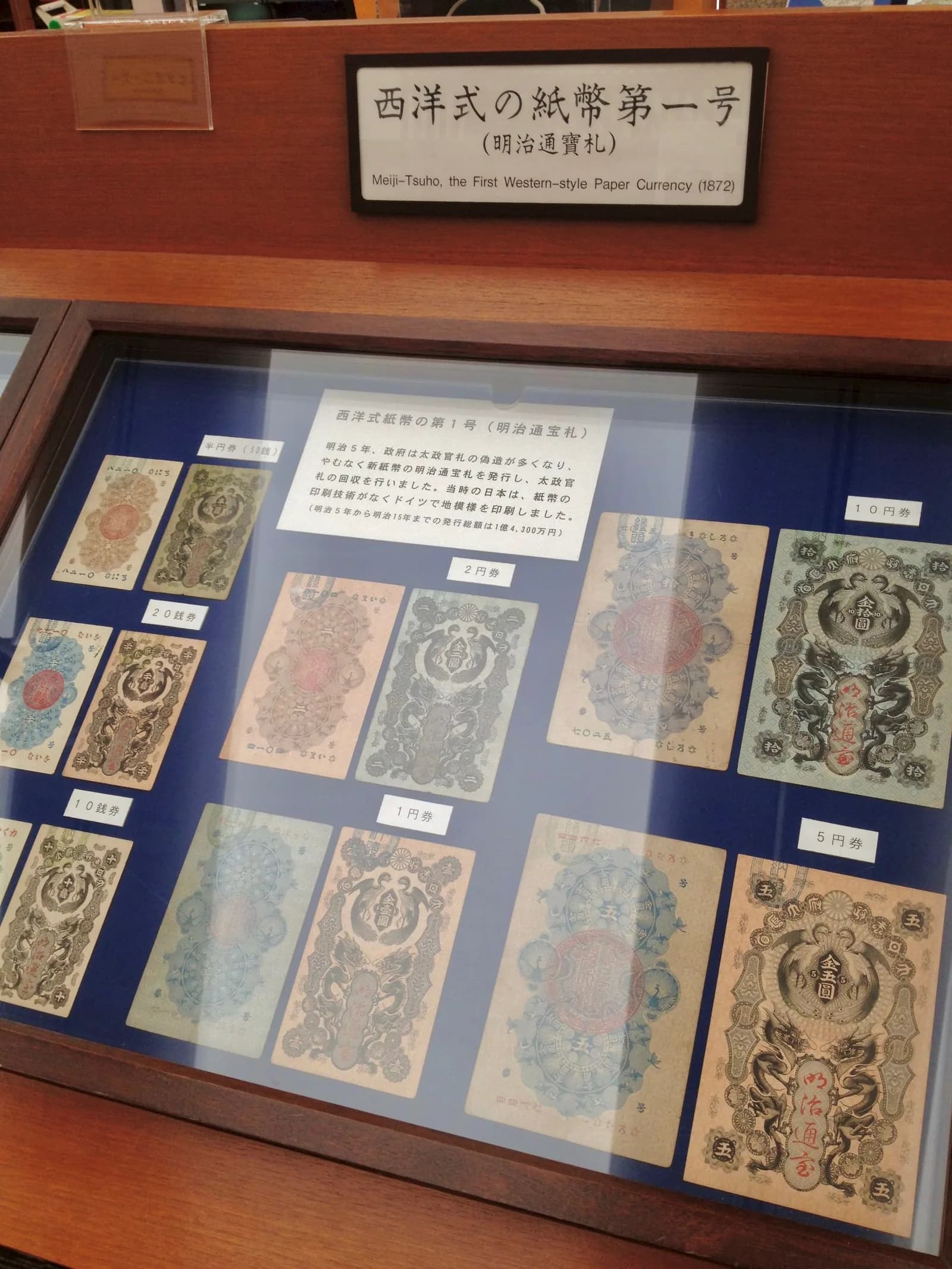
Japan's First Western-style Banknotes
Meiji Tsūhō (明治通宝) is a Western-style banknote issued in Meiji 5 (1872) and is considered Japan's first full-scale Western-style banknote. According to a catalog from the Currency Museum, it was an inconvertible banknote issued for currency unification, initially printed in Germany and later supplemented in Japan with the wording '明治通宝,' also known as German banknotes. There are nine denominations: 100 yen, 50 yen, 10 yen, 5 yen, 2 yen, 1 yen, half yen, 20 sen, and 10 sen (Currency Museum distribution material 'Banknotes Since the Meiji Era'). As explained in Introduction to Old Banknotes, Japan at that time was facing a serious issue of declining trust in Dajōkan bills.
Background and Ordering from Germany
In Japan during the early Meiji period, Western-style engraving (intaglio printing) techniques had not yet been established. The widespread counterfeiting of Dajōkan bills led to declining trust in banknotes, prompting the Meiji government to urgently seek countermeasures. They began consultations with printing companies in Europe and America that possessed the latest anti-counterfeiting technology. According to the National Printing Bureau, because modern printing technology to prevent counterfeiting was unavailable in Japan at the time, they commissioned a German printing company to produce these 'German banknotes,' which are Japan's first modern printed banknotes. The name of the printing company is not listed in the Currency Museum or the National Printing Bureau's materials. It was issued in Meiji 5 (1872) (National Printing Bureau). It heavily reflects 'historical background,' one factor determining the value of old coins.
Intricate Design and Artistic Value
The greatest attraction of Meiji Tsūhō is its overwhelming beauty due to Western-style intricate engraving printing. The surface is intricately engraved with traditional Japanese auspicious motifs of phoenixes and dragons. Surrounding them are complex arabesques, giving the entire banknote a dignified atmosphere. The reverse side also includes Arabic numerals and English inscriptions, reflecting an advanced design with international awareness. Engraving printing is characterized by the transfer of ink carved into intaglio to the paper, creating slight raised textures that can be felt with the fingers, an unprecedented level of detail not achievable with contemporary Japanese woodblock or lithographic printing. This technology astonishes even with the naked eye. As touched upon in Complete Guide to Identifying Fake and Altered Items, its sophisticated design also contributed to anti-counterfeiting. Truly possessing a 'quality that overwhelms viewers,' it is a banknote that can be called a work of art.
Innovation in Anti-counterfeiting Technology
Meiji Tsūhō adopted several advanced anti-counterfeiting technologies of the time. The first is extremely intricate line engraving by engraving printing. With the technology available in Japan then, it was impossible to replicate this level of detail. According to the National Printing Bureau's explanation, the surface design combines a main motif in black intaglio printing and a ground pattern in blue relief printing, though the paper was noted to be fragile. The Currency Museum's catalog mentions that due to the frequent alterations from low to high denominations of the new banknotes 'Meiji Tsūhō bills,' revamped notes 'Jingū Kōgō bills' were issued in 1881. There is no record of the increase or decrease in counterfeiting incidents in the sources referenced.
Rarity by Denomination and Current Market Price
The market price of Meiji Tsūhō varies significantly depending on the denomination and condition. Records showing issuance, existing numbers, and prices for each denomination cannot be confirmed from the sources referenced. All denominations, however, are extremely rare in 'superb gem' or 'uncirculated' conditions. Most that appear in the market are 'average' or 'fine' with signs of use. Understanding grading standards for old coins enables more accurate value judgments. Market records only include individual prices and auction examples that have verified records (including event, lot, source URL, and confirmation date).
State Grades and Proper Preservation Methods
In the collection of Meiji Tsūhō, condition evaluation is an extremely important factor. Points for evaluation include, firstly, the presence or absence of creases. The more vertical and horizontal creases there are, the more the bill's value significantly decreases. Next is 'print clarity.' The sharper the engraving details remain, the higher the evaluation. 'Discoloration and stain degree' are also important. Evenly aged discoloration is acceptable, but dirt or oil stains are depreciating factors. The 'state of the edges' should also be checked, observing whether the clean edges from the original plate are intact. Proper preservation is indispensable for maintaining the value of banknotes. Basic storage involves using neutral paper sleeves or Mylar (polyester) film. Always store flat to prevent creases, and if stacking, insert neutral paper between them. Refer to Proper Storage Methods for Old Coins, avoiding direct sunlight, humidity, and places with minimal temperature changes. When framing, use archival quality materials that do not damage the banknotes.
Position in Japanese Modern Banknote History
The permanent exhibition catalog of the Currency Museum at the Bank of Japan Institute for Monetary and Economic Studies includes a one yen note of the new banknote 'Meiji Tsūhō bills' (catalog). It symbolizes the tumultuous early Meiji currency system transition from Dajōkan bills to National banknotes. Many enthusiasts build a 'Japanese Modern Banknote Collection' that includes pre-war and post-war old banknotes (Prince Shōtoku notes, Iwakura Tomomi notes, etc.), where Meiji Tsūhō occupies the oldest, most design-rich position. Alongside Introduction to Modern Gold and Silver Coins (Meiji to Shōwa), it is indispensable for discussing the history of modern Japanese currency. Market records only include individual prices and auction examples that have verified records (including event, lot, source URL, and confirmation date).
Legacy of German Banknotes and Japan's Printing Technology Independence
Meiji Tsūhō (German banknotes), despite their high quality, also faced the challenge of dependence on German printing. The National Printing Bureau explains that while the new banknotes featured intricate printing, they had a drawback of fragile paper, leading the bureau to produce new banknotes. According to the chronology of the National Printing Bureau, a division of the Ministry of Finance for currency management was established in 1871 (Meiji 4) and later renamed the Currency Office within half a month, issuing the first domestic Western-style banknote 'National Bank Note (new bill)' in 1877 (Meiji 10), the Ministry of Finance Currency Office was renamed the Printing Bureau in 1878 (Meiji 11), and modified one yen notes were issued in 1881 (Meiji 14). In 1885 (Meiji 18), the first Bank of Japan convertible silver banknotes were issued (National Printing Bureau). Meiji Tsūhō is positioned as the 'last summit made in Germany' issued during this transition period to technology independence. Its high artistic completion will stand out even more when compared to the subsequent domestically printed banknotes. It symbolizes Japan's modernization journey as an important banknote.