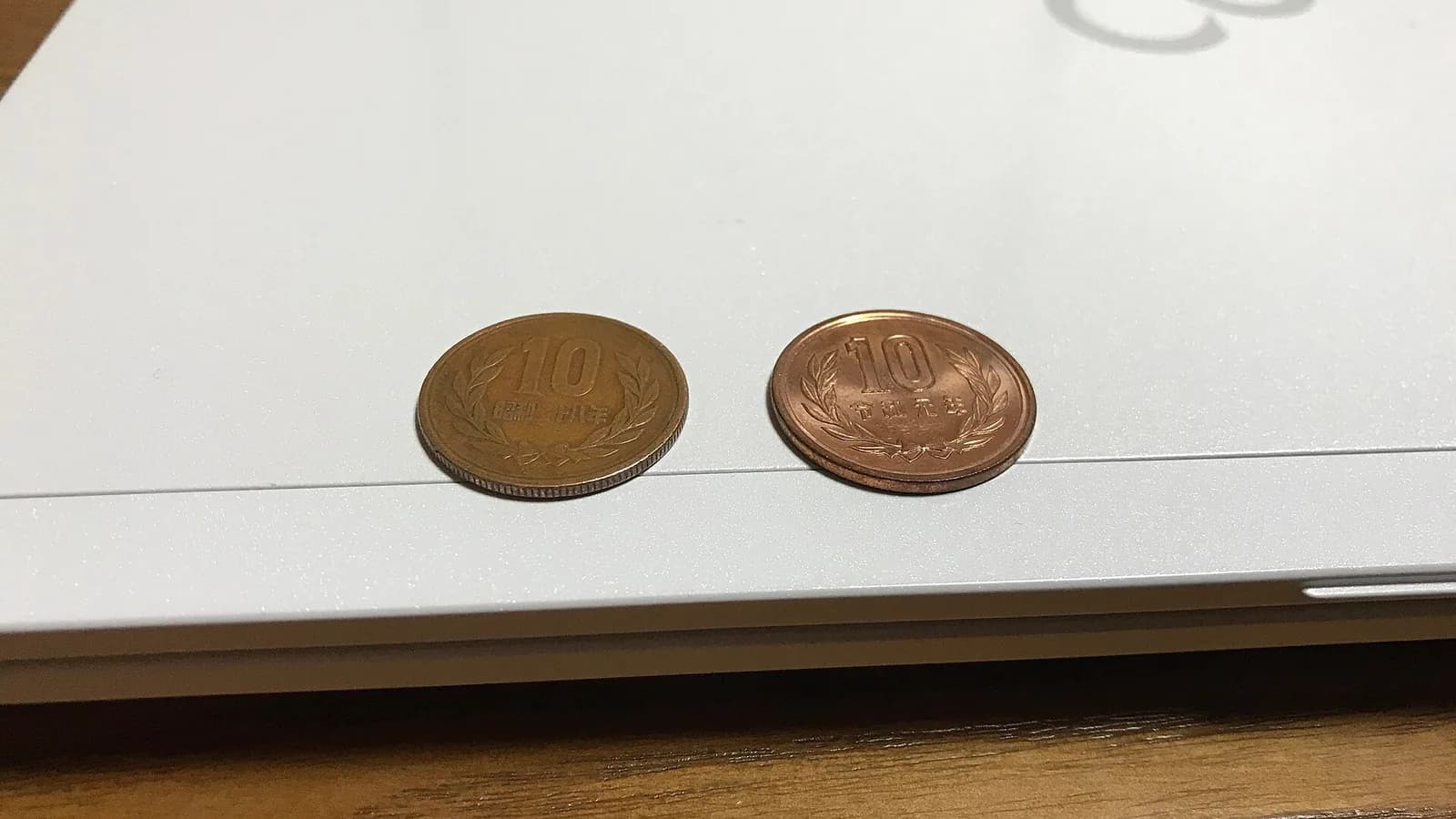
What Is the Giza-jū: A Standout Rarity Among Current Coinage
The term 'Giza-jū' (ギザ十) refers to the early 10-yen coins issued from Shōwa 26 (1951) through Shōwa 33 (1958). While sharing the same design as the currently circulating 10-yen coin—featuring the Byōdō-in Hōō-dō (located in Uji City)—their most distinctive characteristic is the fine reeding (serrations) applied to the edge. Since this reeding was eliminated from 10-yen coins issued from Shōwa 34 (1959) onward, only the eight years of coins dated Shōwa 26 through 33 bear this feature and are distinguished as 'Giza-jū.' Shōwa 26 (1951), the year of first issue, was a period when Japan was accelerating its postwar recovery while benefiting from the Korean War special procurement boom, and these 10-yen coins thus hold historical significance as currency symbolizing postwar Japan's economic fresh start. Giza-jū remain valid legal tender today and are occasionally discovered in wallets. For an overview of the modern coinage system, see Introduction to Modern Gold and Silver Coins (Meiji–Shōwa).
Why the Reeding Disappeared: The Design Change of Shōwa 34
There were several practical reasons behind the Shōwa 34 (1959) design change that eliminated the edge reeding from 10-yen coins. After the Shōwa 33-dated coins, the rim reeding on the 10-yen coin was discontinued. The manufacturing costs of the reeding and issues with die wear were also cited as factors. 10-yen coins dated Shōwa 34 onward have the plain edge found on the current version. Against this backdrop, Giza-jū (dated Shōwa 26–33)—produced for only eight years—came to attract attention among collectors as 'witnesses of an era.' For a deeper understanding of the factors that determine a coin's value, Factors That Determine the Value of Old Coins is highly recommended.
Mintage Figures and Rarity by Year: The Disparity Across Eight Years
Giza-jū exist across eight years from Shōwa 26 through Shōwa 33, but mintage figures vary considerably by year. The highest mintage belongs to the Shōwa 27 (1952) date, with an estimated production of several hundred million coins or more. By contrast, the inaugural Shōwa 26 (1951) date had a comparatively limited production run, and the number of surviving high-grade examples is restricted. Ranking the rarity of each date in broad terms, the tendency runs: Shōwa 26 > Shōwa 28 and Shōwa 33 > Shōwa 27 and Shōwa 29–32 (though this ordering shifts depending on condition and grade). As circulated pieces, all dates trade for roughly 10 to several hundred yen, but prices rise sharply for uncirculated examples (MS63 and above). Shōwa 26-dated coins grading MS65 or higher can command prices of 30,000 to 100,000 yen or more, and it is this spread that makes collecting so rewarding. For guidance on grading standards, see Standards for Grading Old Coins.
Identifying and Assessing Giza-jū: Checking the Edge Is the First Step
The first step in identifying a Giza-jū is examining the edge. By holding the coin sideways and inspecting it with a fingertip or magnifying glass, you can confirm whether a continuous series of fine notches is present. Any Giza-jū dated Shōwa 26 through 33 will always have this reeding. Conversely, 10-yen coins dated Shōwa 34 onward have a smooth edge. There are four key points for assessing condition. First, the presence or absence of scratches and wear on the field (the flat, background area). Second, the sharpness of details on the phoenix and the building. Third, the uniformity of the edge reeding (whether it has been flattened by circulation). Fourth, the degree of remaining luster (the surface brilliance from minting). Uncirculated coins are those in which all of these elements are perfect and which have not entered circulation after minting. On pieces that have been used in pockets or wallets for many years, the edge reeding is often worn down and softened.
Price Ranges: From Circulated Examples to High-Grade Pieces
The price range for Giza-jū varies widely depending on condition and date. Circulated pieces (Fine to Very Fine equivalents) fetch roughly 10 to 100 yen regardless of date, a level close to their face value of 10 yen. For About Uncirculated (AU) pieces, the Shōwa 26 date is roughly 1,000 to 5,000 yen, while Shōwa 27 through 33 dates are roughly 500 to 2,000 yen as a general guide. Fully uncirculated pieces (MS62–64 equivalents) for the Shōwa 26 date fall in the range of approximately 5,000 to 30,000 yen, and high-grade examples at MS65 or above enter a price range of 50,000 to 150,000 yen or more. High-grade examples of the Shōwa 28 date are also scarce, with MS64 and above trading at approximately 10,000 to 50,000 yen. These prices are by no means high within the broader old-coin market, but the fact that coins from just a few decades ago—effectively 'current coinage'—can show such a dramatic range of values makes them a highly intriguing subject from both a collecting and investment standpoint. For an understanding of market trends in old coins, Reading Old Coin Market Cycles is a useful reference.
PCGS and NGC Grading: The International Dimension of Giza-jū Collecting
In recent years, an increasing number of collectors have been submitting Giza-jū to PCGS (Professional Coin Grading Service) and NGC (Numismatic Guaranty Corporation) for certification. Grading by these third-party organizations objectively certifies a coin's condition with a numerical grade (F12 through MS70) and encapsulates it in a slab for both protection and enhanced marketability. In particular, PCGS MS65 and higher certified examples of the Shōwa 26 date attract attention at international auctions due to their scarcity. The phenomenon of an everyday Japanese 10-yen coin being evaluated on the global stage represents one of the ultimate achievements of Giza-jū collecting. For details on how to choose a grading service and how to use one, see A Practical Guide to Grading Old Coins. For the history of the 10-yen gold coin (the old gold coinage of the Meiji era), The Value and Rare Dates of the 10-Yen Gold Coin offers a useful point of comparison.
Discoveries from Wallets and Piggy Banks: The Joy of Giza-jū Collecting
The greatest appeal of collecting Giza-jū is the joy of discovery—finding treasure in the course of everyday life. Giza-jū dated Shōwa 26 through 33 remain valid legal tender and can still be found today in long-forgotten old piggy banks, among the effects of a grandparent's estate, or tucked away in old chests of drawers. This is a charm unique to collecting current coinage, unavailable with many other categories of old coins. However, since circulated Giza-jū have low value, finding one rarely constitutes a 'treasure find.' Condition is everything. Should you happen to come across one in uncirculated condition—retaining its luster and free of scratches—place it in a protective case for storage. The three cardinal rules of value preservation are: do not rub, do not wash, and do not touch with bare hands. For proper storage methods for old coins, consult Proper Storage Methods for Old Coins.
How to Start Collecting Giza-jū: An Entry-Level Collection to Enjoy at Low Cost
Collecting Giza-jū is one of the most accessible entry points into old-coin collecting. Begin by acquiring one piece of each date for Shōwa 27 through 33 in circulated condition (a few tens to a few hundred yen per piece) and aim for an 'eight-date complete set.' This alone allows for a comparison with Edo-period old coins and yields a small-themed collection illustrating 'the evolution of the 10-yen coin that powered postwar Japan.' As a next step, try to acquire a Shōwa 26-dated example, and ultimately take a phased approach of securing one or two higher-grade pieces. Compare multiple channels—specialist old-coin dealers, auctions, and flea-market apps—when choosing where to buy. For details on major acquisition channels and points to watch out for, see A Guide to Sourcing and Purchasing Old Coins. Because Giza-jū are low in cost and carry minimal risk of counterfeiting, they are ideal material for a first step into old-coin collecting.