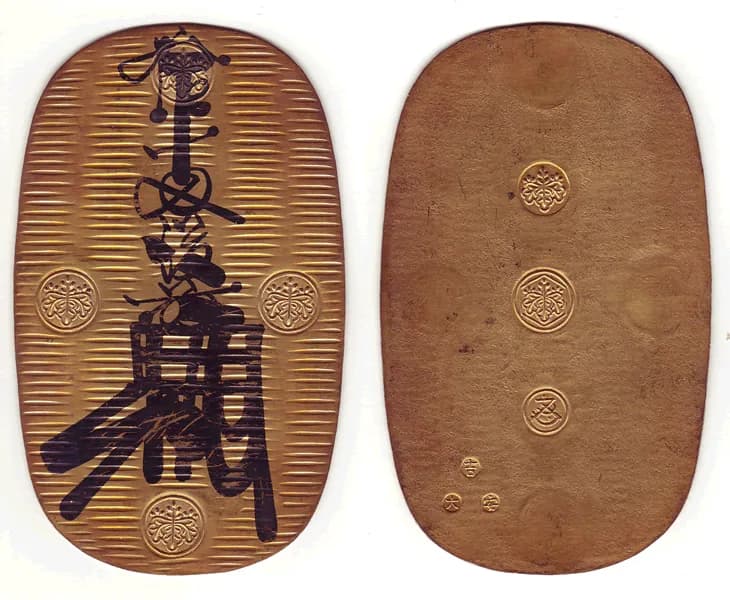
Man'en Ōban: Background to Its Birth Amid Bakumatsu Economic Turmoil and Gold Outflow
The Man'en Ōban (万延大判) was minted in the first year of the Man'en era (1860) and is the last Ōban gold coin in Japanese monetary history. The backdrop to the creation of this coin includes severe economic turmoil during the Bakumatsu period and a major issue with gold outflow. The Treaty of Amity and Commerce between Japan and the United States, signed in 1858, led to the opening of ports in Yokohama, Nagasaki, and Hakodate, and trade with overseas countries began in earnest. However, the exchange rates for gold and silver differed significantly between Japan and the West. In Japan, the exchange rate was gold 1 to silver 5-6, while in the West, it was typically gold 1 to silver 15-16. Foreign merchants exploited this discrepancy in the gold-silver exchange rate, exchanging large amounts of silver coins for gold coins in Japan, which they took abroad to gain enormous profits. This mass outflow of gold coins developed into a serious situation that shook Japan’s economic foundation. To stop this, the shogunate resolutely carried out currency re-mints. The Man'en Ōban was also minted as part of this effort, greatly reducing the gold content. For further details, see Introduction to Edo Gold Coins (Koban and Ōban). The Man'en Ōban's weight was specified at 112.4g with a gold purity of about 37% (reference). This was almost half of the gold content compared to the Tenpō Ōban (with a gold purity of 67.4%). Although this re-minting temporarily curbed the outflow of gold, it led to a decline in the value of currency and brought further chaos to the domestic economy. It can be said that this coin marks a historical turning point, born at the crossroads of the shogunate’s fiscal difficulties and external pressures.
Technical Background and Visual Characteristics of Gold Purity Approx. 37% (Reference)
The gold purity of approximately 37% (reference) for the Man'en Ōban is almost half compared to the Tenshō Ōban (70-76%) or the Keichō Ōban (68%), the lowest level in Japanese monetary history. This indicates that the quality of the currency had reached its limit. Technologically, an alloy was formed by greatly increasing the proportion of copper mixed with gold. By increasing the copper content, it was possible to mint more coins with less gold and reduce manufacturing costs. However, this increase in copper content had a significant impact on the quality as a gold coin. The most noticeable effect was the promotion of surface discoloration and oxidation (rust). Unlike the traditional golden-yellow (yamabuki color) shining Ōban, the color of the Man'en Ōban is evidently whitish, giving a dull impression because the high copper content made the surface prone to oxidation over time. This decline in quality was negatively evaluated as it detracted from the dignity of a gold coin even at the time. Today, its unique color and changes in preservation state are also seen as one of the factors determining the value of old coins.
Distinctive Features and Identification Points of the Man'en Ōban
The Man'en Ōban is characterized by its thinness and unique color. Its size is approximately 153mm in height and 95mm in width, almost the same as the Tenpō Ōban, but it is thinner and lighter at 112.4g. On its surface, beautiful paulownia and fan motifs, inheriting the tradition of Ōban, are intricately engraved. In the center, '拾両' is inscribed with ink, along with the seal of the Gotō family head, which is a crucial element for authenticating the Ōban. The ink inscription is akin to the face of the Ōban, and its clarity and preservation status greatly influence its value. On the reverse side, the '是' mark is stamped for identifying the Man'en Ōban. The depth and shape of this mark are also important clues for authenticity judgment. Due to its low gold content, it tends to discolor easily, losing luster and appearing dull in many cases. Therefore, specimens with clear ink inscriptions and little surface discoloration, well-preserved, are particularly prized. This is also highly valued in standards for grading old coins.
The Last Ōban Production by the Gotō Family: The End of Tradition
The Man'en Ōban was the last Ōban gold coin made by the Gotō family, who had handled the minting of coins for the Edo shogunate. For over 270 years, the Gotō family had been solely responsible for the minting, ink inscriptions, and seal certifications of Ōban. With the production of the Man'en Ōban, this long-standing tradition came to an end. At the time, the head of the Gotō family was Gotō Nuidonosuke Norihiro. His seal and the ink inscription '拾両' hold significant historical and cultural weight as the last Ōban certification by a traditional Japanese metalworker. After the Meiji Restoration, the new government aimed to establish a modern monetary system and set up a mint. Consequently, the Gotō family's monopoly over coin production throughout the Edo period was revoked, marking the end of their role. The seal of the Gotō family recorded on the Man'en Ōban silently tells the story of the termination of the Edo period's currency system and the traditional craftsmanship deeply embedded in it. This single Ōban encapsulates the efforts of the people who lived through tumultuous times and the quintessence of lost traditional Japanese techniques.
Comparison with Tenpō Ōban: Differences in Weight, Purity, and Market Value
Comparing the Man'en Ōban with its predecessor, the Tenpō Ōban, reveals significant differences between the two. First, in terms of weight, the Man'en Ōban is 112.4g, while the Tenpō Ōban is about 165g, heavier by approximately 47%. In terms of gold purity, the Man'en Ōban has about 37% (reference) compared to the Tenpō Ōban's approximately 68% (reference), significantly higher. As a result, the gold content of the Man'en Ōban is about 37.5g, while the Tenpō Ōban is about 111.2g, resulting in nearly a threefold difference. Although the size of both is approximately 150mm in height and 95mm in width, the thinness and lightness of the Man'en Ōban are immediately apparent when held. This is due to the considerably fewer minted Man'en Ōban compared to the Tenpō Ōban and its historical rarity as the last Ōban of the Edo period, factors strongly supporting its price. For respective details, refer to Description of Tenpō Ōban and Description of Kyōhō Ōban. Individual prices and auction examples are published in market records only for those that have verified records (event, lot, source URL, confirmation date).
Position in the Collection Market: Sources of Rarity and Demand
The Man'en Ōban is known as an "extremely rare coin" due to its extremely limited minting and the number of existing specimens. Therefore, opportunities to circulate in the collection market are very rare. Specifically, well-preserved pieces with clear ink inscriptions and little surface discoloration tend to fetch even higher prices. Because it is the last Ōban of the Edo period, there is a consistent demand from Bakumatsu history collectors and Ōban specialists. Additionally, being particularly emblematic among old Japanese coins attracts attention from wealthy collectors and investors. When put up at auction, fierce bidding competition often results in high sales prices. Although the frequency of market listing is low, its rarity and historical value generate consistently high demand. Current market trends are analyzed in Understanding Old Coin Market Cycles. Individual prices and auction examples are published in market records only for those that have verified records (event, lot, source URL, confirmation date).
Major Auction Sale Examples: Price Range and Influencing Factors
Examining recent major auction sale examples of the Man'en Ōban confirms its high and stable market value. Particularly, specimens termed "extremely fine" with vivid ink inscriptions and minimal surface discoloration have been recorded selling for over 10,000,000 yen multiple times. These prices are greatly influenced not only by the weight and purity of gold but also by the historical background of it being the last Ōban of the Edo shogunate and the scarcity of extant specimens. Collectors find value in these coins not as mere currency but as historical documents that narrate the story of tumultuous times. Furthermore, the presence of certificates provided by appraisal agencies also significantly affects the auction prices. Although selling frequency on the market is low, once listed, fierce demand from Bakumatsu history collectors and Ōban specialists leads to intensified competition. Further information is available in Introduction and Utilization of Old Coin Auctions. Individual prices and auction examples are published in market records only for those that have verified records (event, lot, source URL, confirmation date).
Authenticity Verification and Appraisal Agencies: Stringent Confirmation for High-Value Items
For the highly valuable Man'en Ōban, authenticity verification is the most crucial process. There are also sophisticated counterfeits, so it is essential to obtain rigorous appraisals from experts before purchasing. The main check points are as follows: 1. Weight: Verify that it is approximately 112.4g, the stipulated weight, where even slight discrepancies are significant. 2. Gold Purity: Non-destructive testing such as X-ray fluorescence analysis measures whether the gold purity is within the 33-35% range. 3. Handwriting of the Gotō Seal: The seal of the Gotō family head, Gotō Nuidonosuke Norihiro, requires expert handwriting analysis. Details such as script style, pen pressure, and ink absorption are analyzed thoroughly. 4. Reverse Side '是' Mark: Verify that the depth of engraving, shape, and placement of the mark are legitimate. 5. Casting Skin on Surface: Using microscopic observation, examine whether the surface texture and hammer marks from casting match those of original specimens. In Japan, requesting appraisals from members of the JNDA (Japan Numismatic Dealers Association) or from appraisal departments of major auction houses is a standard procedure. Additionally, transactions with certificates from international third-party grading services like PCGS or NGC are more reliable. For more on detecting fakes and processed items, see Complete Guide to Identifying Fakes and Alterations.
Storage and Ink Inscription Protection Practices: Preserving Beauty
To maintain the Man'en Ōban in optimal condition, proper storage methods are essential. Especially, the protection of ink inscriptions is a crucial issue. Ink can easily deteriorate due to ultraviolet light, moisture, and oils or acidic gases from fingers, requiring meticulous attention. Avoid direct sunlight and store in a stable environment with temperatures between 15–20°C and humidity between 40–50%. Using special paulownia boxes, archival cases made of neutral paper, or highly sealed acrylic cases is ideal for storage. Avoid direct handling; always wear cotton gloves. Because of its low gold purity, the surface is prone to oxidation (discoloration or dullness), so it is important to minimize exposure to air. Never attempt self-cleaning or polishing as these actions irreversibly worsen the surface condition and drastically decrease value. Professional cleaning must only be entrusted to reliable experts. More detailed information is available in Proper Storage Methods for Old Coins.