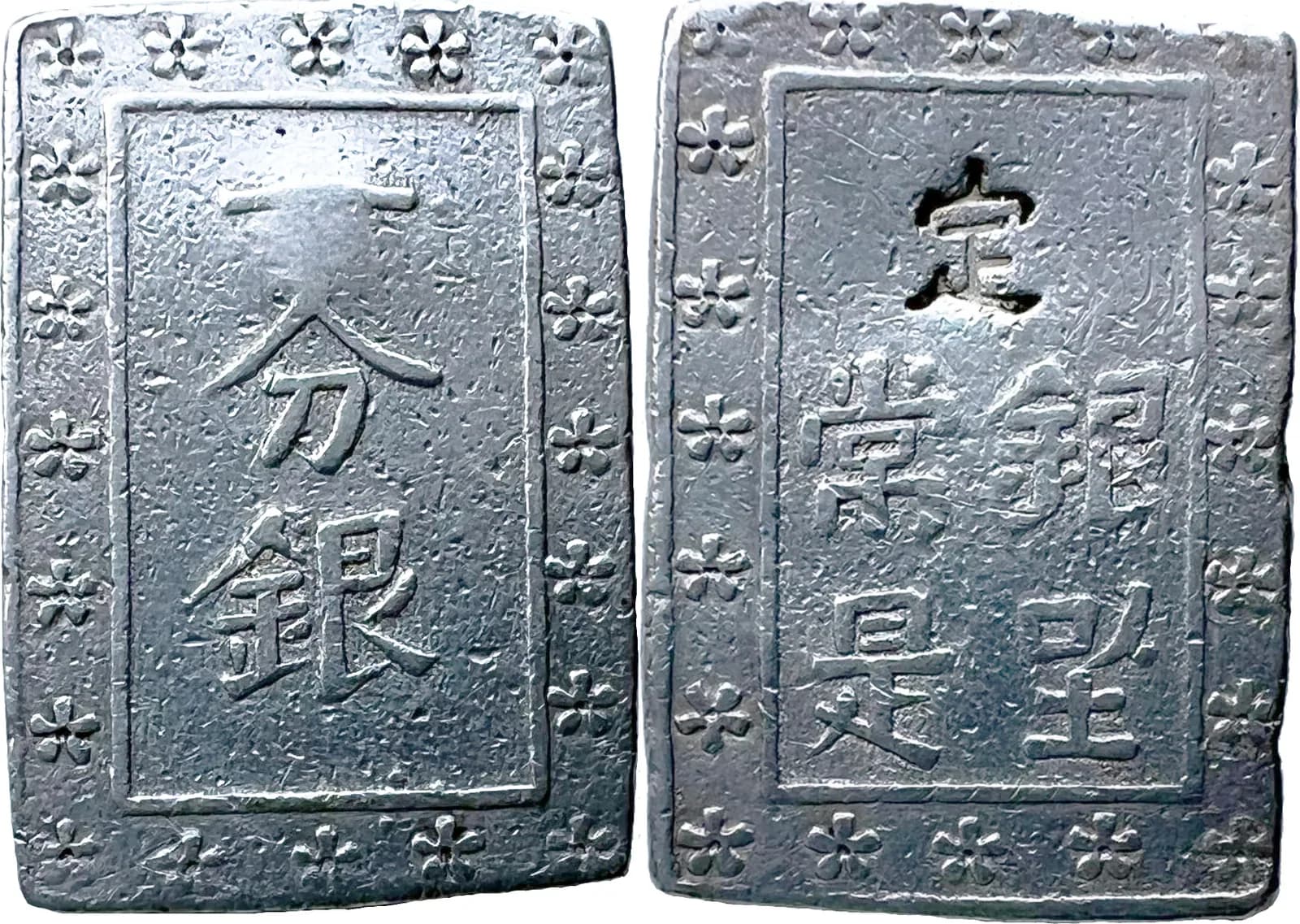
The Ansei Ichibugin, issued in 1859, is closely related to changes in Japan's monetary system accompanying the opening of ports and trade. Its issuance background involved international negotiations and various issues regarding silver coin fineness.
Background of Ansei Ichibugin Issuance
The issuance of Ansei Ichibugin was influenced by changes in the monetary system accompanying the opening of Japanese ports and trade. According to the Currency Museum's "History of Japanese Currency," under the Japan-US Treaty of Peace and Amity (1854), one Western silver dollar was initially treated as equivalent to one Ichibugin coin. However, following the principle of "equal value and equal weight" advocated by the first American consul general to Japan, Townsend Harris, the equivalence was changed to one Western silver dollar being equal to three Ichibugin coins.
Amid such circumstances, in 1859, the shogunate took measures to prevent the outflow of gold coins due to port opening, issuing Ansei Nishugin right before the port opened. This silver coin contained more pure silver than the Tenpō Ichibugin (天保一分銀), aiming to exchange two Nishugin coins for one Western silver dollar. However, owing to American opposition, it was finally set that one Western silver dollar equaled three Ichibugin coins (Currency Museum, "History of Japanese Currency").
Additionally, the permanent exhibition catalog details the Ansei Nishugin issued by the shogunate to prevent gold coin outflow. It aimed to equate the silver amount in two Nishugin coins with one Western silver dollar and was issued just before the port opened. Nonetheless, due to protests from Western countries stating that "the domestic value of Western silver decreases," issuance was halted. Subsequently, the shogunate melted Western silver and issued the Ansei Ichibugin for silver exchange, as recorded.
Thus, the Ansei Ichibugin occupied a significant position in Japan's monetary system, heavily influenced by international negotiations and trade. Detailed information can be found on the Ichibugin page.
Confirmed Specifications and Sources of Ansei Ichibugin
Ansei Ichibugin began to be minted in 1859 (Source: Bank of Japan Financial Research Institute Currency Museum Permanent Exhibition Catalog). Issued in August of the same year, its fineness was recorded at 87% in the catalog (Source: Currency Museum Permanent Exhibition Catalog [Port Opening and Gold Coin Outflow] [BOJ Financial Research Institute Currency Museum]).
According to the Currency Museum's permanent exhibition catalog, the official exchange rate was set as 1 ryō = 4 bu = 16 shu for gold coins, with four Ichibugin coins equating to 1 ryō for counting silver coins (Source: Currency Museum Permanent Exhibition Catalog [Money Changer and Gold-Silver Coin Exchange Rates] [BOJ Financial Research Institute Currency Museum]).
The issuance of Ansei Ichibugin occurred after the issuance halt of Ansei Nishugin. The shogunate melted Western silver and issued the Ansei Ichibugin for silver exchange (Source: Currency Museum Permanent Exhibition Catalog [Port Opening and Gold Coin Outflow] [BOJ Financial Research Institute Currency Museum]). The halt of Ansei Nishugin issuance was due to protests from Western countries, as described (Source: Currency Museum Permanent Exhibition Catalog [Port Opening and Gold Coin Outflow] [BOJ Financial Research Institute Currency Museum]).
Regarding the exchange ratio with Western silver, according to "History of Japanese Currency," based on the Japan-US Treaty of Peace and Amity, one Western silver dollar was initially set as equal to one Ichibugin coin, but later altered to one Western silver dollar equaling three Ichibugin coins at Harris's insistence (Source: History of Japanese Currency [BOJ Financial Research Institute Currency Museum]).
More detailed information on Ansei Ichibugin can be found on the Ansei Ichibugin page.
Identification Features of Ansei Ichibugin
The Ansei Ichibugin represents one of the significant counting silver coins in Japan's monetary system. A key identification feature of this silver coin is that it began to be minted in 1859 (Source: Bank of Japan Financial Research Institute Currency Museum Permanent Exhibition Catalog). Its fineness is 87%, as recorded in the permanent exhibition catalog. The Ansei Ichibugin was issued as a substitute when the issuance of Ansei Nishugin was halted, crafted from melted Western silver (Source: Currency Museum Permanent Exhibition Catalog [Port Opening and Gold Coin Outflow]).
In the monetary system at the time, one Ichibugin was counted with gold coins at a rate of four coins per one ryō, as cited in the official exchange rates catalog. For instance, under the Japan-US Treaty of Peace and Amity (1854), the ratio set was one Western silver dollar to one Ichibugin coin, later changed to one Western silver dollar = three Ichibugin coins according to Harris's argument (Source: Currency Museum "History of Japanese Currency").
These features, such as fineness, year of minting, and the transition of international exchange rates, are closely related to the Ansei Ichibugin. Identifying clues require comprehensive consideration of these features for authenticity verification. For a detailed classification system, refer to Types and Classification System of Old Coins.
Record of Fineness of Ansei Ichibugin and Tenpō Ichibugin
Ansei Ichibugin and Tenpō Ichibugin are silver coins issued at different periods during the Edo period, with fineness information provided in the Currency Museum's permanent exhibition catalog. According to the catalog, the Tenpō Ichibugin was issued in 1837 and its fineness is recorded as 99%. It should be noted that these values are rounded and not exact figures.
Specific comparison of pure silver content or weight between Ansei Ichibugin and Tenpō Ichibugin is unavailable in the referenced materials. Additionally, distinct identification methods such as script, marks, weight, and size are not documented, so these will not be covered in detail here. Individual verification should involve cross-referencing catalog information, avoiding conclusions based on a single feature.
Ansei Ichibugin and Tenpō Ichibugin are recorded as silver coins with different levels of fineness, although they belong to the same series of Ichibugin coins. Detailed information on Ansei Ichibugin can be found on the Ichibugin page. Further, reference materials on Tenpō Ichibugin are available for related information.
Conclusion on Ansei Ichibugin and Materials Guide
To sum up the conclusion from ITTENDO on Ansei Ichibugin: This coin is a counted silver coin with a face value of one ichibu, first issued in August 1859 (Ansei 6). According to the permanent exhibition catalog at the Currency Museum, its fineness is set at 87%. This information is based on pages from the permanent exhibition catalog at the BOJ Financial Research Institute Currency Museum, specifically "Port Opening and Gold Coin Outflow" and "Money Changer and Gold-Silver Coin Exchange Rates" pages, as well as the "Modern" chapter in "History of Japanese Currency."
No auction records have been confirmed for Ansei Ichibugin, so there is no data on individual auction prices, median values, transaction numbers, or market levels. Therefore, it is not possible to suggest a price for this type using close types, but interested parties can view auction history in a list.
For those who want to confirm overall information and materials on Ansei Ichibugin, please visit the Ansei Ichibugin page. Related items, such as Tenpō Ichibugin and Ichibugin, as well as Introduction to Edo Silver Coins (Chōgin and Mameita Gin), may also be of interest.