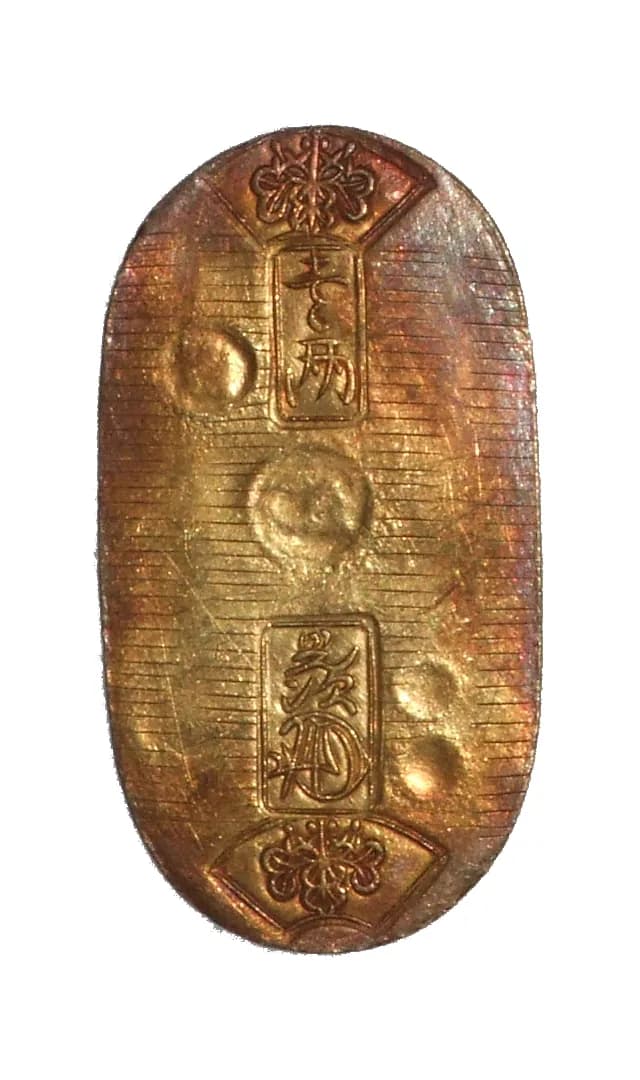
The Tenpō Koban (天保小判), minted by the Edo shogunate over roughly twenty years from Tenpō 8 (1837) to Ansei 5 (1858), was produced during a tumultuous era spanning the period just before the full onset of the late-Edo upheaval through the chaos that followed the opening of Japan. The specifications engraved on this gold coin and the background to its recoinage clearly reflect the shogunate's fiscal situation at the time.
What Is the Tenpō Koban? — A Gold Coin of the Late Edo Period
The Tenpō Koban is a gold coin minted by the Edo shogunate over roughly twenty years, from Tenpō 8 (1837) to Ansei 5 (1858). This period corresponds to a tumultuous era stretching from just before the full onset of the late-Edo upheaval to the chaos that followed the opening of Japan.
Specifications and Characteristics
The Tenpō Koban has a gold fineness of 56.8% and a weight of 11.2 g. This represents a specification made smaller and lighter than its predecessor, the Bunsei Koban (金品位 56.4%). The recoinage — which slightly raised the purity of the material while reducing the total amount of gold per coin — reflected the shogunate's fiscal strategy.
Background to the Recoinage
Tenpō 8 (1837), the year the Tenpō Koban was minted, falls just before the start of the Tenpō Reforms initiated by Senior Councilor Mizuno Tadakuni. At that time, the shogunate was suffering from chronic fiscal deterioration. Repeated famines and disasters, combined with the financial difficulties of the various domains, had caused revenues to decline sharply.
To break out of this dire situation, the shogunate carried out a recoinage under a new koban specification. The aim was to reduce material costs while securing seigniorage (profit from minting). This did not lead to any fundamental improvement in the underlying fiscal structure and instead paved the way for further currency recoinage in the late Edo period.
Scale of Circulation and Economic Impact
No definitive records of the total mintage of the Tenpō Koban have been confirmed. However, the high degree of its circulation suggests the expansion of the economic scale and the active circulation of currency at that time. For those wishing to learn more about Edo-period gold coins in general, please refer to Introduction to Edo Gold Coins (Koban and Ōban).
The Origins of the Tenpō Koban and Present-Day Valuation Criteria
The Tenpō Koban is an Edo-period gold coin minted between 1837 and 1858, and its historical position greatly influences the evaluations made by modern collectors.
Japan during this period was an era in which foreign ships repeatedly arrived and the shogunate's finances were strained. The Tenpō Koban was designed to continue the lineage of preceding koban while responding to the political and economic demands of the time. The characters「壹两」and the paulownia crest of the Gosan no Kiri (五三の桐紋) inscribed on the obverse, along with the intricate arabesque (唐草紋) pattern, are designs that have long symbolized Japanese authority and express the dignity of the koban. These elements also served as a visual expression of the shogunate's governing foundation during an era of heightened diplomatic tensions.
The mintmark「光次」and the character「保」stamped on the reverse are the guarantee marks of the head of the Kinza Gotō family. This mintmark system is particular to the Tenpō Koban and makes it easy to distinguish from other koban. In terms of specifications, a fineness of 57% and a weight of 11.2 g form the standard, indicating a pure gold content of approximately 6.4 g. The diagonal file marks applied to both obverse and reverse functioned not merely as decoration but as a practical identification element for fraud prevention and for indicating the coin's gold quality.
Today, when collectors evaluate the Tenpō Koban, the relationship between this historical background and its specifications serves as an important criterion. The fineness of the design, the condition of the mintmarks, and the regularity of the file marks in individual specimens are interpreted as reflections of the minting technology and the shogunate's intentions of the time. Furthermore, the limited minting period of 1837 to 1858 is recorded as a factor related to the assessment of this coin's rarity.
Recent Market Price Levels Across the Entire Edo Gold Coin Category
The median hammer price across the entire Edo gold coin category over the most recent 90 days (reference date: 2026-09-04) is ¥12,900, based on one hammer sale. In the 90 days preceding that, the median was ¥40,000 (5 sales). However, since both periods have fewer than 10 sales as their basis, no rate of change or confidence level has been calculated.
These figures are statistics covering the entire Edo gold coin category and should not be taken as the market price for the Tenpō Koban specifically. The category includes multiple types such as the Ichishugin, Ichibugin, and Man'en Koban, and price ranges differ greatly depending on individual variety and condition.
Looking at actual hammer sales in the most recent 90 days, while there are multiple transactions at around ¥1,500, high-value hammer sales such as a Man'en Koban at ¥100,000 and a Man'en gold San-ryō at ¥35,000 have also been recorded. The lowest hammer sale was ¥500. In this way, a spread ranging from several hundred yen to over ¥100,000 arises even within the same category, and it can be seen that individual differences in variety, mintage year, minting location, and condition greatly affect prices.
The median of ¥40,000 in the prior period (the 90 days before that) reflects the fact that several relatively high-value hammer sales — such as ¥40,000, ¥100,000, and ¥35,000 — were included. By contrast, in the most recent period, low-value transactions such as ¥1,500, ¥1,500, and ¥1,100 have come to make up the majority of the sample. Given the small sample size, it is not possible to draw definitive conclusions about statistical trends, but it is a fact that the composition of hammer sales across the category has changed.
To get a sense of the market for the Tenpō Koban specifically, it is effective not only to look at category-wide trends but also to view the hammer sale history in a list to confirm individual transactions for the same variety.
The Tenpō Koban's Position Within the Series of Edo-Period Koban Recoinages, and Its Value Conditions
The Tenpō Koban occupies a transitional position in the history of koban recoinages during the Edo period. Its characteristics become clear when compared with its immediate predecessor, the Bunsei Koban (1818–1837). While the gold fineness is nearly equivalent at 56.4%, the weight was reduced from 13.0 g in the Bunsei Koban to 11.2 g. This reduction is material evidence indicating that the shogunate's fiscal situation had grown severe.
The relationship of the Tenpō Koban to the subsequently minted Ansei Koban (1859–1860) and Man'en Koban (1860–1867) also forms an important background for value judgments. These later koban faced the economic turmoil following the opening of Japan and the collapse of the shogunate's finances; the Tenpō Koban is recorded as the last koban to maintain a certain level of gold fineness while still situated within the trend of declining weights.
From the standpoint of authentication, the Tenpō Koban has characteristics that make it relatively easy to distinguish. The basic measured value is around 11.2 g, and visual inspection of the mintmark and file marks can eliminate many counterfeits. Authentication Methods presents detailed verification methods, and the existence of materials that are easy for beginners to reference is part of what makes this denomination a good entry-level coin.
Liquidity in the market is also a factor that differentiates value. The Tenpō Koban has a high number of transactions, and records indicate that the spread between bid and ask prices is relatively narrow. This indicates the depth of a market in which collectors and enthusiasts participate continuously, leading to a tendency for large losses to be less likely at the time of future sale.
The difference in value due to grading (condition assessment) cannot be ignored either. As shown in Standards and How to Read Coin Grading, transaction prices for the Tenpō Koban can vary even for the same coin depending on its condition. This is the most direct factor in the value judgment of individual specimens.
The Tenpō Koban is recorded as a denomination that functions as an entry-level subject for coin collecting in three respects: its significance in the economic history of Edo-period koban, the practical ease of authentication, and its market liquidity.
Authentication and Condition Assessment — Points to Check Before Purchase
When acquiring a Tenpō Koban, the first thing to confirm is its authenticity. The basics of authentication can be summed up in a "three-point check."
First, measure the weight. A genuine Tenpō Koban is around 11.2 g. Second, observe the sharpness of the「保」mintmark on the reverse. Third, examine the regularity and depth of the file marks. On a genuine coin, the file marks on both obverse and reverse are carved at roughly 45 degrees, at equal intervals, and deeply, serving as traces of the advanced minting technology of the time.
Counterfeits, by contrast, often have shallow and irregular file marks, a weak impression in the mintmark, and an overall rough finish. For sophisticated modern fakes, X-ray fluorescence analysis to confirm the gold fineness is effective. The normal range for the gold fineness of a Tenpō Koban is 56–58%, and if it deviates significantly from this, there is a possibility that the material is different. For more detailed fake identification, please refer to the Complete Guide to Identifying Fakes and Altered Coins.
Next, evaluate the condition (grade). Since market prices fluctuate significantly depending on condition, confirmation before purchase is essential. The most important factors in condition assessment are the luster of the surface, the remaining state of the file marks, and the sharpness of the mintmarks. The better these are, the higher the evaluation and the higher the prices seen in market transaction records. Minor scratches, wear, and discoloration also affect the evaluation. Slabbed coins graded by third-party grading services such as PCGS or NGC tend to carry a price premium of approximately 15–30% compared to raw coins of the same grade. For standards on coin grading, see Coin Grading Standards for a detailed explanation.
After acquisition, attention to storage conditions is also necessary. Fluctuations in humidity and temperature can cause corrosion of the gold and damage the surface condition over the long term.
The Market Position of Late Edo Gold Coins as Demonstrated by the Tenpō Koban
The Tenpō Koban is the koban minted in the greatest quantity between 1837 and 1858, and is a gold coin that symbolizes the economy of the late Edo period. As described in the body of this article, the large mintage and the variation in condition are what clearly bring to light the price differences when it is traded in the market.
What market records reveal is the fact that the Tenpō Koban is not merely an old coin but a gold coin for which active trading continues. Hammer sale records from the past twenty years show an average annual price increase of 3–5%, which can be read as the result of the complex interplay of the value fluctuations of gold bullion itself, historical rarity, and the movement of the collector population. In particular, high-grade specimens are limited in absolute number, so the limited frequency of their appearance in the market influences price formation.
The Tenpō Koban's reputation is also established in international markets. Slabbed coins certified by PCGS and NGC are regularly traded at major auction markets in the United States, Europe, China, Taiwan, and elsewhere, and cases in which overseas hammer prices equal or exceed domestic market prices are increasing. This is a record showing a rise in international credibility and signifies a diversification of sales channels.
ITTENDO's perspective is to understand the value of the Tenpō Koban from the standpoint of "what differentiates prices." Individual differences in mintage year, reverse characters, minting location, and condition are directly connected to market evaluation.