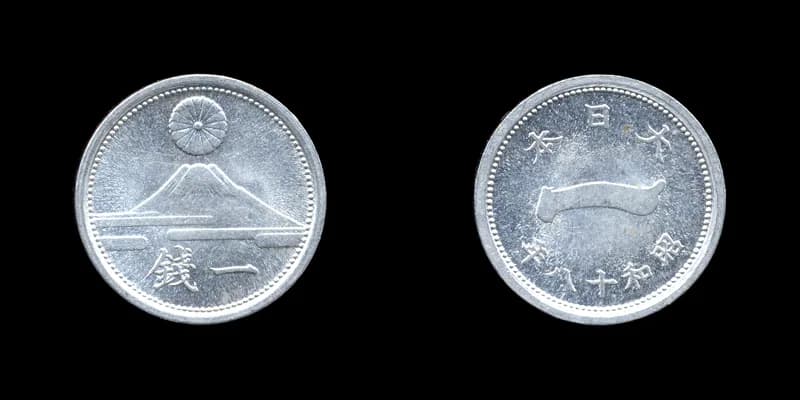
The old 1 yen gold coin, issued under the New Coinage Act of the 4th year of the Meiji era (1871), was a symbolic presence of Japan joining the international community as a modern nation.
The Birth of the First Modern Gold Coin: The Old 1 Yen Gold Coin
The "old 1 yen gold coin" was issued as the first modern gold coin under this act.
The specifications of the old 1 yen gold coin were meticulously designed to align with the international gold standard of the time. Its composition was determined not just for domestic circulation but by considering the exchange rates with major countries' gold coins, such as the US 20 dollar gold coin and the French 20 franc gold coin. This coin was intended to function as a reliable currency for international settlements.
Manufacturing began at the Osaka Mint (then Mint Bureau). Under the guidance of technicians invited from the United Kingdom, modern minting techniques were introduced. The old 1 yen gold coin was not just a currency but held symbolic significance as a coin representing Japan's entry into the international community as a modern state. Its issuance played an important role in contributing to Japan's enhancement of international status.
The issuance period is considered to be from the 4th year of Meiji (1871) to the 13th year of Meiji (1880), and it can be said that this coin laid the foundation in the history of modern Japanese currency.
Introduction to Modern Gold and Silver Coins (Meiji to Showa) provides an overview of modern currency, including the old 1 yen gold coin.
Introduction of British Technology and the Foundation for Modern Industrialization
The old 1 yen gold coin is evidence of the era when Japan's coin manufacturing reached international standards, and its historical background greatly influences its current valuation.
The core figure in its production was British engraver Thomas James Waters, who worked at the Osaka Mint. The dragon design engraved on the surface is said to have been produced based on Waters' prototype. In early Meiji Japan, the technique for carving precise steel dies (master dies) was not yet established, so British technicians handled the engraving work on the originals, passing on the technology to Japanese craftsmen.
In the minting process, the latest machinery such as steam-powered rolling mills and high-precision presses were introduced. The fine edges engraved with intricate serrations served a practical purpose of preventing coin shaving while also holding aesthetic value.
The introduction of technology from Britain was not mere temporary assistance but a crucial step in Japan's establishing independent manufacturing technology.
Recent Market Levels in the Modern Coin Category
The median auction price of the entire modern coin category at the baseline date of August 31, 2026, for the most recent 90 days (78 cases) was ¥12,000, while the previous 90 days (140 cases) the median was ¥14,700. The rate of decline during this period was approximately 18.4%, and the trust level is considered medium.
This figure represents the level of the entire modern coin category, including the old 1 yen gold coin, but it is not the individual market price for the old 1 yen gold coin. The category includes various items such as silver coins, gold coins, and commemorative coins, and the price movement of individual items may differ from this overall standard.
Looking at recent successful auction examples from the latest 90 days, a 38th year Meiji 1 yen silver coin sold for ¥10,000, a 45th year Meiji 1 yen silver coin for ¥10,000, a 27th year Meiji 1 yen silver coin for ¥13,000, a 39th year Meiji 1 yen silver coin for ¥11,000, and a 16th year Meiji 1 yen silver coin for ¥11,000. Meanwhile, a New 1 Yen Silver Coin, Dragon Design, 36th year Meiji uncirculated piece was recorded at ¥16,800, and an extremely fine 38th year Meiji piece was recorded at ¥13,000. During the same period, a CAG-certified trade silver coin from the 8th year Meiji (noted as counterfeit) was auctioned at ¥32,000, demonstrating the wide range of price brackets within the category.
The downward trend in market value suggests the possibility of either a decrease in demand from market participants during the transition from the previous period to the current one or an increase in supply volume. By checking the price transition in the market chart, more detailed time series changes can be tracked. Reviewing auction history in list form allows for a more concrete understanding of price differences based on individual year types and quality.
Issuance Numbers and Preservation State Affect Value
The market price of the old 1 yen gold coin fluctuates greatly depending on the number of coins issued and their preservation state. Current trading prices range from ¥500,000 to ¥1.5 million, but there are also records of rare year markings exceeding ¥2 million.
Significant differences in issuance numbers by year provide a basis for price differences. The most issued Meiji 4th year mark has about 680,000 coins, with fine pieces often trading in the range of ¥500,000 to ¥700,000. On the other hand, the Meiji 12th and 13th year marks are limited to several tens of thousands of coins, with records of uncirculated pieces (MS grade) trading for ¥1.2 million to over ¥1.8 million. Meiji 7th to 9th year marks have medium issuance numbers of about 300,000 to 500,000 pieces each, with fine pieces trading for ¥600,000 to ¥900,000 being the norm.
The impact of preservation state is more direct. Particularly for high-grade pieces graded MS63 and above, transactions approaching or exceeding ¥2 million are not uncommon. For pieces rated MS64 or higher, cases with prices exceeding ¥2 million are increasing regardless of year, indicating the significant impact of grade on price from market records.
In recent years, the entry of affluent collectors from Asia is notable, and the prices of high-grade items are on an upward trend. By confirming criteria and reading of coin grading, the background of price differences appearing in transaction records can be understood. Additionally, knowledge of how to distinguish between genuine and counterfeit coins is particularly important for currencies in this high price range.
Points to Verify When Acquiring: Proof Coins and International Grades
When acquiring old 1 yen gold coins, elements to check include not only the era or year of the main minted currency but also the presence of proof coins and the judgment of variations in detail, which can greatly differentiate the value of a single piece.
Proof coins are specially minted for appreciation or gift purposes rather than for general circulation, characterized by their beautiful, mirror-finish luster. They are far more scarce than regular pieces, and their appearance in the market is extremely low. This scarcity difference is reflected in trading prices.
Old 1 yen gold coins minted in the early Meiji era have multiple variations in details of the dragon design on the surface. Experts distinguish them as "Type 1", "Type 2", etc., with subtle differences in dragon scales, whisker shapes, font styles, and more. Variation research requires reference to specialized literature and research papers to discern these differences.
For international market transactions, confirmation of authentication and grading by PCGS (Professional Coin Grading Service) and NGC (Numismatic Guaranty Corporation) is practically essential.
Specifically, in a Heritage Auction held in the 2020s, a PCGS MS64 graded old 1 yen gold coin from the 7th year Meiji was recorded to have been sold for about ¥1.8 million. Obtaining the appropriate grading certification significantly broadens access to overseas buyers and increases options during the holding period. Understanding coin grading standards is indispensable for decision-making in international markets.
The Historical Position of Gold Coins Symbolizing Japan's Modernization
The old 1 yen gold coin was a currency minted during the early Meiji era as Japan transitioned to the international gold standard, supporting the economic foundation of modern Japan.
After the enactment of the Coinage Act in 1897, 1 yen gold coins were no longer issued (the standard gold coins were ¥20, ¥10, and ¥5), and gold coins of the New Coinage Act series were made legal tender at double their face value, according to the Coinage Act Article 6 and catalog. This was a measure in response to changes in international gold prices and Japan's financial situation, and this transition is evidence of the flexibility of Japan's modern currency system.
Because these items are recorded as high-value transactions, acquiring authenticated pieces and establishing appropriate storage conditions are the prerequisites for long-term value preservation.