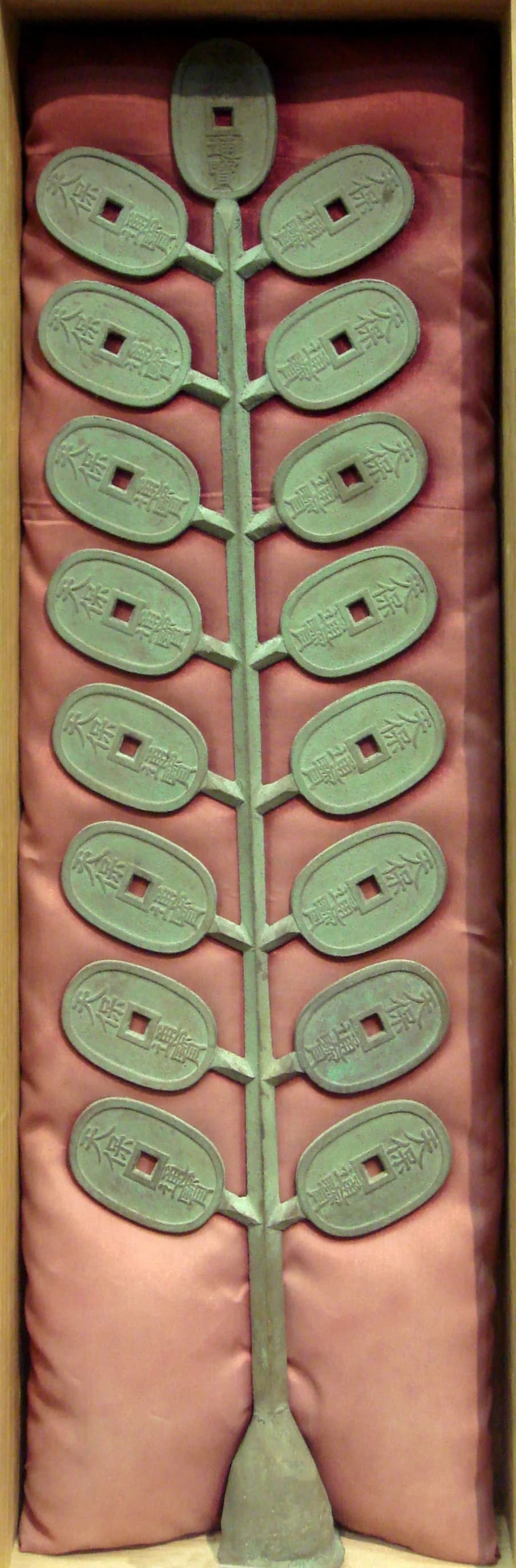
The Tenpō Tsūhō (天保通宝), minted in 1835 against the backdrop of the shogunate's fiscal crisis in the late Edo period, was a coin divided into two lineages: the Honza coins (本座銭) manufactured with official shogunate authorization, and the Mitsuchū coins (密鋳銭) secretly cast by domains throughout the country. It is this difference in origin that remains the single greatest factor determining a coin's present-day valuation.
A Large Hyaku-Mon Coin Minted in the Late Edo Period
The Tenpō Tsūhō is a large copper coin whose minting began in 1835, in the late Edo period. It was issued as a "hyaku-mon coin" (当百銭, hyaku-sen) with a face value equivalent to one hundred mon.
Its most striking feature is its size: whereas the conventional Kan'ei Tsūhō (寛永通宝) had a diameter of approximately 25 mm, the Tenpō Tsūhō is oval-shaped, measuring approximately 49 mm vertically and 33 mm horizontally—roughly twice as large. At its center is a square hole, expressing its essential nature as a hole coin (穴銭, anasen). The obverse bears the characters "天保通寳" and the reverse bears the characters "當百." The standard specifications are a weight of approximately 20.6 g and a thickness of approximately 2.5 mm; its imposing appearance has attracted many collectors owing to its visual appeal.
The purpose of minting this coin was to make up for the shogunate's strained finances. The Tenpō era was beset by repeated famines and foreign crises, leaving the government in extremely dire fiscal straits. The shogunate sought to record as revenue and use as a financial resource the "deme" (出目)—that is, the profit derived from the difference between a coin's face value and its material value—obtained through currency recoinage.
At the time, the material value of copper fell far short of one hundred mon, making this effectively an inflationary policy aimed at capturing seigniorage. Consequently, in private commerce the coins were often traded at rates far below their face value, and they carried almost no worth at par. This gap between actual market value and face value became a major factor inducing counterfeiting, ultimately undermining the "creditworthiness" that determines the value of old coins.
Honza Coins and Mitsuchū Coins—Official Shogunate Authorization and Secret Domain Casting
The single greatest factor determining the present-day valuation of Tenpō Tsūhō is the origin of their casting. This is because two lineages circulated: the "Honza coins" (本座銭) manufactured with official shogunate authorization, and the "Mitsuchū coins" (密鋳銭) produced by various domains while evading the shogunate's notice.
Honza coins were manufactured at coin mints (Fukagawa Ishihara and Koume) overseen by the Goto family of the Edo gold mint. Honza coins documented in the historical record have sharply rendered characters and an exceptionally careful finish, with uniform quality. The prestige the shogunate staked on the manufacturing system is inscribed in each individual coin.
Mitsuchū coins, by contrast, were produced by many domains throughout the country, including the Satsuma, Mito, and Tosa domains. This was done either to supplement strained domain finances or to meet circulation demand within their territories. Although they were subject to shogunate crackdowns, the volume in circulation reached a scale that could not be ignored. Some Mitsuchū coins possess distinctive characteristics not found in Honza coins, and they continue to attract attention today as collector's items.
The characteristics of Mitsuchū coins differ by place of origin. Those from the Satsuma domain are of relatively high quality, and some are so precise that they are difficult to distinguish from Honza coins; however, their average weight tends to be slightly heavier than that of Honza coins (approximately 20.6 g), typically ranging from 21 g to 23 g. Mito domain coins show characteristic differences in the first stroke of the character "天" (ten) and in the brushwork of the character "保" (ho). Tosa domain coins are of somewhat rougher copper quality, and many individual examples have shallowly incised characters.
Mitsuchū coins were also produced in many other domains across the country, including Chōshū, Okayama, and Hizen. Identifying the place of origin requires a comprehensive assessment involving weight measurement, calligraphic style comparison, and observation of the copper's color. The subject is so deep that even experts sometimes disagree, and it is precisely this diversity that lies at the heart of Mitsuchū coin collecting. The questions of whether a coin is a Honza or Mitsuchū coin, and from which domain it originates, greatly affect the valuation of a single piece.
Recent Market Price Levels and Fluctuations in the Hole Coin Category
The median hammer price for the hole coin category as a whole over the most recent 90-day period (as of the reference date of August 23, 2026) is ¥1,655, based on 49 transaction records. The preceding 90-day period showed a median of ¥1,500 (60 transactions), representing a rate of change of 10.3 percent increase. Since both periods have a sample size of at least 30 transactions, reliability is assessed as moderate.
This level reflects the overall market for the hole coin category as a classification, and is separate from price trends for Tenpō Tsūhō individually. The category includes multiple coin types such as Kan'ei Tsūhō and Tenpō Ichibugin (天保一分銀), each of which has its own different trading level.
Looking at hammer price examples from the most recent 90 days, the price range is wide. The highest price was ¥10,000, recorded on August 11, 2026 (Shin Kan'ei Tsūhō, Mitsuchū coin Morioka-sen gyōhō dō-utsushi, or Mitsuchū bosen). The lowest price was ¥790, also on August 11, 2026 (Japanese Edo-period Kan'ei Tsūhō, Ishinomaki iron coin, small character with reverse sen-shinkai-hō). In the mid-range, a Tenpō Ichibugin Pq-type fetched ¥4,480 on August 10, 2026, and a Kan'ei Tsūhō Sendai Ishinomaki coin with reverse "sen" sold for ¥3,400 on August 21, 2026.
The number of transactions near ¥1,500 is relatively high, indicating that this level forms the central price band for the hole coin category. Examples such as a Kan'ei Tsūhō at ¥1,500 on August 17, 2026, and Tenpō Tsūhō at ¥2,000 each on August 8 and August 23, 2026, constitute the general market sense for the category as a whole.
Check price trends on the market chart to conduct a more detailed analysis of which coin types are driving this 10.3 percent increase.
Authenticity and Quality: Assessment Points and Their Impact on Hammer Value
The factors that most significantly affect the value of a Tenpō Tsūhō are the determination of authenticity—whether it is a Honza coin or a Mitsuchū coin, and whether it is a modern reproduction rather than a genuine piece.
Distinguishing Honza Coins from Mitsuchū Coins
Honza coins are precisely cast, with the outlines of the characters rendered sharply and uniformly. In particular, the angle and length of the first horizontal stroke of the character "天" (ten), and the way the strokes of the sennin (仙人) component of the character "保" (ho) connect, are important clues that distinguish Honza coins from Mitsuchū coins. Mitsuchū coins, by contrast, often have less well-defined character outlines and irregularities in the thickness of the coin's rim.
Weight is also an indicator for assessment. The average weight of Honza coins is approximately 20.6 g, whereas Mitsuchū coins range from 18 g to 23 g depending on place of origin and manufacturing technique. Those that deviate substantially from this prescribed value are likely to be Mitsuchū coins. The shape and position of the hole and the color of the copper are also factors to verify. Using a loupe to observe the fine finish of the coin's rim and the depth of the character incisions enables a more accurate determination. Since the assessment changes with the degree of wear, it is important to practice judging the condition of individual coins by referring to the standards for old coin grading.
Modern Reproductions and Edo-Period Counterfeits
Owing to the popularity and high circulation volume of Tenpō Tsūhō, inexpensive reproductions made of brass or zinc alloy for use as souvenirs or decorative items continue to circulate to this day. These are markedly light in weight (around 12–15 g), have uniform color, and exhibit excessive luster. They are characterized by the absence of casting-surface traces and an unnaturally smooth surface. Genuine Edo-period examples show the roughness in the casting surface that arises from the manufacturing process, as well as the natural patina (verdigris) and traces of use that develop over many years.
During the Edo period, counterfeit coins known as "shichūsen" (私鋳銭, privately cast coins) also existed without shogunate authorization. Because these were made by smelting copper using the technology of the time, some are difficult to distinguish. However, modern reproductions can be easily identified with a precise scale. Problems involving beginners purchasing reproductions as antiques are unceasing; to avoid trouble, it is most important to read carefully the guide on how to distinguish genuine from fake coins and to purchase from a trustworthy old coin dealer.
Points to Check When Acquiring or Holding Tenpō Tsūhō
When acquiring a Tenpō Tsūhō, the first priority is confirming quality and provenance. According to market records, standard Honza examples trade in the price range of approximately ¥5,000–¥15,000, with well-preserved fine (美品) and gem (極美品) specimens achieving higher hammer prices. Rare Mitsuchū coins and calligraphic variants can reach tens of thousands to hundreds of thousands of yen, and bosen (母銭, pattern coins used before circulation) have recorded transaction prices exceeding ¥300,000 and sometimes surpassing ¥1,000,000.
At specialist auctions, more than several dozen examples are offered annually, and Mitsuchū coins with clearly identified place of origin, calligraphic style, and copper purity tend to command higher prices due to their rarity. Because the coins are large and visually striking, there is also demand from overseas collectors attracted by their impressive display quality, placing them among the more liquid items in the hole coin genre. The fact that high-quality Honza examples show stable hammer prices is another reason they are easy to compare as collector's items.
For storage and management, please strictly observe the following points.
Given the large size of Tenpō Tsūhō, storing them individually in coin holders (coin slabs or airtight cases) is strongly recommended. As is common to copper objects in general, humidity promotes the development of verdigris, so the basic principle is to store them in a well-ventilated place away from direct sunlight. Using a desiccant in combination is also effective.
If verdigris has already formed, it is important not to try to remove it forcibly. Cleaning with metal polish or abrasives will scratch the surface and significantly diminish the value, so this should be avoided. If professional cleaning is deemed necessary, it is advisable to consult a specialist old coin cleaning service. Since some Mitsuchū coin examples are prone to rust due to inconsistent copper quality, it is reassuring to develop the habit of regularly checking their condition. By practicing the correct storage methods for old coins, you can preserve the value of your treasured collection for a long time.
The Position of Tenpō Tsūhō as a Large Hole Coin for Collectors
The Tenpō Tsūhō is one of the most commanding pieces among Edo-period hole coins. The diversity of Honza coins and Mitsuchū coins is the characteristic that shapes its value as a collectible.
Standard Honza coins serve as an entry point into the world of old coins for beginners. The sense of weight and size when held in the hand provides a satisfaction unavailable from other, smaller hole coins. Prices vary greatly depending on condition; market records show roughly ¥3,000–¥8,000 for average examples, ¥10,000–¥25,000 for fine examples, and ¥30,000–¥70,000 for gem examples. These price differences are directly tied to the condition of each individual coin—the sharpness of the characters, the uniformity of the verdigris, and the presence or absence of traces of use.
Mitsuchū coins likewise present differences in calligraphic style and weight by place of origin as subjects for observation. Individual examples cast at coin mints in various locations—background types such as Haisoku (背足), Haisa (背佐), Haimori (背盛), and Haisen (背千)—form a wide price range from ¥3,000 to hundreds of thousands of yen. Records exist of bosen exceeding ¥300,000. A precise scale makes it straightforward to distinguish genuine Edo-period examples (19 g to 22 g) from modern reproductions (12 g to 15 g).
Collecting Tenpō Tsūhō is not merely a matter of accumulating individual pieces; the value lies in the process of deepening one's knowledge through identifying places of origin and observing calligraphic styles. Understanding the differences between Honza and Mitsuchū coins, and the price fluctuations driven by condition, makes this a coin through which one can advance step by step from beginner to experienced collector.