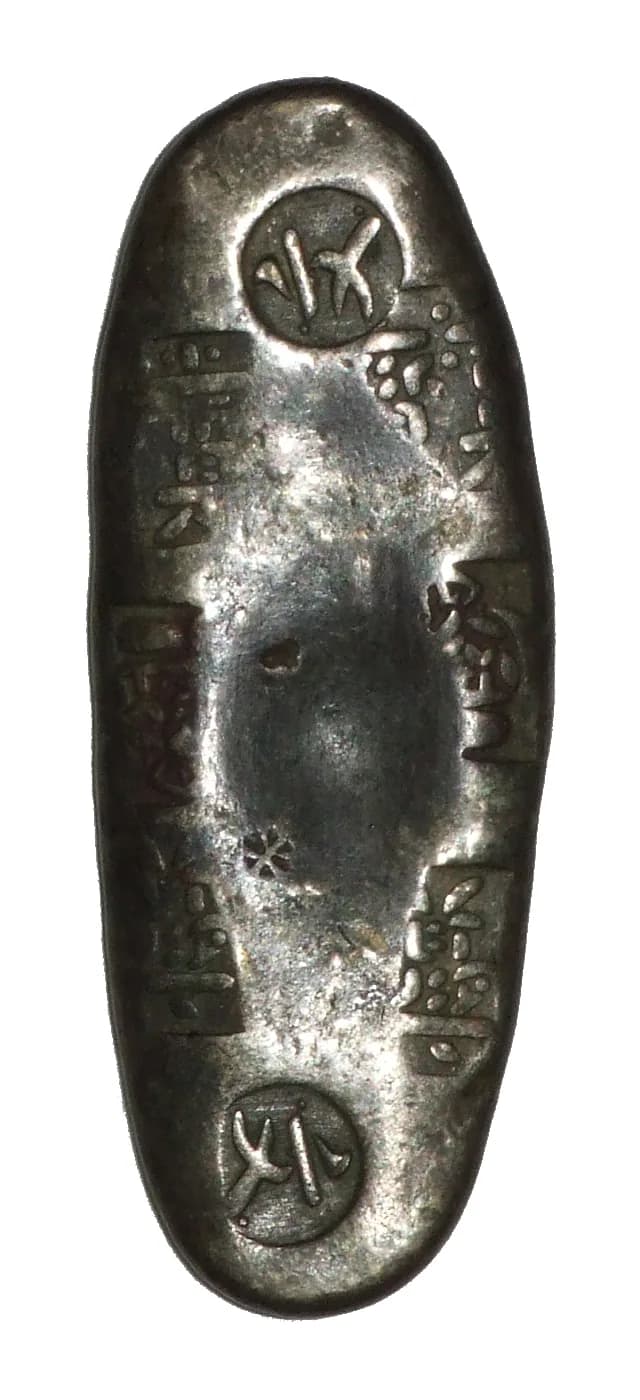
In "Today's Coin Spotlight," we pick up one item from the coin encyclopedia and clearly organize how to view its market price and value. Today we cover the Genroku Chōgin (元禄丁銀), a representative Edo silver coin. The Genroku Chōgin is of deep historical significance; authenticating it is important, and it has earned a stable reputation as a collecting target for advanced collectors.
What Is the Genroku Chōgin? — Grasping the Basics of Edo Silver Coins
Edo silver coins circulated from the Keichō era through the end of the Edo period as weighed silver currency (称量銀貨) in the forms of chōgin (丁銀) and mameitagin (豆板銀). The silver purity was lowered with each recoinage, so even coins called "chōgin" differed in content depending on the period. The quickest way to understand the Genroku Chōgin is to first grasp the framework of this era. You can systematically review the foundational knowledge at A Detailed Overview of Edo Silver Coins (Chōgin and Mameitagin).
A key perspective when understanding old coins is that currency was a product of the economics and institutions of its time. Knowing the background — who minted it, in what era, and for what purpose — transforms a single old coin from a mere ancient piece of metal into a historical document that reflects its age. Edo silver coins, too, carry the social circumstances of each period, and grasping that context sharpens the accuracy of value judgments.
If you are starting a collection, we recommend first learning the names and characteristics of representative coin types and looking at a large number of photographs of actual specimens. Getting a handle on basic points of interest — such as the style and form of the characters, and the color of the metal — will serve as the foundation for later authentication and market assessment.
The range of what the term "old coins" covers is broad, spanning from round copper cash to large coins like koban, to modern coins and commemorative currency. Because each has its own distinct materials, manufacturing methods, and circulation history, it helps to first get the major categories into your head and decide where your own interest lies, so that you can map out a clear path of learning. When you dig deeply into one field, related coin types and historical context become understandable in a chain reaction, and your knowledge develops in a three-dimensional way.
Three Factors That Determine Value — Rarity, Condition, and Demand
The value of an old coin is determined by three axes: "rarity," "preservation condition (grade)," and "market demand." Even among the same type, prices can diverge by several times to several tens of times depending on whether it is a mother coin or a circulation coin, differences in script style, and whether the condition approaches mint state. Standards and How to Read Old Coin Grading is a helpful reference for thinking about condition assessment, and the overall structure of value is explained in detail at Factors That Determine the Value of Old Coins.
Rarity skyrockets for coin types with low mintage or limited surviving specimens. Types that were produced only for a short period, or denominations that circulated only in specific regions, are highly valued because the very opportunity for them to appear on the market is limited.
Preservation condition is judged by the sharpness of characters and designs, and by how little wear the surface has sustained. Specimens that circulated for a long time show advanced wear, and the crisp engraving from the time of minting is lost. The basics of grading are also covered at Basics of Old Coin Grading.
Demand is determined by the depth of the collector base paying attention to that coin type. Coins with high popularity have many potential buyers and a stable market price, while coins with low attention can see prices move dramatically on a single transaction.
These three factors are not independent; they influence each other. Even a rare coin type will not gain a high evaluation if its condition is poor, and even a coin in excellent condition will be hard to price if there is no demand. Conversely, a specimen that combines all three — rarity, condition, and demand — is highly valued in the market and retains its value over the long term. Making a value judgment is nothing other than the work of reading the balance of these three axes in a comprehensive way.
For beginners, the quickest path is to first develop an eye for assessing condition. Rarity and demand become visible through the accumulation of knowledge and experience, but the quality of condition can be judged relatively quickly by looking at many actual specimens.
It helps to think of condition assessment as having a certain number of stages. From specimens that retain the sharpness of the time of minting to those showing advanced wear from circulation, condition changes continuously. Since the price changes in steps depending on where a specimen falls on that continuum, identifying which stage the specimen in your hands occupies leads to buying and selling at an appropriate level.
How to Read the Market — Distinguishing the Median from Thin Trading
The Genroku Chōgin is a weighed silver currency whose minting began in 1695 (Genroku 8). At the time, the Edo shogunate was facing severe financial difficulties due to repeated disaster relief efforts and increasing fiscal expenditures. To overcome this predicament, under the reign of the fifth shogun Tokugawa Tsunayoshi, the Commissioner of Finance (勘定奉行) Ogiwara Shigehide proposed a groundbreaking recoinage.
His proposal was to boldly reduce the silver purity of the existing Keichō Chōgin from 80% to 64%. The purpose was to secure the resulting profit margin (demedē, 出目) from this reduction in purity as a source of shogunate revenue. This Genroku recoinage was the first large-scale reduction in purity in Japanese monetary history, and it holds extremely important significance in that it established a precedent for the repeated recoinages that followed.
Throughout the Edo period, changes in the purity of currency became an important lever of shogunate finance. The appearance of the Genroku Chōgin was not merely a change in currency; it is a key reference for understanding the economic conditions and fiscal policies of the shogunate at the time.
When looking at price trends, the basic approach is to use the median rather than the average as a benchmark. For coin types with few transactions, the overall market price tends to be pulled by a single high-winning-bid result — this is the so-called "thin trading" (薄商い) condition. Make sure to distinguish between moments when genuine demand has emerged and movements caused by a single isolated transaction. You can check the latest price movements at View Price Trends on the Market Chart, and the degree of overheating across entire categories at View Market Temperature by Category Heatmap.
It is also important not to confuse listed prices with realized prices. The asking price at the time of listing reflects only the seller's wishes; the price at which a transaction actually concluded is what speaks to the true market price. Gathering multiple examples of realized transactions and looking at the spread of prices will tell you whether that coin type is seeing thick or thin trading. Past auction records can be reviewed at View Auction Realized Price Data in List Form.
Another thing to be mindful of when reading the market is the difference in the venue where transactions take place. Specialized dealer shops, online auctions, and flea-market apps each have different pricing dynamics and buyer profiles. Even for the same coin type, price levels can differ depending on the venue, so building a market perspective by looking across multiple channels will keep you from being led astray by the overpricing or underpricing that forms within a single venue.
It is important to read numbers with a cool head, but also including the background. When a realized price is high, having the perspective to distinguish whether that reflects the coin type's intrinsic value or coincidental factors — such as the timing of the listing or the presence or absence of competing bidders — increases the accuracy of market judgment.
There is also room for creativity in how you frame the time axis. Looking at only the most recent few transactions makes it easy to be swayed by temporary overheating or cooling, so it is prudent to look at realized price trends over a span of six months to several years, and to separately capture the long-term trend and short-term fluctuations. Seasonal factors also deserve attention: during periods when more items are listed, choices increase and prices tend to settle; during periods when listings thin out, buying concentrates on quality specimens. Knowing the cycle of supply and demand allows you to wait calmly and choose opportunities with favorable conditions.
Structural Background of the Market — How Supply and Demand Are Determined
The market price of Edo silver coins is shaped by the balance of supply and demand. Because old coins are no longer newly produced, supply is limited to existing specimens. High-quality specimens gradually leave the market over time, and rarity tends to increase as the years pass.
On the demand side, conditions fluctuate due to external factors such as shifts in collecting popularity, media coverage, and advances in research. When a particular coin type attracts attention, the number of buyers increases and the market tightens; when interest wanes, trading thins and prices settle. Understanding these waves of supply and demand makes it easier to avoid being buffeted by price swings. The concept of cycles in which market prices move is also organized at Understanding Old Coin Market Cycles.
The market contains both readily available common items and rare items that are seldom listed at all. Common items have stable prices and are suitable for beginners, while rare items attract multiple collectors competing whenever they appear. Identifying which of these two natures applies to the coin type you are looking at is the starting point for sound buying and selling.
The characteristic that supply moves in only one direction — decreasing — creates a market structure unique to old coins. High-quality specimens gradually disappear through handling and aging, and no new perfect specimens are ever created. This one-way increase in rarity underpins long-term value, and it is also the reason that collecting takes on the aspect of historical preservation rather than mere consumption.
We should also keep an eye on external factors that move supply and demand. Events such as exhibitions, media coverage, publication of research results, and the release of related books can temporarily boost interest in specific coin types. Markets that overheat due to surging interest often return to prior levels once attention subsides, so the cool-headedness not to grab at high prices in the midst of a trend is required.
Practical Aspects of Authentication — How to Assess Condition and Authenticity
In the practical work of evaluating old coins, the first step is to check the script style of the characters and design, then measure the diameter and weight (量目) and compare them against specified values. Finally, you examine the surface for wear and any post-production alteration to determine how well the appearance at the time of minting has been preserved. Keeping a record of measurements gives you a scale of reference when comparing against other specimens, and increases the reproducibility of your judgments.
Authenticity verification requires greater caution the higher the value of the coin type. Because elaborate fakes and specimens with altered condition can be mixed into the market, judgment must be made by integrating the details of weight, diameter, and script style. Key points for identification are summarized at How to Identify Fakes and Altered Coins.
When you feel uncertain relying on your own eye alone, the option of using evaluation by a third-party authentication organization is also available. Since the condition of authenticated specimens is guaranteed, the burden of judgment is reduced for both parties in a transaction.
The basic approach to observation is to examine fine details using a loupe in a well-lit environment. Check carefully how much of the raised parts of the characters remain, and whether there are any unnatural scratch marks or signs of repair on the surface. Observing not just the front but also the reverse and the edge (side) of the coin provides clues about the manufacturing method and lineage, increasing the reliability of your judgment.
The more sophisticated a fake or alteration is, the harder it is to detect from a single point of observation. Cross-referencing multiple perspectives — weight, dimensions, script style, and surface — and maintaining a cautious attitude whenever even one of them raises a doubt will prevent losses before they occur. For high-value items where you are uncertain, it is wise not to force a self-judgment but to borrow the eye of an expert.
Having measurement tools at hand raises the accuracy of authentication by a full step. Measure the diameter and thickness with calipers, verify the weight with a precision scale, and compare those figures against the specified values for each coin type. Combining the qualitative clue of script style with the quantitative backing of dimensions and weight allows you to make judgments about lineage or authenticity — which cannot be narrowed down by appearance alone — with solid grounds.
Thinking About Storage and Long-Term Holding
The condition of old coins is greatly affected by their storage environment. Moisture and oxidation are the greatest enemies of metal, and copper and silver coins in particular suffer discoloration and corrosion in high-humidity environments. The basic approach to maintaining condition is to store coins individually in neutral storage materials in a dry place.
For long-term holding, rather than reacting to every short-term price movement, a disposition of maintaining condition and waiting for a phase of rising demand tends to be more rewarding. In the short term, market prices fluctuate with thin trading, but over the long term they converge on the fundamental value of rarity and preservation condition.
Keeping records of acquisitions also supports long-term holding. If you note when, in what condition, and at what price level each coin was acquired, you can understand the average acquisition cost across your entire collection and which coin types are missing, and it also becomes explanatory material at the time of sale. For coin types whose market price movements you want to track, it is convenient to register them at Monitor Coin Prices in the Vault.
Attention should also be paid to the choice of storage materials. Soft cases made of polyvinyl chloride (PVC) can damage metal surfaces with plasticizers, so choose materials that are neutral and sulfur-free. Storing coins in a place with minimal changes in temperature and humidity, and avoiding unnecessary contact with bare hands, are the basics for protecting condition over the long term.
What ultimately supports long-term holding is the accumulation of knowledge and records. Continuing to study the background of each coin type and keeping records of the circumstances of acquisition and condition allows you to develop your collection in a planned way. The more seriously you commit to the pursuit, the more your eye is refined and the higher the probability of encountering a truly valuable specimen.
Connection with the International Market
Japanese old coins attract interest not only domestically but also from collectors overseas. In recent years, there has been an increase in cases of overseas buyers entering the Japanese old coin market through cross-border e-commerce and online auctions. High-quality specimens and coin types with beautiful designs tend to be internationally appreciated.
However, international market evaluations often lean heavily on grades from third-party authentication organizations, and the emphasis differs from the Japanese domestic approach that prioritizes detailed classification. Depending on the coin type, domestic markets that share the culture of classification may more accurately reflect value; and the method of documentation required changes depending on whether you choose to sell domestically or overseas.
The growing international interest also stimulates domestic research and collecting. Overseas attention causes a re-recognition of the cultural depth of certain coin types, and the two-way exchange makes the market's overall valuation more three-dimensional.
If you are considering overseas transactions, extra care is needed in documenting condition and in packaging. Because buyers find it difficult to directly inspect the actual item, authentication organization grades and photographs recording condition become the foundation of trust. Packaging that protects against changes in temperature and humidity and against shock during shipping is also indispensable for preserving condition upon arrival.
Japanese old coins are positioned within the broader context of East Asian monetary history. Being conscious of connections with Chinese and Korean currency reveals a historical flow that transcends the framework of a single nation. Such a broad perspective not only deepens the enjoyment of collecting but also helps in viewing the value of coin types from multiple angles.
Mistakes Beginners Often Make
Common mistakes include: judging by appearance alone, taking authentication lightly, and plunging into high-value items right away. Especially for high-value coins, sophisticated fakes and altered specimens are more likely to be on the market, making it essential to measure weight and diameter and to check the fine details of script style.
Another pitfall is mistaking listed prices for market prices. If you see only an asking price and estimate the market to be high, you will end up acquiring at an inflated price. The habit of verifying levels with multiple realized-transaction data points supports sound judgment.
Polishing coins to improve their appearance is also something to avoid. Since the original surface and settled coloring of old coins are themselves what is evaluated, forcibly polishing them destroys surface information and actually lowers their value. Leaving them in their current state without intervention is ultimately the choice that protects value.
Rushing into buying and selling is itself likely to lead to mistakes. Good specimens will always come around if you wait, and simply avoiding phases when the market is overheated can dramatically change your acquisition cost. Rather than trying to acquire many at once, the attitude of accumulating one satisfactory specimen at a time will, in the long run, build a collection with a high degree of satisfaction.
Being careful not to rely too heavily on a single source of information is also worth keeping in mind. Words like "rare" and "precious" in listing titles are the seller's subjective opinion; actual value is told by the condition of the specimen and multiple realized-transaction data points. Cultivating the habit of judging by facts rather than words will allow you to continue on a sound path without being misled by exaggerated evaluations.
Carelessness in storage and handling is also a pitfall beginners tend to fall into. If you carelessly store coins in cheap storage materials and cause discoloration or corrosion, or if you damage the surface by touching them with bare hands, you will yourself diminish the value of the specimen you carefully selected. Directing as much awareness toward protecting coins as toward collecting them will support a collection you can live with over the long term.
ITTENDO's Conclusion
For beginners, the sound approach is to first enter zones with high transaction volume and thick price data. After understanding the impact that grade and script-style differences have on price, the attitude of waiting until multiple data points are available prevents mistakes with thinly traded coin types. With the Genroku Chōgin as well, the most important thing of all is to avoid rushing, to compare multiple transaction data points, and to steadily build your own framework for judgment.
Old coin collecting is a hobby whose enjoyment deepens the more your knowledge grows. The process of collecting while letting your imagination dwell on the eras, institutions, and lives of the people behind each coin brings a richness that cannot be savored from market numbers alone. If you use Edo silver coins as your entry point and gradually broaden your understanding of how to assess value and of history, your collecting will eventually bear fruit as a genuine connoisseur's eye.
At ITTENDO, we make it possible to track the "present" of old coins based on past auction histories and market charts. If you register categories of interest in the Vault, it becomes easier not to miss changes in market prices.
To Know Edo Silver Coins More Deeply
Old coin collecting is a hobby of tracing in the palm of your hand the history of currency stretching from the Edo period through the Meiji, Taishō, and Shōwa eras. In the short term, market prices fluctuate with thin trading, but over the long term they converge on the fundamental value of rarity and preservation condition. Above all else, it is important to avoid rushing, to compare multiple transaction data points, and to steadily build your own framework for judgment.