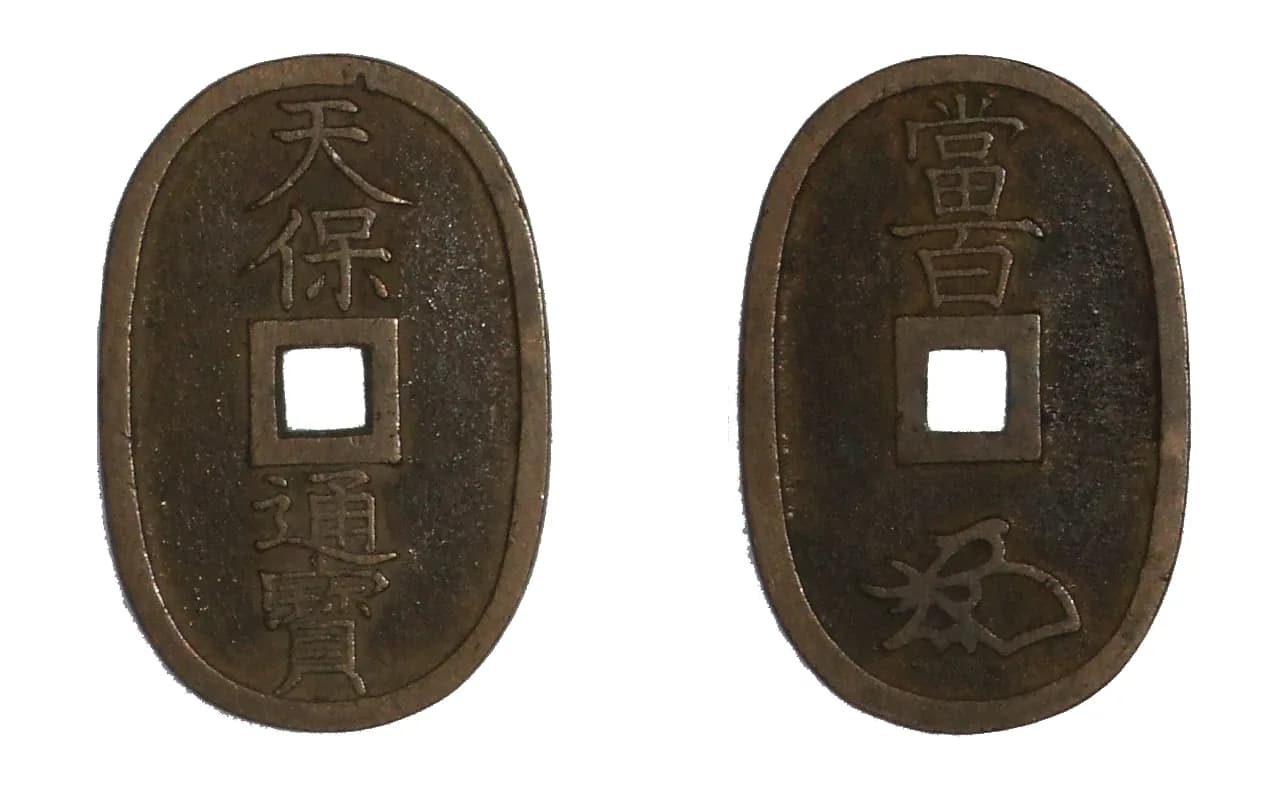
Even though they are all called "Tenpō Tsūhō," their values can range significantly from several hundred yen to hundreds of thousands of yen. Where does this price difference originate?
What is Tenpō Tsūhō? Its History and Diversity
Tenpō Tsūhō is one of the representative Japanese coins with a hole, which began issuance in the 6th year of Tenpō (1835), at the end of the Edo period. This coin, characterized by its rectangular hole, had a denomination 100 times that of an Ichimon coin, bringing significant changes to the monetary system of the time. Due to the economic conditions and financial difficulties of the era, it was minted in large quantities, making it relatively easy to acquire as an ancient coin today.
However, this "relatively easy to acquire" aspect can sometimes cause misconceptions among beginners. Tenpō Tsūhō has a wide variety of variations based on the period and place of issuance, and the mint where it was produced. These are called "tegarari," and each variation can greatly influence the rarity and market value of the coin.
For example, slight differences in shape, font style, edge thickness, or errors during production are important distinguishing points for collectors. Understanding these subtle differences is the first step to knowing the depth of Tenpō Tsūhō. This diversity is precisely what makes these coins an attractive target for collection.
Recent Auction Trends of Tenpō Tsūhō
In recent auctions, a certain type of "Mito coin" in extremely good condition fetched a surprisingly high price, even astonishing experts.
This result exemplifies how much rare specimens are valued, considering that typical Tenpō Tsūhō are traded for several hundred to several thousand yen. Similarly, unused or nearly unused rare "Satsuma coins" and "Hizen coins" also consistently maintain high price levels. These brands have very high demand among collectors due to their limited minting quantity or the very limited existence of high-quality specimens.
On the other hand, for the commonly mass-produced type known as "Honza coins," due to their high circulation volume, there is not much price fluctuation unless in extremely good condition. However, if unique variation points like font disparities or dot placements are discovered, the value can suddenly skyrocket. Thus, contrary to general perception, the Tenpō Tsūhō market displays very dynamic movements. Understanding the overall market trends involves learning the Basics of Coin Auctions.
Factors Influencing the Value of Tenpō Tsūhō [For Beginners]
The value of Tenpō Tsūhō isn't simply determined by its age. Beginners need first to understand that there are multiple factors that dictate its value.
[Condition (Grade)]
Condition is one of the most fundamental elements in assessing the value of ancient coins. It refers to how worn the coin is, whether there are scratches or dirt, and such physical preservation conditions. Coins graded closer to Uncirculated by grading agencies receive higher evaluations, thus increasing their price. Criteria such as whether the letters are clearly visible, edges are not flattened, and original luster remains from minting are important judgment bases. Even within the same variation, a single grade difference in condition can result in prices escalating several times, sometimes even dozens of times. Therefore, understanding Standards and Reading of Coin Grading is essential in coin collecting.
[Type (Tegarari)]
As mentioned earlier, Tenpō Tsūhō has countless variations referred to as "tegarari". These arise from differences in the minting mint (such as Honza, Mito, Satsuma, Hizen), production period, and even the mint worker, resulting in minor design and font discrepancies. Some variations were produced over a very short period or circulated only in specific areas, making existing specimens extremely rare. Differences such as font shapes like "Chōkaku", "Kōkaku", "Tankaku", and script styles like "Chōhō", "Seiji" are key points dividing the value. Getting familiar with the Coin Types and Classification System, including Tenpō Tsūhō, can help understand its value more deeply.
[Authenticity (Presence of Counterfeits)]
Unfortunately, the world of ancient coins includes counterfeits and processed items. The ability to discern authenticity is one of the most crucial skills in coin collecting. This is why expert appraisals and purchasing from reliable dealers are encouraged. Buying counterfeits equates to having a coin with zero value. Beginners, in particular, should learn Ways to Distinguish Counterfeits and Processed Items and avoid easy purchases.
Market Supply and Demand and Grade Band Rarity [For Intermediates]
The market price of Tenpō Tsūhō is formed by the balance of supply and demand, as well as the rarity within specific grade bands. This goes beyond mere object value, with market psychology and collector trends intricately interwoven.
[Fluctuations in Supply-Demand Balance]
While Tenpō Tsūhō generally has a high circulation volume, certain rare variants and high-grade items have extremely limited supply. Temporary demand factors include coverage in media or the auction appearance of notable collectors' collections. Such events can attract new collector demographics, leading to market activation.
Conversely, during recessions, asset liquidation can increase supply and soften prices. However, rare ancient coins act as "safe assets," less influenced by economic fluctuations, always maintaining a certain demand.
[Recent Market Trends]
The market for Tenpō Tsūhō shows a gradual uptrend over several years. Especially with the spread of grading by international agencies like PCGS and NGC, coins' conditions are objectively evaluated, and high-grade items show a stable upward price trend. This development provides a secure environment for collectors to confidently purchase high-quality coins.
However, there are instances where specific brands witness temporary spikes due to speculative moves. Such cases carry risks of price misalignment from actual demand, followed by sharp declines. Intermediates are required to thoroughly analyze past trading histories and market news, maintaining a calm judgment unaffected by short-term price movements. Checking price trends on Market Charts is effective for trend comprehension.
[Rarity within Grade Bands]
The value of Tenpō Tsūhō varies significantly by its grade band. For instance, many examples exist in the VF (Very Fine) class, making them relatively affordable. However, examples in AU (About Uncirculated) or MS (Mint State) classes, particularly those in the higher MS60s, drastically decrease in numbers. Taking into account that nearly 200 years have passed since minting, the rarity of coins that remained almost unused under the circulation conditions of the time becomes clear.
In certain rare variants, high-grade examples exceeding MS65 are sometimes referred to as "miracle pieces." These examples rarely appear on the market, become highly coveted among collectors, and command exceptionally high prices when auctioned. Thus, the true value of Tenpō Tsūhō is most fully realized when rarity and high grade combine.
Key Players and Cash Flow in the Tenpō Tsūhō Market [For Advanced Collectors]
Understanding the market deeply as an advanced collector requires insights into "who" is buying and "why," along with the understanding of how funds are moved.
[Hypothesis: "Who is Buying?"]
The main players driving the Tenpō Tsūhō market can be broadly classified into the following three groups:
- History Enthusiasts and Coin Collectors: Collecting out of pure historical value appreciation and beauty. They tend to focus on specific mints or variations, holding well-preserved items long-term. Their demand is relatively stable, supporting the market's base value.
- Affluent Individuals and Asset Owners: Viewing coins as art or alternative assets, integrating them into portfolios. They particularly prefer high-grade items or pieces with famous historical backgrounds.
- Speculators and Dealers: Engaging in transactions aimed at short-term capital gains, capturing price fluctuations. They keenly detect market trends, buying at low prices and selling at high to increase market liquidity, while also heightening price volatility.
These players engage in transactions across different price levels, based on distinct motivations, forming the multi-layered price structure of the Tenpō Tsūhō market.
[Cash Flow and Pricing Logic]
The cash flow in the Tenpō Tsūhō market primarily occurs through auction houses, specialized dealers, and individual transactions. High-priced rare items are often traded in international auction houses, attracting funds from affluent collectors and dealers worldwide. At these auctions, competition principles dictate that when demand surpasses supply, prices tend to rise without a ceiling.
Pricing logic extends beyond simple "supply and demand". Rarity, condition, historical context, and the "story element" are all intertwined intricately.
Coins with authoritative grading provide assurance of quality, allowing buyers to confidently offer high prices. Funds flow toward coins that are most attractive by intertwining objective evaluations and collectors' subjective "desire to own." To understand this intricate market better, referring to Detailed Explanation of Coins with Holes (Kan'ei Tsūhō, Tenpō Tsūhō) is recommended.
Deciphering Tenpō Tsūhō Price Fluctuations from Market Charts
The analysis of market charts is indispensable for understanding ancient coin price trends. However, simply observing graph directions is insufficient, and accurately deciphering the meanings behind these movements is a necessary skill.
[The Median is Fundamental When Viewing Price Trends]
When viewing market charts, focusing on the "median" is fundamental. Avoid being swayed by sporadic high or low trades, and confirm the level at which the median trade prices over a certain period are transitioning. Especially for coins like Tenpō Tsūhō, with various variations, prices can vary significantly even within a single brand due to conditions or minor variations. As such, narrowing down on a specific grade or variation and tracking its median trend aids in cultivating more accurate market perceptions.
[When Trading Volume is Low, It's Just a "Dot"]
In the ancient coin market, particularly rare Tenpō Tsūhō trades don't occur daily like in the stock market. Consequently, a solitary high (or low) price point may appear on charts. This could merely represent a "dot" resulting from a rare item being auctioned under exceptional circumstances. Such singular high-priced sales do not always indicate overall market trends and do not guarantee continued prices at that level. Expressed as a "single point in thin trade," caution should be exercised not to hastily set this price as the benchmark.
[Using Expressions like "Thin Trading" and "Timing of Genuine Demand"]
"Thin Trading" refers to a state with fewer transactions and limited market participants. In such situations, even slight buying and selling can greatly influence prices, causing charts to appear unstable. However, it doesn't necessarily reflect overall market demand and does not ensure similar pricing in subsequent trades.
Conversely, if trading ceases after a sudden surge followed by a price drop, it may hint at speculative behavior. Analyzing market charts requires considering both "trading volume" and "price continuity" to make wise decisions.
Common Misunderstandings and Mistakes Beginners Make in Collecting Tenpō Tsūhō
Collecting Tenpō Tsūhō is a deeply fascinating hobby, but entering without sufficient forethought can lead to unexpected pitfalls for beginners. Here, we'll present common misunderstandings and failure patterns.
[Buying Based on Appearance Alone]
Purchasing Tenpō Tsūhō simply because "it looks beautiful" or "seems good" is one of the most common mistakes beginners make. As mentioned, the value of Tenpō Tsūhō is vastly influenced by factors beyond just condition, including mint, variation, font style, and authenticity. Even if it looks nice, if it is a general Honza coin, its rarity value is not high. Some counterfeits or processed items are so finely crafted that they appear indistinguishable from genuine ones at first glance.
For example, a heavily worn rare variation may be much more expensive than a pristine general Honza coin. Particular caution is necessary when using flea market apps or individual transactions where information reliability may be low.
[Neglecting Appraisal and Authenticity]
Many beginners think, "it's a waste to spend money on appraisals" or "I can judge authenticity with my own eyes," but this is a dangerous mindset. Even professional appraisers occasionally struggle to determine authenticity, so the world of ancient coins is complex. In particular, diverse variations like those of Tenpō Tsūhō and their large circulation volumes mean many counterfeits or later reproductions exist.
When purchasing high-priced Tenpō Tsūhō, opting for coins graded by international third-party grading agencies such as PCGS or NGC is the safest option. These appraisals objectively certify the coin's condition and authenticity, providing a seal of trust for future transactions. Though grading costs are involved, considering the risks of buying counterfeits or coins with no value at a high price, it is not a high investment. Knowledge of distinguishing authenticity can be further explored in the Comprehensive Guide to Counterfeit Detection.
[Plunging into High-Priced Bands Immediately]
The enthusiasm of "If I'm buying, I want rare, high-priced items" is understandable, but beginners should avoid jumping into high-priced Tenpō Tsūhō areas immediately. Ancient coin collecting requires learning about its history, types, grading standards, market trends, etc. Without sufficient knowledge and experience, purchasing high-priced items might result in facing risks like:
- Risk of buying counterfeits: High-value items are frequent counterfeit targets, and beginners may find it challenging to spot them.
- Mistaking fair prices: Inaccurately judging market prices or the rarity of specific coins, resulting in purchases well above market value.
- Risk in management and storage: High-value ancient coins require meticulous care in storage. Without suitable conditions, deterioration could happen, affecting their value.
Starting with easily accessible general Tenpō Tsūhō and gradually learning various variations and conditions is the prudent approach. By doing so, one can develop an "eye" for ancient coins, significantly reducing future risks of failure when purchasing high-value items.
ITTENDO's Proposals for Smart Tenpō Tsūhō Collection Strategies
Collecting Tenpō Tsūhō has a deeply attractive allure due to its history and diversity. However, without careful planning, it may not yield expected values and might even lead to unexpected losses. ITTENDO proposes specific strategies for smart collection of Tenpō Tsūhō.
Firstly, beginners should enter through "high-transaction zones," which refers to selecting well-conditioned items from among generally frequently traded Tenpō Tsūhō without limiting to specific rare variations. Such zones have stable market prices with numerous transaction data existing, making fair price determination easier. At this stage, it's important to learn by handling various mints and variations firsthand to cultivate one's "eye."
Next, note that AU58 to MS63 grade pieces are currently more affordable, and the price gap with MS64 and above is excessively wide. However, coins from AU58 to MS63 still have excellent quality, and the differences between them and MS64 are often barely noticeable to the naked eye. These grades can be acquired at considerably less cost than higher coins, providing superior cost performance. Betting on this zone with the potential for this price gap to narrow in the future is indeed a wise strategy.
Thin trading brands are easily influenced by the closing price of a single item, so waiting for multiple data points to emerge is prudent. Extremely rare variations occasionally appear on the market once every few years, known as "thin trading brands." If a high closing price is observed in such brands, it does not necessarily reflect the entire market's fair price. There is a sufficient chance of transient speculative surges. Instead of impulsive buying, waiting patiently for multiple trading data to accumulate is crucial for avoiding risks.
At ITTENDO, past auction histories and market charts allow tracking the "now" of ancient coins.
Regarding the numerical examples in this article: Prices in the text are hypothetical figures meant to explain the concept of price differences based on grade and condition. They do not indicate specific auction results. Actual auction records can be confirmed through Auction History, with aggregation conditions published under Market Data Calculation Methodology.
Individual prices and auction examples are included in market records only when they have verified records (with event, lot, source URL, and confirmation date).