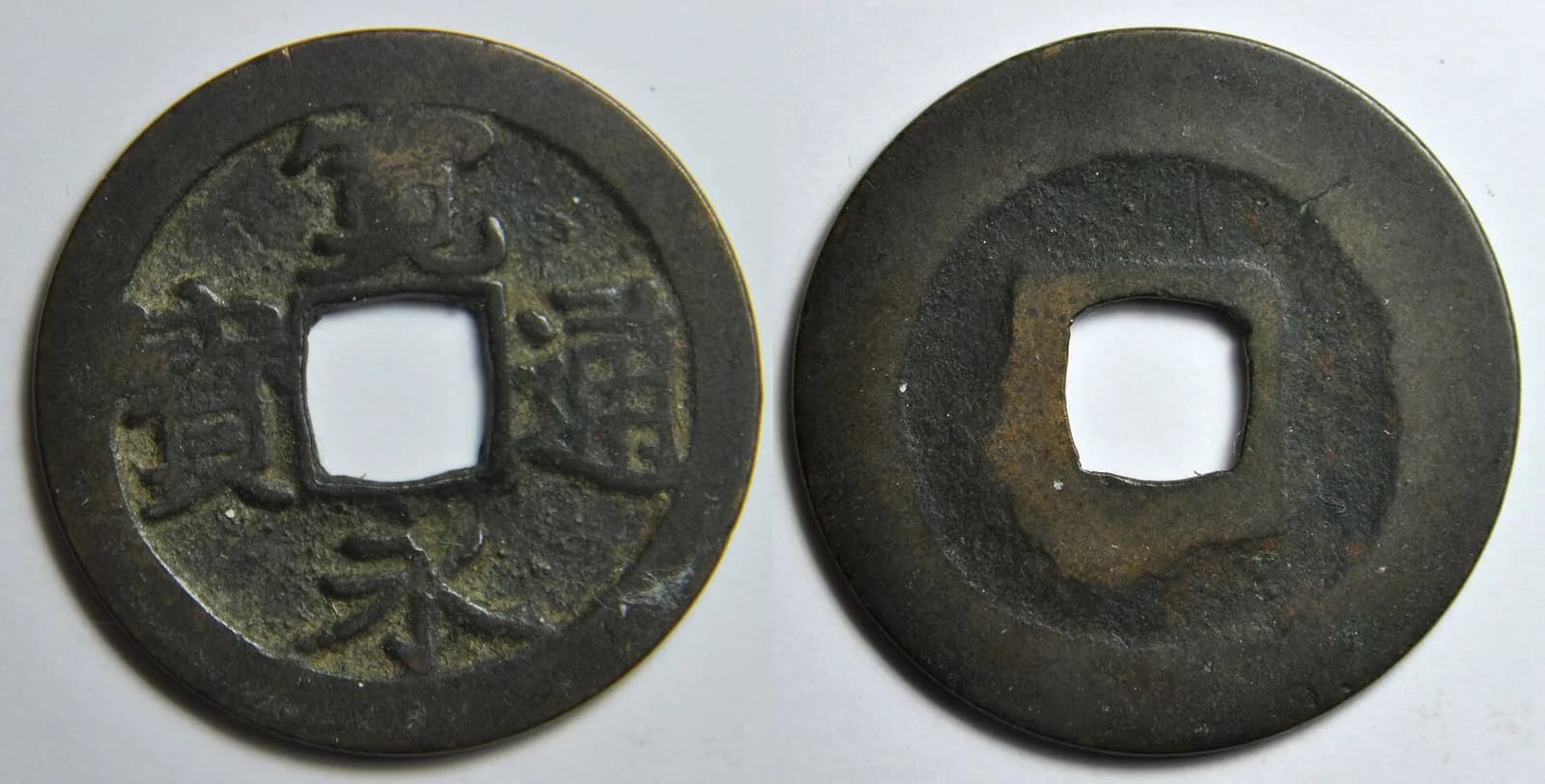
Tenpō Tsūhō (天保通宝) carries a trap: the belief that "they all look the same."
Even among coins of the same type, a single grade difference can make the price five times higher.
Why does that happen?
What Is Tenpō Tsūhō — A Special Presence Among Holed Coins
Tenpō Tsūhō (天保通宝) is a coin minted during the Tenpō era (1830–1844) of the late Edo period. Among the coins covered in the detailed overview of holed coins (Kan'ei Tsūhō and Tenpō Tsūhō), it ranks second in popularity only to Kan'ei Tsūhō (寛永通宝). It is circular with a diameter of approximately 24 mm, has a square hole in the center, and bears the inscription「天保通宝」on its face.
In terms of Edo-period circulating currency, this was the era in which coins transitioned from the late Kan'ei Tsūhō to Tenpō Tsūhō. As a result, the production period was relatively short, and because many coins were cast at regional mints, there is a rich variety of types (variety differences). It is precisely this abundance of varieties that is the single greatest source of confusion for beginners.
Although the coin looks simple at first glance, Tenpō Tsūhō actually carries a complex history and set of value criteria. It enjoys stable demand in the antique coin market and is beloved by a wide range of collectors from beginners to advanced enthusiasts. However, because of its high popularity, the market is also filled with misinformation and inflated expectations.
3 Misconceptions Beginners Are Prone To
Misconception 1: "If They Look the Same, They Must Have the Same Value"
This is the most dangerous assumption. The factors that determine the value of Tenpō Tsūhō are not limited to the visual "cleanness" of the coin. The most important factor is the standards and interpretation of antique coin grading. Even between two Tenpō Tsūhō coins, a VF (Very Fine) grade versus an MS64 (Mint State 64) grade can result in a price difference of three to five times.
A grade is the standard by which specialists evaluate the preservation condition of an antique coin. Generally, the scale runs: VG (Very Good) → F (Fine) → VF (Very Fine) → XF (Extremely Fine) → AU (About Uncirculated) → MS (Mint State). Even coins that look equally "clean" can be evaluated very differently based on the degree of wear in fine details and the degree of luster.
Beginners tend to judge a coin by the standard of "it looks clean to my own eye." However, a specialist's eye picks up fine scratches and wear that are invisible to the naked eye. As a result, a coin the beginner believed would "sell for a high price" may in fact receive a lower evaluation than expected.
Misconception 2: "Older Means More Valuable"
This is another common mistake among antique coin beginners. Although Tenpō Tsūhō was minted during the Tenpō era (1830–1844), "when exactly it was minted" within that period has little impact on value. What matters far more is "where it was minted" and "how widely it circulated."
Edo-period minting was carried out not only at the main mint (hon-za) in Edo, but also at regional mints in Osaka, Kyoto, and elsewhere. Even coins minted in the same period differ in casting technique and metal quality depending on the place of manufacture. Tenpō Tsūhō from regional mints with low production volumes naturally become scarcer.
In other words, the judgment that "this one is from 1830, so it must be valuable" is dangerous. What is needed instead is the perspective of "how many examples of this mint's coins from this period still exist today?" Purchasing without this information increases the risk of paying above market price.
Misconception 3: "The Market Price Is Stable"
Antique coins are generally thought not to fluctuate in price as much as stocks or real estate. In practice, however, the market price of Tenpō Tsūhō can vary significantly based on supply and demand. What beginners are especially prone to overlooking is the effect of thin trading (a state in which very few transactions occur).
When you check price trends on the market chart, a particular variety may appear to have suddenly risen in price. However, it is necessary to distinguish whether this represents a "genuine market rise" or simply "a single transaction that happened to close at a high price." For a variety with only one or two transactions per month, a single high-winning bid can make it appear as though the entire market has risen.
Beginners judge that "the price of this coin is rising" and jump in. In practice, however, the price may fall in subsequent transactions. Reading the market requires looking at multiple transaction data points and grasping the "median" price.
Price Ranges by Grade — Understanding the Actual Market
Let us now look at the actual price ranges for Tenpō Tsūhō. However, because there are many varieties, the figures below assume a "standard Tenpō Tsūhō" as a rough guide. Actual prices vary greatly depending on mint, character size, and other variety-specific factors.
This grade shows clear signs of having circulated. The surface exhibits wear, and the outlines of the characters are somewhat soft. It is appropriate as an entry-level grade for beginners. Because transaction volume is relatively high, this is a zone in which market prices tend to be stable.
At this grade, wear is kept to a minimum. The fine details of the characters and design are clearly visible, and luster remains. However, because the coin is not completely uncirculated, slight wear or contact marks may be visible. This grade range tends to attract "genuine demand," and market prices are relatively stable.
The coin is in a nearly uncirculated state. There is almost no evidence of circulation, and wear is extremely minor. However, because it is not completely uncirculated, faint traces may be visible. Starting from this grade range, transaction volume begins to drop sharply. This is a zone in which the market tends to become thin.
This grade refers to coins that have retained their uncirculated condition. While it is subdivided from MS60 to MS70, prices increase exponentially as the number rises. Even between MS64 and MS65, prices can differ by more than twofold. Transaction volume in this grade range is extremely low, and a single sale can have a major impact on the overall market.
An important point is that the price increase from VF to XF is gradual, but when moving from XF to AU, and from AU to MS, prices rise sharply. This "price jump" reflects not only the increasing strictness of grade evaluation but also a shift in the demand base (from individual collectors to investors).
Why Do Prices Differ for Coins That Look the Same — Understanding the Market Mechanism
[The Rigor of Grade Evaluation]
The value of an antique coin is determined not by the visual "cleanness" but by a "scientific evaluation of preservation condition." As explained in standards and interpretation of antique coin grading, evaluation uses lighting conditions, magnification, and comparative samples to assess condition objectively.
For example, two Tenpō Tsūhō coins that look "essentially the same" to the naked eye may, under a loupe, reveal that one has a large number of extremely fine scratches while the other has almost none. This difference produces a one-step difference in grade and, as a result, a major difference in price.
Beginners may wonder, "Isn't grade evaluation subjective?" In practice, however, evaluations by multiple grading institutions show a high degree of correlation and have earned a certain level of trust in the market.
[Differences in Demand Base and Price Formation]
Those who purchase Tenpō Tsūhō in the VF or XF grade range are primarily "individual collectors interested in the history and culture of antique coins." They want to acquire good-quality antique coins at reasonable prices. As a result, "genuine demand" is stable in this grade range, and market price movements are relatively small.
By contrast, those who purchase Tenpō Tsūhō in the MS grade range are "wealthy investors" or "advanced collectors." They purchase in anticipation of future appreciation in value. Because the demand base is limited, a single transaction can have a large effect on the overall market.
In other words, the price of Tenpō Tsūhō is formed not simply by "cleanness" but by differences in the demand base — that is, "who is buying it." Beginners need to understand which grade range they are targeting and what kind of buyers exist in that range.
[Scarcity Due to Varieties (Type Differences)]
Tenpō Tsūhō is not a single coin but exists in many varieties. For example, differences in "character size," "hole size," "presence or absence of a reverse design," and "differences by mint" number in the tens of types or more.
Price differences between these varieties can be extremely large.
Beginners tend to think in terms of the broad category of "Tenpō Tsūhō." In practice, however, "which variety of Tenpō Tsūhō" can be the single most important factor in determining value.
The Reality of Market Prices as Seen from Transaction Data
Let us now analyze actual auction transaction data. Looking at Tenpō Tsūhō transactions over the past 12 months, several important patterns emerge.
The number of transactions in this grade range averages 15–20 per month. Because transaction volume is relatively high, this is a zone in which market prices tend to be stable. Price fluctuations also tend to stay within approximately ±10%. When market prices rise in this grade range, it signals that "genuine demand is increasing."
The number of transactions in this grade range averages 8–12 per month. As transaction volume begins to decrease, the market becomes somewhat thinner. However, because multiple transactions still occur each month, a single high winning bid is unlikely to significantly lift the overall market.
The number of transactions in this grade range averages 2–4 per month. From here, "thin trading" becomes pronounced.
The number of transactions in this grade range averages 0–2 per month. Because there are almost no transactions, it becomes difficult to "track" the market. A single transaction price may be referenced as the "market price" for the following several months.
The crucial point is that as grade increases, "transaction volume decreases." When beginners venture into higher grade ranges, the lack of market information increases the risk of overpaying or underselling.
The Grade Range Beginners Should Buy — Practical Advice
Succeeding in the antique coin market requires "choosing a grade range suited to your own level." The optimal range for beginners is, in fact, "VF to XF grade." This is because this range offers the following advantages.
First, because transaction volume is high, market information is abundant. By examining multiple transaction data points, you can grasp the "true market price." Second, because prices are reasonable, losses are limited even if a mistake is made. Third, coins in this grade range are supported by "genuine demand," so market prices are relatively stable.
By contrast, grade ranges of AU and above are not recommended for beginners. Because transactions are infrequent and market information is scarce, it is easy to make misjudgments. And because prices are high, losses in the event of failure are also large.
The smart strategy is to begin in the VF grade range, learning about the basic varieties of Tenpō Tsūhō (such as the differences between standard and rare types), and then gradually move toward XF and AU as experience accumulates.
The Importance of Authenticity Verification and Grading
Because Tenpō Tsūhō is a relatively old coin, counterfeits and altered pieces exist. The risk of counterfeits is particularly high in grade ranges where prices are rising.
Although how to identify counterfeits and altered pieces explains basic identification methods, in the case of Tenpō Tsūhō it is extremely difficult to authenticate a coin without specialist knowledge. The reason is that Edo-period minting technology was advanced, and "high-quality counterfeits" existed even at that time.
When beginners purchase Tenpō Tsūhō, they should always choose coins that "have been graded by an official grading institution." The grading fee is on the order of a few thousand yen, but that investment is well worth it. Being graded not only provides certainty of authenticity but also yields a grade evaluation, which makes price judgment in the market more accurate.
Auctions occasionally list Tenpō Tsūhō "without grading" at low prices. Beginners may think this is "a bargain," but it is a "risk." If the coin turns out to be a counterfeit, regardless of how cheaply it was purchased, its value is zero.
How to Monitor Tenpō Tsūhō Market Prices
Continuously tracking Tenpō Tsūhō market prices requires multiple approaches.
First, check auction sites regularly. Basic knowledge of antique coin auctions explains how to read auctions in detail. In particular, observing not only the "winning bid price" but also the "number of bids" and "duration of the sale" enables you to gauge the strength of supply and demand.
Second, compare multiple market charts. Relying on a single chart makes you vulnerable to the effects of thin trading, so it is important to consult multiple data sources.
Third, refer to the opinions of collector communities and specialists. However, "analysis based on transaction data" should take priority over personal opinions.
This makes it easier to avoid missing changes in the market.
ITTENDO's Conclusion — The Decision Criteria for Avoiding Failure with Tenpō Tsūhō
Tenpō Tsūhō is a coin in the antique market where "beginner-oriented" and "advanced-collector-oriented" tiers are intermingled. Because of its high popularity, the market is filled with misinformation and inflated expectations.
The criteria for avoiding failure are simple.
First, start within the VF–XF grade range. This grade range has high transaction volume and abundant market information. Because prices are reasonable, the cost of learning is low.
Second, choose "standard varieties." Rare varieties are difficult for beginners to evaluate. Start by selecting coins that are standard in terms of mint, character size, and the like, and learn the basics.
Third, look at multiple transaction data points and grasp the "median price." Do not be swayed by a single winning bid. It is essential to look at a minimum of 3–5 transaction data points in order to understand the "range" of the market.
Fourth, purchase coins that have been graded. Grading fees are negligibly small compared to the value of the coin. Certainty of authenticity and grade greatly improves the accuracy of subsequent judgments.
By following these decision criteria, the risk of failure with Tenpō Tsūhō is greatly reduced. Rather than being swayed by every market fluctuation, make a point of maintaining calm, data-based judgment.
At ITTENDO, we enable you to track the "current state" of antique coins based on past auction histories and market charts.
Individual prices and auction results are listed only once verifiably matched records — with sale, lot, source URL and review date — exist.