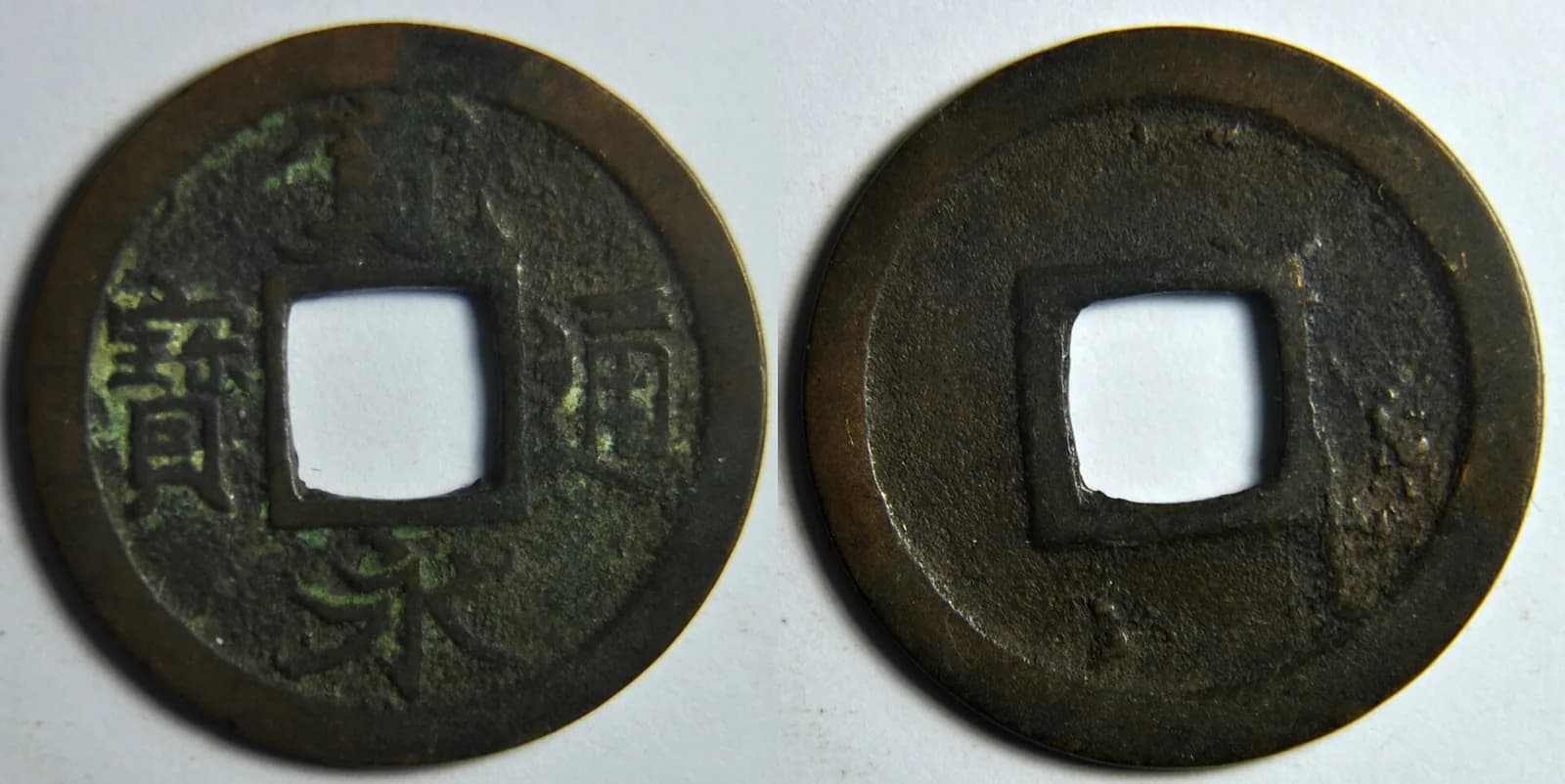
Why do coins that look nearly identical have such different values?
The reason isn't just the "year."
What is Kan'ei Tsuho? — A Basic Currency that Supported the Edo Period
Kan'ei Tsuho, representing Japan's holey coins, was minted from 1636 until the Meiji period. It was the most circulated coin throughout the Edo period and is still frequently excavated. As a result, it is often considered an "introductory coin for old coin collectors."
However, this "high circulation" characteristic actually complicates value assessment. Reading the Detailed Explanation of Holey Coins (Kan'ei Tsuho and Tenpō Tsuho) provides a comprehensive overview of this coin type.
The high circulation means that slight differences significantly impact rarity. Even with the same name "Kan'ei Tsuho," the evaluation in the market can change dramatically based on the mint, year, inscriptions, errors, and grade.
Five Factors Determining Value
[Factor 1] Mint Location and Year — Vast Differences in Circulation
Kan'ei Tsuho was produced at 17 different mints across Japan. The minting volumes in major cities like Edo, Kyoto, and Osaka are enormous. In contrast, coins minted at smaller regional mints during limited periods have very low circulation.
For instance, "Kan'ei Tsuho (Sendai coins)" were minted briefly by the Sendai Domain. Due to their low circulation, the price can be more than five times that of Edo coins of the same grade.
Years also play a similar role. Coins from the early-minted Kan'ei 13 (1636) are treated very differently in the market than those from the later Kan'ei 19 (1642).
[Factor 2] Grade — "Appearance" Determines Value
In the old coin world, Standards and Interpretation of Old Coin Grading directly impact market value.
The difference between MS (Mint State) 65 and 64 is minimal in appearance.
To the untrained eye, they might look "almost the same."
This distinction is rooted in "collector mentality" and "rarity."
Coins rated MS65 and above are extraordinarily rare.
Thus, a one-grade increase concentrates demand and significantly raises the price.
Conversely, in the VF (Very Fine) 30–40 range, price differences due to grading are minimal. The high circulation means buyers become more selective.
[Factor 3] Rarity and "Availability" Frequency — Market Visibility
In the old coin market, "how often does this type appear each year" greatly affects prices.
Among Kan'ei Tsuho, Edo coins appear in auctions almost monthly. However, specific regional coins or rare inscription coins are limited to 1–2 auction appearances a year.
The less frequent the availability, the more buyers worry about "not knowing when the next opportunity will be," leading to higher-than-market-price bids.
This leads to the phenomenon where "the price of thinly traded coins fluctuates significantly with a single auction win."
[Factor 4] Supply and Demand and "Trends" — Is This Type Being Bought Now?
The old coin market has cycles of trends.
For example, if a TV special focuses on "Edo period economics," interest in Kan'ei Tsuho might temporarily spike. Consequently, even rarely moving coins can suddenly see increased buyer interest and rising prices.
Conversely, when interest wanes, even high-grade coins may become hard to sell, and prices drop.
This fluctuation in supply and demand can be visualized by checking price trends in market charts.
Regularly checking market data allows one to identify "what types are currently being noticed."
[Factor 5] Authenticity and Appraisal — Trust Underpins Value
This is the most easily overlooked factor.
Even when they look the same, the value of Kan'ei Tsuho significantly differs depending on whether they have been appraised by a trusted institution.
Coins that have been appraised and confirmed as "authentic" offer buyers peace of mind.
On the other hand, coins without appraisals carry the suspicion of being "modified or fake."
Learning to Identify Fakes and Altered Coins is crucial for correctly understanding the market.
Many high-priced auction wins involve appraised coins.
Viewing Auction Data — The Mechanism Behind Price Differences in the Same Type
Reviewing auction data for Kan'ei Tsuho from the past year reveals clear patterns.
Pattern 1: Edo Coins with High Circulation (VF30–50)
- 5–10 listings per month
- Winning bid: ¥3,000–¥8,000
- Price variation: Small (about ±20%)
The reason is "buyers are plentiful, and comparisons can be made." For the same grade, there is a strong tendency to choose the cheaper option, leading to price homogenization.
Pattern 2: Regional Coins or Rare Inscriptions (MS60–65)
- 0–2 listings per month
- Winning bid: ¥15,000–¥50,000
- Price variation: Large (over ±50%)
Due to "limited buyer pool and low availability," buyers who fear "there won't be another chance" may bid significantly above the market rate. Conversely, prices drop when buyers are scarce.
Pattern 3: Error Coins or Extremely Rare Pieces
- A few listings per year
- Winning bid: ¥100,000 or more
- Price variation: Extremely large (±100% is not unusual)
At this level, the concept of "market price" diminishes. Prices depend on whether buyers feel a strong need for the coin.
Common Mistakes Beginners Make
Mistake 1: Judging Value "Only by the Year"
The simplistic thinking of "Kan'ei 13 is rare, so it's pricey" is dangerous.
If the grade is low, even rare years remain inexpensive.
Conversely, even common years can fetch high prices in MS65 or higher grades.
Mistake 2: Mistaking a Single Auction Price for the "Market Price"
It's not guaranteed that the same coin will sell for the same price now.
Especially for less frequently available types, thin trading makes a single win unlikely to function as the subsequent "market price."
Mistake 3: Purchasing High-Priced Coins Without Appraisal
There are a certain number of modified or counterfeit coins in the old coin market.
Under the premise of "you can't tell by appearance," getting an appraisal is crucial.
The higher the market price of a type, the higher the risk of modifications. Cases of later discovering a purchase was actually a modification are not uncommon.
Perspectives Needed to Read the Market
To correctly determine the value of Kan'ei Tsuho, multiple data points are necessary.
- Look at Past Auction Data
Examine what price the same type/grade sold for previously.
It's important to gather multiple auction examples, not just one.
- Watch Market Charts to See Flow
Focus on median trends rather than short-term auction price fluctuations.
Understanding Basic Knowledge of Old Coin Auctions deepens the ability to read data.
- Check the Frequency of Availability
Information on "how many listings per month" indicates market stability.
The more listings, the more the market price tends to homogenize.
- Confirm Appraisal Status
The market significantly differs between appraised and non-appraised coins.
The presence or absence of appraisal affects the price more for high-value coins.
Benefits of Learning the Market with Kan'ei Tsuho
In reality, Kan’ei Tsuho is the "ideal study material to learn the market mechanism of old coins."
The vast amount of data from high circulation offers insights.
With many variations in the same type, learning the impact of "grade," "rarity," and "supply and demand" is possible.
Mastering how to read the market with Kan'ei Tsuho can be applied to value assessments for other old coins.
Reasons Why Value Can Vary 100-Fold — Five Structural Factors
There are clear structural reasons why the market value of Kan'ei Tsuho differs by more than a digit, even for the same type. This chapter organizes these factors with real-world examples.
The first factor is "Mint." Kan'ei Tsuho was minted nationwide during the Edo period, with official minting (Edo Shogunate's official mint) mixed with domain minting and private minting. The classification of minting locations, especially in Kan'ei Tsuho, which is treated in Introduction to Old Coins and Classification by Type, is specifically subdivided. Against the centralized quality management of official minting coins, domain minting, and private minting reflect local craftsmanship and material procurement circumstances, appearing as individual differences. Minting differences are an important evaluation axis in the collector market, with numerous cases where prices significantly differ between official minting coins and certain domain minting coins.
The second factor is "Era Classification." Kan'ei Tsuho is broadly divided into two periods: Old Kan'ei (1636–1659) and New Kan'ei (after 1668). Old Kan'ei, covered in Comprehensive Explanation of Old Kan'ei Tsuho, and the later New Kan'ei differ significantly in minting technology, alloy composition, and market value. The Old Kan'ei coins are relatively scarce and highly valued in the collector's market.
The third factor is "Fonts." There are dozens of font classifications for the four characters "寛永通寳," detailed in Detailed Explanation of Variants of Kan'ei Tsuho. The font classification is so varied that even experts find it challenging to memorize completely, offering a significant pleasure in collecting. Specific fonts or variants see significant price increases due to rarity, making font identification central to price evaluation.
The fourth factor is "Condition." Applying the grading system discussed in Standards and Interpretation of Old Coin Grading to Kan'ei Tsuho, high-grade coins of AU and above are rare and show significantly different market values. Kan'ei Tsuho was widely circulated, making near-mint conditions extremely rare. Condition assessment serves as an independent axis from mint and font in constructing value.
The fifth factor is "Marks and Mint Marks." A small mark or mint mark on the reverse can change the value by orders of magnitude. It functions as a marker identifying the minting batch, minting person, or minting period, and specimens with specific marks see their market value significantly elevated due to rarity.
Practicalities of Mint Classification — Features of Major Domain Minting
The mint classification of Kan'ei Tsuho saw various domains independently mint coins in addition to official minting. Notable domain mints include Mito, Sendai, Matsumoto, Takada, Ashio, and Yoshida, each with unique fonts, edge treatments, and alloy compositions. These domain mint coins are treated as independent categories with distinct evaluation axes in the collection market due to their issuance reflecting historical economic facts of the time.
Particular domain mints are traded at high prices due to scarcity not only from a lack of current examples but also from short minting periods and historically unique minting backgrounds. Recent research into domain minting continues, with discoveries periodically leading to re-evaluation of certain coins' market values.
Practical Steps for Value Evaluation
To practically evaluate Kan'ei Tsuho, the steps correspond to the five structural elements in five stages of verification. The first stage is distinguishing between official mint and domain/privately minted coins. The second stage is the era classification into Old Kan'ei and New Kan'ei. The third stage involves font identification. The fourth stage is grading assessment, and the fifth stage involves checking marks and mint marks. By performing these steps in sequence, the majority of Kan'ei Tsuho seen on the market can be adequately evaluated. Third-party grading institutions, covered in PCGS and NGC's Evaluation of Japanese Old Coins, serve as a valuable backup for judgment precision, particularly for beginners.
Combining the evaluation axes obtained from value assessment with market analysis covered in Correct Interpretation of Old Coin Market Charts allows one to judge if the current market price aligns with the coin's intrinsic value. While market prices fluctuate short-term with supply-demand balances, they tend to converge to intrinsic value long-term.
Conclusion
Practical Judgment Axes for Reading the Market
The reason Kan'ei Tsuho's value can vary 100-fold lies not in a "simple difference in rarity" but in multiple overlapping factors, including grade, availability frequency, supply and demand, and authenticity.
The strategy beginners should take is simple.
"Start with types/grades with multiple listings per month."
This zone has homogenized market prices with abundant data.
It makes judging "overpriced" or "underpriced" easier, reducing failure risk.
Meanwhile, "rare types with only 1-2 appearances a year" lack data and are challenging to evaluate. They should not be tackled immediately.
ITTENDO diligently follows the current status of old coins based on past auction histories and market charts.
Structural Understanding as a Starting Point for Collection
The reason Kan'ei Tsuho's value varies 100-fold is an understandable phenomenon with five structural factors. Understanding this system is the starting point for collecting and investing and is the basis for making accurate judgments in the market. Developing a viewpoint that can structurally explain why prices are what they are, rather than making judgments solely by price, is the first step to deeply enjoying the world of Kan'ei Tsuho. Learning in combination with Comprehensive Explanation of Kan'ei Tsuho ensures a three-dimensional understanding of Kan'ei Tsuho as a whole.
The charm of Kan'ei Tsuho lies in this diversity from the combination of these five structural factors. With minting performed nationwide through the Edo period, the individuality of each region, era, and minter is engraved on each coin, to the extent that no two identical specimens exist within a collection. This fundamentally differs from modern mass-produced industrial products, embodying the essential pleasure of old coin collection. When starting a Kan'ei Tsuho collection, it is recommended to first acquire the basics of distinguishing between official and domain minted coins, separating Old and New Kan'ei, and identifying representative fonts. Once these fundamentals are solidified, the majority of Kan'ei Tsuho seen on the market can be structurally sorted and understood. Combining this with the auction participation methods covered in Basic Knowledge of Old Coin Auctions allows for efficient use of purchasing opportunities. The world of Kan'ei Tsuho is a typical brand that becomes more interesting the deeper you know them, with a depth that never gets dull even with lifelong learning.
Research on Kan'ei Tsuho continues continuously into the 21st century, with periodic announcements of new discoveries and reclassifications. Parallel progress in font classification research, excavation of mint sites for domain minted coins, and precise alloy composition analysis deepen the understanding of Kan'ei Tsuho each year. From a collector's perspective, continually following these research developments allows for more precise placement of encountered specimens within their historical context. Specialist magazines published by the Japan Numismatic Dealers Association and old coin research societies everywhere provide ongoing insights into the latest research, serving as an indispensable learning base for collectors.
The extraordinarily complex and profound classification system that developed within the Kan'ei Tsuho brand group results from the long-term issue over more than two centuries. Throughout the Edo period, the economic circumstances, political conditions, and craftsmanship of each era were reflected in individual minting batches, resulting in several hundred varieties under the singular name "Kan'ei Tsuho." This perspective fundamentally differs from that of modern mass-produced goods, housing the essential joy of old coin collecting. Studying Kan'ei Tsuho means learning about the Edo period itself through tangible, physical evidence.
Kan'ei Tsuho research will continue to advance.
Systematically understanding the world of Kan'ei Tsuho through collection activities is the royal road to deepening the pleasure of collecting.
Kan'ei Tsuho research is anticipated to remain a theme with ongoing new discoveries, making the collaboration between collectors and researchers increasingly important. It's an endeavor to pass on the monetary culture of the Edo period to the future.
Only verified records (with event, lot, source URL, and verification date) are used to list specific prices and auction cases in market records.