Starting an Antique Coin Collection—Where Should You Begin?
You've become interested in antique coin collecting, but Edo period gold and silver coins cost hundreds of thousands of yen—far beyond a beginner's reach. Many people share this concern.
In reality, the world of antique coins has "hidden gems for beginners." One such gem is the Bunkyū Eihō, a holed coin. You can start a serious collection for around 5,000 yen, it has significant historical value, and its market price is relatively stable. For beginners in antique coin collecting, there's hardly a more ideal option.
This article explains the appeal of Bunkyū Eihō, current market prices, and common mistakes beginners make—all from the perspective of Ichitendō. Let's take the first step in your antique coin collection journey together.
Bunkyū Eihō—The True Identity of a Holed Coin Reflecting the Late Edo Period
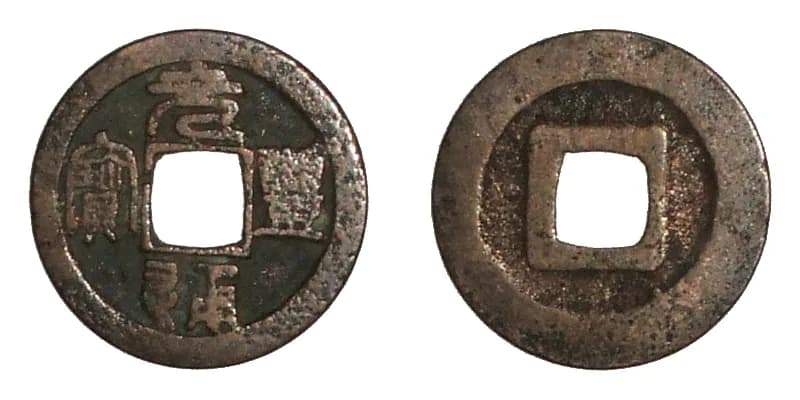
Bunkyū Eihō (文久永宝) is a copper holed coin issued during the Bunkyū era (1861–1864). During this turbulent period leading from the late Edo period into the early Meiji era, it was used as small-denomination currency for everyday purchases by common people.
Basic Specifications of Bunkyū Eihō
- Diameter: Approximately 2.3 cm
- Weight: Approximately 3.75 g
- Material: Copper
- Characteristic: A hole approximately 8 mm in diameter at the center
- Obverse: Characters "Bunkyū Eihō" and paulownia flower design
- Reverse: Characters "Dai Nihon Koku" (Great Japan) and astronomical chart design
Bunkyū Eihō is called a "holed coin" because of the hole at its center. This hole was created to thread coins together with string for circulation during the Edo period—an important element that conveys the distribution methods of that era to the present day.
Why Bunkyū Eihō Is Attracting Attention Now
In the antique coin market, rarer denominations tend to command higher prices. However, because Bunkyū Eihō was issued in relatively large quantities, many examples still exist, which has resulted in affordable pricing.
This is a major advantage for beginners. You can learn fundamental antique coin knowledge while gaining actual trading experience.
The Three-Layered Appeal of Bunkyū Eihō Collecting
Collecting Bunkyū Eihō isn't simply "because it's cheap." Behind it lies a three-layered appeal.
Layer 1: Economic Accessibility—Prices Gentle on Beginners' Wallets
The biggest barrier to antique coin collecting is price. Edo period koban and ōban gold coins command prices from hundreds of thousands to millions of yen per piece. In contrast, Bunkyū Eihō typically sells for 5,000 to 15,000 yen.
At this price point, purchasing one or two pieces monthly is within reach for most beginners. Furthermore, even well-preserved examples can be obtained relatively affordably, allowing you to build a "high-quality collection."
Layer 2: Historical Value—The Story of a Coin Reflecting Its Era
The period from 1861 to 1864, when Bunkyū Eihō was issued, was one of the most turbulent in Japanese history. This was approximately ten years after Perry's arrival. The shogunate was forced to open the country, and within Japan, the Sonnō Jōi (revere the emperor, expel the barbarians) movement intensified.
Bunkyū Eihō was issued against this historical backdrop. The paulownia flowers on the obverse were a design favored by the power holders of the time, while the astronomical chart on the reverse demonstrates the technological level of the Edo period.
When collectors hold this coin, they're not simply possessing "an old coin"—they're directly touching "the late Edo period" itself.
Layer 3: Collectibility—The Joy of Diverse Variations
Even within the same "Bunkyū Eihō" denomination, variations exist in issuance periods, inscriptions, and design patterns.
- Bunkyū 2 (1862) issue: The earliest issue with high rarity
- Bunkyū 3 (1863) issue: Large issuance quantity, relatively easy to obtain
- Keiō period issue: Following the Bunkyū period, with subtly different designs
By collecting these variations, you transform from simple "antique coin collecting" into "historical tracking along a timeline"—a deeper form of enjoyment.
Discerning Bunkyū Eihō—Three Key Points Beginners Must Understand
Purchasing antique coins is similar to real estate investment. Only when three factors align—"location," "building condition," and "trustworthy seller"—does it become a good purchase. The same applies to Bunkyū Eihō.
Point 1: Identifying the Denomination—Clarifying "What You're Buying"
Even among Bunkyū Eihō, value differs by issuance year. A common beginner mistake is thinking "any Bunkyū Eihō will do."
In reality, significant differences exist:
Bunkyū 2 (1862) Issue
- Earliest issue
- Few examples in existence
- Market price: 10,000–30,000 yen
- Beginner-friendliness: ★★☆☆☆ (somewhat challenging)
Bunkyū 3 (1863) Issue
- Large issuance quantity
- Relatively easy to obtain
- Market price: 5,000–10,000 yen
- Beginner-friendliness: ★★★★★ (most beginner-friendly)
Keiō Period (1865–1868) Issue
- Issued after the Bunkyū period
- Design may differ
- Market price: 3,000–8,000 yen
- Beginner-friendliness: ★★★★☆ (inexpensive but lower rarity)
If you "prioritize historical value," aim for Bunkyū 2. If you want to "first experience the joy of collecting," starting with Bunkyū 3 is wise.
Point 2: Confirming Condition—Understanding the Price Difference Between "Fine" and "Average"
An antique coin's market price is determined by two factors: "denomination" and "condition." The same Bunkyū Eihō varies greatly in price depending on condition.
Price Range Example by Condition (Bunkyū 3 Issue)
| Condition | Description | Market Price |
|-----------|-------------|--------------|
| Uncirculated | Virtually no scratches or discoloration | 12,000–15,000 yen |
| Fine | Minor scratches or discoloration, overall good | 8,000–10,000 yen |
| Average | Noticeable scratches or discoloration, but characters readable | 5,000–7,000 yen |
| Poor | Severe scratches or discoloration | 2,000–4,000 yen |
A common beginner mistake is "buying cheap pieces and later regretting it." Buying a poor-condition Bunkyū Eihō for 3,000 yen, then thinking "I really want a fine example" a few years later and paying an additional 8,000 yen is a common pattern.
Based on Ichitendō's experience, beginners should aim for "the middle ground between average and fine." At 6,000–8,000 yen, the visual satisfaction is high and regrets are minimal.
Point 3: Choosing Trustworthy Sales Channels—The Importance of Authentication
Bunkyū Eihō has relatively few counterfeits. However, the antique coin market contains "gray area" merchandise.
Trustworthy Purchase Routes
- Specialty Shops
- Advantages: Strict authentication, often offer returns
- Disadvantages: Prices tend to be somewhat higher
- Beginner-friendliness: ★★★★★
- Major Auction Sites
- Advantages: Transparent pricing, past winning bids serve as reference
- Disadvantages: Seller reliability varies
- Beginner-friendliness: ★★★☆☆
- Private Sales (Marketplace Apps)
- Advantages: Sometimes lower prices
- Disadvantages: Difficult to discern authenticity, unclear dispute resolution
- Beginner-friendliness: ★☆☆☆☆
For beginners, I recommend purchasing from specialty shops even if prices are somewhat higher. "Buying with confidence" matters more than "buying cheaply" for long-term collecting.
Reading the Market—Why Bunkyū Eihō Prices Fluctuate
Antique coin prices may seem irregular at first glance, but they're actually composed of multiple factors. Understanding these reveals "buying times" and "selling times."
Factor 1: Seasonality—Prices Move in Spring and Fall
The antique coin market shows clear seasonal variation.
- Spring (March–May): New fiscal year budgets activate, new collectors enter. Prices trend upward
- Fall (September–November): Many antique coin exhibitions occur. Prices stable to slightly upward
- Winter (December–February): Year-end funding needs increase sales. Prices trend downward
- Summer (June–August): Prices relatively stable. Fewer buyers
If beginners want to "buy cheaply," targeting winter purchases (especially January–February) is effective.
Factor 2: Circulation Changes—The "Mass Listing" Signal
Sometimes the same denomination appears in large quantities on auction sites. This indicates "a major collection was liquidated somewhere."
During such periods, prices temporarily drop. Conversely, when "a denomination that hasn't appeared in a while suddenly lists one piece," prices tend to rise.
Factor 3: Media Effect—Television Program Influence
When television programs feature antique coins, prices often rise immediately afterward as new collectors enter en masse.
This is a "selling time," not a "buying time." Conversely, "when the price of a denomination featured on television stabilizes" becomes the beginner's buying opportunity.
Common Beginner Mistakes and Countermeasures
Ichitendō receives many inquiries from novice collectors. Certain failure patterns repeatedly emerge.
Mistake 1: Judging Based Solely on "Cheapness"
Example: "Bunkyū Eihō selling for 3,000 yen!" you excitedly purchase, only to find it covered in scratches with barely readable characters.
Countermeasure: Target "mid-range market prices" for your first piece. For Bunkyū 3, around 8,000 yen is the benchmark. At this price, you'll be satisfied with appearance and experience minimal regret.
Mistake 2: Making Unrealistic Plans to "Collect Everything"
Example: "Since Bunkyū Eihō has multiple issuance years, I'll collect them all," but funding runs out and you abandon the project midway.
Countermeasure: Set small initial goals like "three fine examples of Bunkyū 3." Later, gradually expand to "let me try collecting Keiō period too." Incremental expansion is key to persistence.
Mistake 3: "Ignoring Market Prices and Overpaying"
Example: At auction, thinking "This is rare!" you bid twice the market price.
Countermeasure: Always research "winning bids from the past three months" before purchasing. Ichitendō makes such market data visible.
Mistake 4: "Neglecting Storage Methods"
Example: You store your purchased Bunkyū Eihō in a humid location, and green patina develops within months.
Countermeasure: For antique coins, "humidity control" is critical. At minimum, store in a small case with desiccant. With budget, consider purchasing a humidity-controlled cabinet.
Current Bunkyū Eihō Market Prices—Reading the 2024 Market
Based on latest data tracked by Ichitendō, here's the current Bunkyū Eihō market organized by issuance year.
Market Trends by Issuance Year
Bunkyū 2 (1862) Issue
- Average winning bid (past 6 months): 18,000 yen
- Market trend: Slightly upward
- Reason: Rarity is becoming recognized
- Beginner-friendliness: ★★☆☆☆
Bunkyū 3 (1863) Issue
- Average winning bid (past 6 months): 7,500 yen
- Market trend: Stable (±500 yen fluctuation)
- Reason: Large issuance, stable supply
- Beginner-friendliness: ★★★★★
Keiō 3 (1867) Issue
- Average winning bid (past 6 months): 5,200 yen
- Market trend: Slightly downward
- Reason: Low rarity, limited new collector interest
- Beginner-friendliness: ★★★★☆
Price Differences by Condition
Using Bunkyū 3 as an example, price differences by condition:
| Condition | Average Winning Bid | Price Range |
|-----------|-------------------|-------------|
| Uncirculated | 13,500 yen | 12,000–15,000 yen |
| Fine | 9,000 yen | 8,000–10,500 yen |
| Average | 6,000 yen | 5,000–7,000 yen |
| Poor | 3,500 yen | 2,500–4,500 yen |
Market Reading Tips: The price difference between uncirculated and average is about 10,000 yen, but the difference in "visual satisfaction" isn't actually that large. Beginners maximize cost-performance by targeting "fine" condition.
Future Market Predictions
Based on overall antique coin market trends, Bunkyū Eihō's future outlook:
- Next 6 months: Current prices likely to continue (±10% fluctuation)
- Next year: Possible slight increase with new collector growth (+5–15%)
- Next 3 years: Prices likely to stabilize (±5% fluctuation)
In other words, now is a good time to buy. I recommend securing your favorite piece before prices rise.
Practical Steps to Start Your Bunkyū Eihō Collection
Based on the knowledge above, here's the procedure for actually beginning your collection.
Step 1: Decide Your Goal (1 week)
First, clarify "why you're collecting Bunkyū Eihō."
- "I'm interested in the late Edo period" → Start with Bunkyū 2
- "I want to experience the joy of coin collecting" → Start with Bunkyū 3
- "I want to start cheaply" → Start with Keiō period
Step 2: Learn the Market (2 weeks)
Research past three months of winning bids on auction sites. Examining at least 50 data points develops "market sense."
Step 3: Purchase Your First Piece (Month 1)
Target: Bunkyū 3 fine condition around 8,000 yen. Don't rush—wait for the piece that says "this is it."
Step 4: Organize Storage (Immediately After Purchase)
Store in a case with desiccant. If possible, consider purchasing a humidity-controlled cabinet.
Step 5: Plan for Second and Later Pieces (Month 3 Onward)
After experiencing "the joy of antique coins" with your first piece, systematically add second and third pieces.
Ichitendō's Summary—Bunkyū Eihō Is the "Optimal Solution for Antique Coin Beginners"
Bunkyū Eihō is an almost perfect choice for antique coin collecting beginners.
Three reasons:
- Economic Accessibility: The 5,000–15,000 yen price range is manageable for beginners
- Historical Value: Directly touching the late Edo period, a deep learning opportunity
- Price Stability: Large issuance means relatively stable prices with low "failure risk"
If you're considering starting antique coin collecting, I recommend beginning with a fine-condition Bunkyū 3. Collecting one or two pieces monthly, accumulating about ten pieces over three years, is the most sustainable pace for beginners.
Antique coins aren't merely "investment objects"—they're "means of traveling through time." Each time you hold a Bunkyū Eihō, you contemplate Japan from over 150 years ago. That experience is the true value of antique coin collecting.