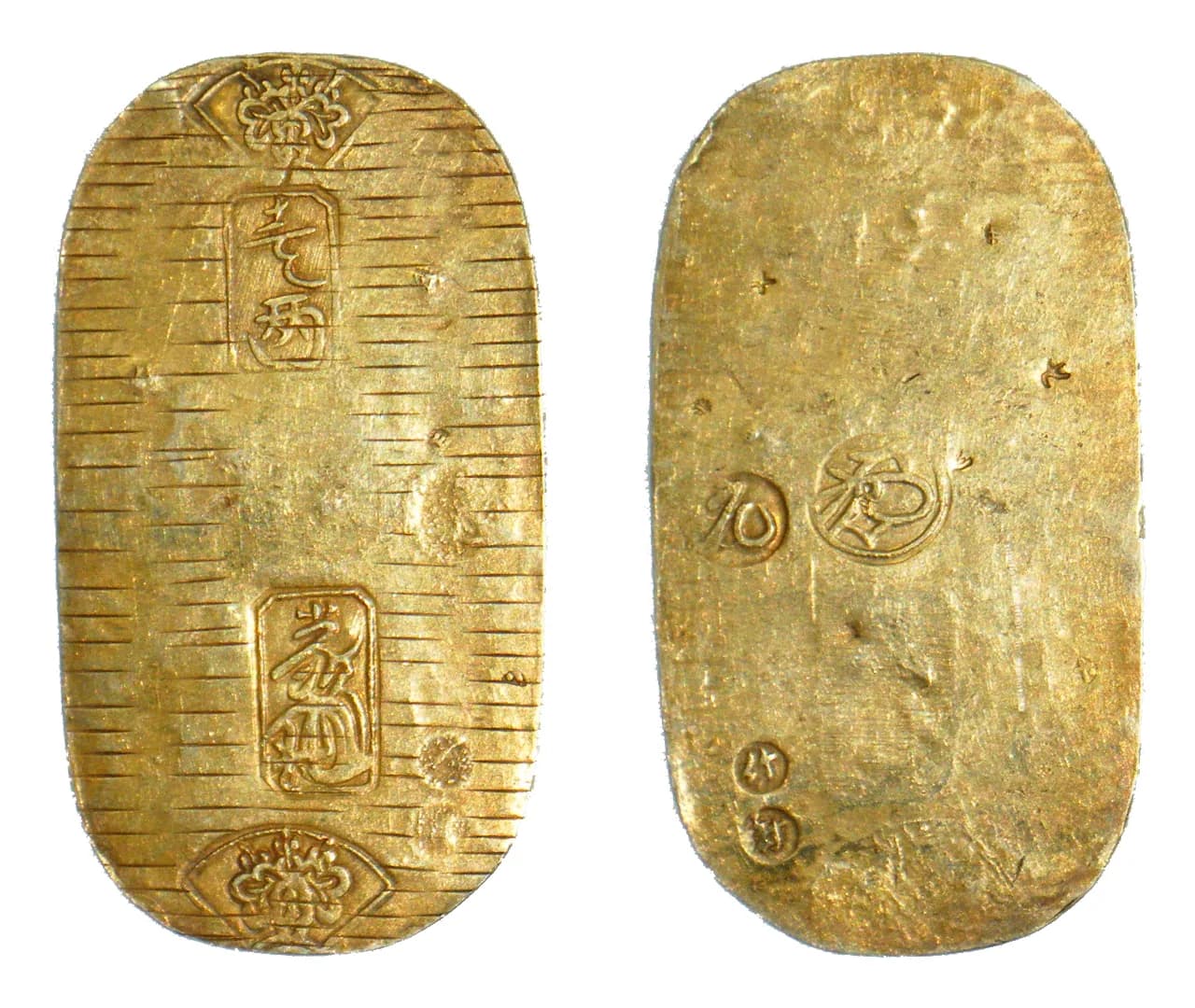
Why does the value of the same "Genroku Koban" change multiple times, sometimes even by dozens of times, just because of a single script? We unravel the deep logic of the old coin market hidden in those slight pen strokes.
Genroku Koban Variants and Script: The Background of Value Differences and Market Trends
Genroku Koban, issued in the Edo period, has historical value and variants due to script differences, garnering particular attention among old coin collectors. At first glance, they may seem like the same koban, but slight differences in the engravings of "Gen" (元) and "Roku" (禄) characters create notable differences in market value. This phenomenon is not merely a matter of aesthetics; it is intricately tied to the minting system of the time, the distribution background, and the psychology of contemporary collectors.
Recently, both domestic and international auctions have recorded high bids for well-preserved Genroku Koban variants, particularly those with rare scripts. For example, koban with specific scripts can be traded at prices multiple times up to dozens of times higher than the standard versions. This reflects collectors valuing not just the monetary worth of the gold coin but also its historical background, rarity, and artistic value. Such market trends indicate that Genroku Koban variants are recognized not merely as old coins but as a distinct field of collection.
ITTENDO aims to provide precise information so that readers can understand the true value of Genroku Koban variants and make informed decisions, especially uncovering why script differences create such a significant value gap.
Why Did This Happen? Explaining in Three Layers
For Beginners: Factors Deciding Value and Reasons for Script Differences
The value of an old coin is determined primarily by three factors: "rarity," "preservation condition," and "historical background." In the case of Genroku Koban, script differences play an essential role, particularly regarding "rarity." Genroku Koban were minted from 1695 (Genroku 8) to 1710 (Hōei 7), but during this period, slight differences in script emerged due to the minting craftsmen at the gold mint or specific koban made for presentation purposes. For instance, subtle variations such as the length of the horizontal stroke in "Gen" and the stroke order of "Roku" are differences that are hard to discern with the naked eye.
These script variants were created only during a limited period of minting or for specific purposes, so their extant numbers are extremely low. While koban with standard scripts were circulated in large numbers, those with rare scripts have only a small remnant. This absolute scarcity in supply directly leads to high rarity value in the modern market. Even though it looks like the same gold coin, the historical testimony included in its inscription and the scarcity of its extant number are decisive factors that substantially influence its value. Script differences are essential elements that tell the tale of rarity as a historical witness, not merely as design variations.
For Intermediates: Supply and Demand, Market Trends, and Grade Scarcity
The value difference in Genroku Koban script variants is closely linked to the current balance of supply and demand. Specific rare-scripted Genroku Koban have extremely limited supply due to their scarcity. On the other hand, there is an increasing demand for these rare variants among old coin collectors and investors, particularly those who value historical and artistic significance. This imbalance in supply and demand is a major factor driving up market prices.
Looking at recent market trends, while Genroku Koban with standard scripts maintain stable prices, koban with specific rare scripts sometimes update their high prices whenever they are auctioned. For instance, certain presentation coins or scripts believed to be from the early minting period can exhibit price differences of multiple times, even up to dozens of times, compared to normal Genroku Koban, as confirmed in the Detailed Explanation of Edo Gold Coins (Koban and Ōban) page. The grade, as evaluated by the Coin Grading Standards and How to Read, also greatly affects the price. High-grade items above MS65 are scarce, regardless of script variance, but if the rare script is in high grade, its market value increases dramatically. Collectors place importance not only on the rarity of the script but also on the excellent state of preservation, making the supply-demand balance for high-grade items even tighter.
For Advanced: Market Participants, Flow of Funds, and Price Formation Logic
Price formation in the Genroku Koban script variant market is complicated by the dynamics of various market participants and the flow of funds. The main buyers are affluent individual collectors, investors who also aim for art investments, and museums or research institutions collecting historical materials. These market participants purchase not just for the gold value or the coin's rarity but also for its historical background, artistic completeness, and anticipated increase in future asset value.
In terms of fund flow, interest in tangible assets has risen globally from perspectives like financial easing and inflation hedging, making old coins one of the targets. Especially, rare script variants of Genroku Koban with high historical and cultural value and limited extant numbers are noted as alternative investments with different risks and returns from traditional investment targets like stocks and real estate. The logic of pricing relies heavily not only on the supply-demand balance but also on the "narrative" and "authenticity" the koban embodies. For example, when a certain script is associated with significant historical events or figures, its added value increases dramatically. If there's a high evaluation from a trusted grading institution in detecting counterfeits, as explained in the Complete Guide to Detecting Counterfeits, its authenticity is assured, enhancing market trust and price stability. Consequently, it gets established not merely as a collector's item but as a "movable asset" with historical and artistic value, leading to high-value transactions.
How to Read Market Charts
The Reviewing Price Trends with Market Chart provided by ITTENDO is a powerful tool for judging the value of Genroku Koban script variants. The most crucial aspect when viewing charts is to focus on the "median" rather than being fooled by the single highest or lowest auction price. The median represents a midpoint of transaction prices during a specific period, serving as a realistic market price indicator less affected by temporary surges or declines.
Distinguishing between "thin trading" and "actual demand" is also important. Due to the limited number of rare script variants of Genroku Koban on the market, trading volumes tend to be limited. In such a state of "thin trading," a very few trades can appear to raise the overall market just because they achieved high prices. However, this is often temporary and probably not based on actual demand. When transactions continue at similar price ranges across multiple auctions, it indicates solid "actual demand." As a benchmark, it's effective to review transaction histories over several months to a year and analyze the spread of transactions and price ranges. For the same script variant, prices vary significantly depending on the grade, so comparing trading histories of coins with the same grade is advisable.
Common Beginner Mistakes
There are several mistakes that novices tend to make in collecting Genroku Koban script variants. The most typical is misjudging slight script differences, leading to high-priced purchases of items with low rarity. For example, slight wear or changes over time can obscure the original script characteristics, leading to misidentification as a rare script. This is often very difficult to discern without professional knowledge and experience.
Another common mistake is purchasing counterfeits or later modified items without understanding the Detection of Fake and Altered Coins. Even in the Edo period, high-value koban coins, like fake ones, were cleverly counterfeited. Even today, advanced replicas using digital technology circulate. Some attempt to polish a poorly-preserved koban themselves and inadvertently decrease its value. Because the value of old coins can fluctuate greatly depending on the preservation state, hasty self-judgment is prohibited. Skipping information collection and impulsively buying at prices far exceeding the market are also frequent beginner mistakes. Before conducting high-value transactions, it is prudent to refer to multiple information sources and consult reliable experts.
ITTENDO's Conclusion (Editor's Comment)
Genroku Koban script variants are an attractive category that encapsulates the depth of old coin collecting and the romance of history. However, because their value varies greatly due to slight script differences, appropriate knowledge and judgment are required. For beginners, it is recommended to start with well-preserved Genroku Koban with standard scripts. Doing so allows one to understand the basic characteristics and evaluation criteria in the market for Genroku Koban. After that, by deepening knowledge about script variants through guides like the Types and Classification System of Old Coins and reference books, and with the advice of reliable experts and grading institutions, stepping up to rare variants becomes a wise approach.
In the current market, Genroku Koban of grade MS64 and below, especially those with standard scripts, are relatively easy to obtain. On the other hand, high-grade MS65 or higher pieces and rare script variants are limited in supply and tend to be priced increasingly. Especially some rare script variants have lower liquidity, so investment decisions presupposing long-term holding are crucial. To avoid hastily seizing goods at high prices, it is essential to calmly assess market trends.
ITTENDO ensures that you can track the "now" of old coins based on past Basic Knowledge of Old Coin Auctions history and market charts.
Historical Background of Genroku Koban
The Genroku Koban is a gold coin begun in 1695 (Genroku 8) during mid-Edo, reflecting the financial state of the Tokugawa shogunate's recoinage. Unable to maintain the high quality of Keichō Koban, the shogunate issued the lower-quality Genroku Koban to tide over fiscal emergencies. Its fineness is 57.4% gold and 42.6% silver, a significant decrease from the approximately 84% gold of the Keichō Koban. This marks a critical turning point in the history of Edo-period gold coins and is positioned as the representative brand of the first significant period of purity decline examined in Comprehensive Overview of Edo-period Koban Types.
Script Variant System
The Genroku Koban features multiple script variants, each receiving independent evaluations in the market. Notable scripts include Nagaji, Yaji, and Kuwadon, distinguishable by the vertical and horizontal ratio and thickness of the "Koji" hallmark on the surface. Script variants reflect minting batches and periods, resulting in significant market value differences depending on rarity.
The most scarce are script variants from early minting batches, with existing numbers estimated in the double digits. These coins receive exceptional evaluations in the collector market, attracting immediate attention from collectors and institutions worldwide when exhibited. Comprehensive Explanation of Genroku Koban covers detailed information about each script variant, aiding systematic script identification.
Five Elements Producing Value Differences
Understanding five elements is necessary to decipher the value differences in Genroku Koban: script variants, condition (grade), variations in metal composition, the clarity of hallmarks, and provenance and supporting documents. These combinations cause substantial market value differences for the same Genroku Koban.
As mentioned above, script variants are detailed. As for condition, applying the grading system explained in the How to Read Coin Grading and Standards results in AU or higher-grade items being rare, influencing market value significantly. Due to limitations of minting technology at the time, individual differences exist in metal composition, gaining high evaluation in the collector market for higher-grade individuals. The clarity of hallmarks reflects usage and circulation levels; near-unused items are rare. Regarding provenance, certificates by reliable appraisal institutions and past storage and transaction histories are components supporting value judgments.
Authenticity Verification and Counterfeit Risks
Due to the relatively high circulation volume of Genroku Koban, counterfeits and altered versions also exist historically. Applying the general principles edited in Basics of Identifying Fake Coins to Genroku Koban, metallurgical analysis of fineness, precision measurement of weight and dimension, and hallmark feature comparison are effective differentiation methods. Special attention is needed to combat the dissemination of items that have been tampered with through "purity counterfeiting," where the metal of inferior quality Genroku Koban has been altered. Though items that thinly plaster gold on the surface may resemble the genuine article in appearance, the metal composition is entirely different. Non-destructive testing like X-ray fluorescence analysis to confirm fineness is an effective measure against counterfeits.
Market Trends and Trading Conditions
The Genroku Koban market has maintained stable trading volumes in recent years. Seen from the perspective of market analysis treated in Correct Reading of Old Coin Market Charts, the trading frequency of Genroku Koban is at a level of several times per quarter, making it easy to reference its market price. The price range is generally tens of thousands of yen in VF class, up to hundreds of thousands in EF class. Price differences due to script variants are even more pronounced, and rare scripts are traded at prices multiples of those of common scripts of the same grade.
Summary
Genroku Koban Collection Strategy
Systematically learning about Genroku Koban script variants serves as a fundamental understanding for delving into the gold coin history of the Edo period. The concept that value significantly changes due to script differences within the same brand is a universally applicable perspective for other Edo gold coins. By learning in conjunction with Key Points of Differentiating Genuine and Fake Keichō Koban and Grading Standards for Bunsei Koban, one can comprehensively understand the positioning of Genroku Koban within the scope of Edo-period gold coins. Starting with Genroku Koban, venturing into the deep world of Edo-period gold coin history forms the intellectual foundation supporting the enjoyment of collector activities.
Enjoyment of Genroku Koban Collection
Studying the system of Genroku Koban script variants is among the most intellectual joys within the domain of Edo-period gold coins. Understanding that value varies greatly with script differences is a cultural artifact-specific trait that cannot be experienced with modern mass-produced products. Observing the individuality of each Genroku Koban and deciphering the minting techniques, craftsmanship, and historical backgrounds behind them elevates collection activities beyond mere accumulation, making it an object of intellectual pursuit. As the Genroku era was a period of great cultural and economic growth in Japanese history, Genroku Koban as physical evidence is a valuable entity narrating the era. Utilizing long-term preservation techniques discussed in Practical Management of Old Coins and Humidity Control to pass the Genroku Koban collection on to the next generation is a responsibility required of 21st-century collectors.
Research on the script of Genroku Koban continues to be a progressive field, with continuous reports of new discoveries, new classifications, and new interpretations. By continuously following the latest trends in research, collectors can always reevaluate the positioning of their collections with the latest knowledge. The intellectual exchange between researchers and market participants is a critical element supporting the development of the numismatic community, and a collaborative attitude that respects each other's perspectives will determine the course of future numismatics.
Systematic learning of the Genroku Koban script list forms the intellectual foundation supporting the enjoyment of collector activities. By unraveling the stories embedded in each script, collection becomes an object of intellectual pursuit beyond mere accumulation.
The tradition of script research in old coin collecting is an intellectual activity system perpetuated to this day. Through collaboration among academic institutions, old coin study groups, specialized journals, and collector colleagues, script classification continues to be refined even in the 21st century. By continuously following the latest research trends, collectors can more accurately reevaluate their collections.